
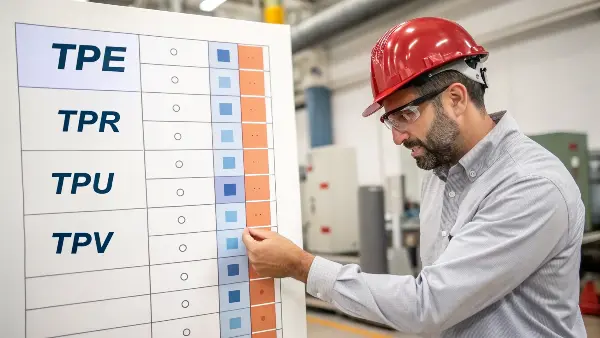
TPE is the broad category; TPR is a market term often used for styrenic TPE compounds; TPU and TPV are specific TPE families. The family name is a useful first screen, but the commercial grade, formulation, hardness, environment, interface and test conditions determine whether it will work.
TPU grades are often evaluated for abrasion, tear or mechanical demand, while TPV grades are often evaluated for compression, weathering, heat or fluid exposure. These are not universal rankings. A grade in any family must be matched to the part’s failure mode and validated in the actual geometry and process.
Related CKMOLD resources: insert molding and overmolding, production injection molding and mold design.
What Exactly Is a Thermoplastic Elastomer (TPE)?
You hear the term “TPE” used for all sorts of flexible materials, which can create a lot of confusion. This lack of clarity often leads to miscommunication with suppliers and specifying a material that isn’t quite right for the job. Let’s clear the air by defining what TPE is and why it serves as the foundation for this entire family of versatile materials.
TPE, or Thermoplastic Elastomer, refers to a class of materials that blends the processing ease of thermoplastics with the flexible, rubber-like properties of elastomers. Essentially, you get a material that can be melted and molded like plastic but behaves like rubber at room temperature. This unique duality makes TPEs incredibly versatile and suitable for countless applications, from soft-touch grips on power tools to flexible seals on consumer goods.
To really understand TPEs, think of them as a hybrid. On one side, you have traditional thermoset rubber, which, once cured (vulcanized), can’t be melted and reshaped. On the other side, you have rigid thermoplastics like polypropylene or ABS. TPEs bridge this gap. They are made of a mix of hard and soft polymer phases. The hard phase gives it processing stability and strength, while the soft phase provides elasticity.
I like to think of the general TPE category as a “base recipe” in a kitchen. It’s a fantastic starting point, but you can add different ingredients to create specialized materials. These special versions are what we know as TPR, TPU, and TPV. Each one takes the fundamental TPE concept and enhances specific properties.
Key Characteristics of the General TPE Family:
- Thermoplastic processing: many TPE grades can be remelted during manufacture, but permitted regrind depends on the exact grade, degradation history, contamination, color, appearance and end-use requirements.
- Elastic response: hardness, tensile behavior, compression set and temperature response vary by family and grade; the word TPE does not define one performance level.
- Recycling claim: in-process regrind, theoretical reprocessability and collection/recycling of a finished consumer product are separate questions. Multi-material overmolding, additives, contamination and the local recycling stream can prevent practical recovery.
KRAIBURG TPE’s process-recycling guidance discusses adding tested process regrind under controlled conditions rather than treating all TPE scrap as automatically reusable. Avient’s overmolding guide likewise limits reuse to clean, non-degraded material and notes appearance, color and contamination constraints. These production practices do not prove that the final product will be accepted by a local post-consumer recycling program.
How Is TPR Different From a Standard TPE?
TPR is often used commercially for styrenic TPE compounds, although naming differs by supplier and region. Do not assume that “TPR” identifies a unique chemistry, cost tier or performance level. Compare the exact grade’s base chemistry, hardness, density, service temperature, compression set, chemical exposure, color, regulatory needs and bonding substrate.
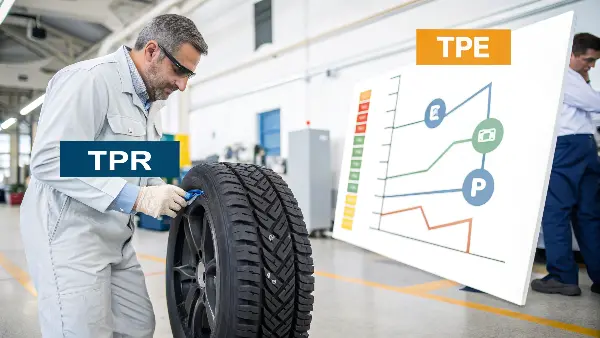
A styrenic TPR can be economical for grips, feet, seals or flexible consumer components when its deformation, aging and chemical limits meet the application. Another TPE family may produce a lower total accepted-part cost if it reduces scrap, permits reliable bonding, avoids secondary assembly or survives the required environment. Request grade-level data and molded-part validation rather than buying from the family name.
When Should You Evaluate TPU for Mechanical or Abrasion Demand?
TPU is one family within the broader TPE category. Many TPU grades offer useful abrasion resistance, tear strength and load-bearing capability, but performance varies with chemistry, hardness, moisture control, thickness, temperature and chemical exposure. Some grades require careful drying and process control; hydrolysis, UV, heat or specific chemicals can be limiting depending on the formulation.
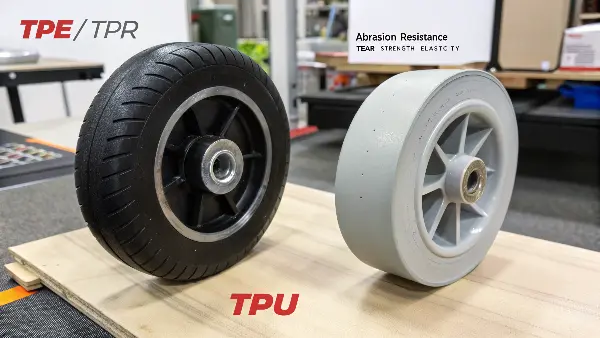
Choose TPU when grade-level data and a representative molded-part trial show that its mechanical and environmental performance justifies the material and processing cost. Do not infer a fixed cost premium or universal superiority from the family name. Specify the property that controls failure—such as abrasion loss, tear propagation, flex fatigue, hydrolysis resistance or bond strength—and the test condition used to accept it.
When Should You Evaluate TPV for Heat, Weathering or Compression?
TPV combines a thermoplastic matrix with a dynamically vulcanized rubber phase. Suitable grades can provide useful compression-set, heat, weathering or fluid-resistance performance while retaining thermoplastic processing. Those benefits are grade- and condition-specific; TPV is not automatically the highest-performance or highest-cost choice.
Evaluate TPV for seals, under-hood components, outdoor parts or other demanding applications only after defining temperature/time exposure, compression, fluid contact, weathering, hardness, geometry and acceptance tests. A lower-cost family can be adequate when those demands are modest, while a specialized grade in another family can outperform a generic TPV on a particular requirement.
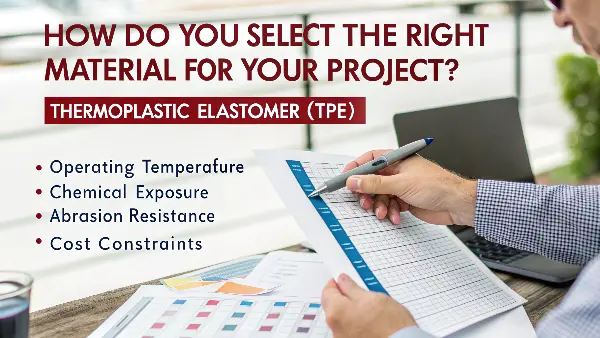
How Do You Select the Right Material for Your Project?
Compare candidates for the same part, function, quality level and volume. First define the failure mode, then screen grade data, molding and bonding requirements, and finally compare total cost per accepted part.
| Selection step | Required input | Decision / evidence |
|---|---|---|
| 1. Define service | Load, deformation, temperature/time, chemicals, weather, abrasion and life | Eliminate grades that do not meet the limiting condition |
| 2. Define interfaces | Substrate, insert, bond area, sealing surface and allowed adhesion method | Confirm supplier compatibility and run bond/peel or leak validation where relevant |
| 3. Define manufacturing | Part geometry, color, appearance, machine, drying, runner and regrind policy | Confirm a stable process window and acceptable scrap |
| 4. Compare cost | Grade price and density, material usage, cycle, scrap/rework, tooling, assembly and inspection | Compare total cost per accepted part—not a family label or resin price alone |
| 5. Validate end of life | Product construction, disassembly, contamination and local collection/recycling route | Use stream-specific guidance; do not call a multi-material product recyclable without evidence |
For product-level recyclability, use guidance that matches the product and region. RecyClass publishes design-for-recycling guidance for plastic packaging streams; its scope should not be generalized to every durable or medical product. Confirm the applicable local collection and recycling route before making a claim.
TPE and TPR as Broad or Styrenic Families
TPE is the umbrella term. TPR is a market term often used for styrenic TPE compounds, but supplier usage is not perfectly consistent. Record the actual polymer family and commercial grade on the drawing or material specification rather than relying on the abbreviation alone. This section defines terminology; the grade-selection workflow in this article then compares performance, processing and cost.
TPU for Abrasion and Mechanical Demand
TPU is often selected for abrasion, tear, impact, flexibility and chemical resistance. Hardness, moisture, drying, shear, mold temperature and conditioning affect performance. It can be a strong choice where a soft material must survive repeated mechanical action.
TPV for Heat, Weather and Compression Applications
TPV is often evaluated for seals, gaskets and automotive or industrial components where a balance of elastic recovery, heat, weather and chemical resistance is needed. It may process differently from a styrenic TPE or TPU and requires grade-specific design and validation.
Compare Processing and Bonding
TPE, TPR, TPU and TPV can differ in drying, melt temperature, shrinkage, gate, venting, ejection, regrind and substrate bonding. A material pair that works for one TPE family may fail when the chemistry changes. Test the exact grade and substrate.
Choose From the Failure Mode
Define hardness, compression set, elongation, tear, abrasion, chemicals, heat, UV, odor, skin contact, sealing and service life. Then compare grades using molded samples, not only catalog labels or Shore hardness.
For a medical or healthcare component, chemistry-family screening is only the first step. The medical TPE selection guide separates exact-grade evidence, contact and sterilization conditions, supplier change control and finished-device validation.
TPE vs. TPR vs. TPU vs. TPV: Buyer Review Checklist
- Define hardness, compression, tear, abrasion, heat, chemical, UV and service requirements.
- Distinguish broad TPE terminology from exact TPR, TPU and TPV grades.
- Review drying, flow, shrinkage, gate, venting, ejection and regrind behavior.
- Test overmold bond or mechanical lock with the actual substrate.
- Validate compression set, aging, abrasion, sealing and dimensions after conditioning.
FAQ
Is TPU a type of TPE?
TPU is a thermoplastic elastomer family based on polyurethane, while TPE is a broader category that includes several chemistries.
Is TPV generally better than TPR?
No. TPV may offer advantages in selected heat, weather or compression applications, while a TPR grade may offer different cost, feel or bonding benefits.
Conclusion
TPE is the broad category; TPR is a supplier-dependent market term often used for styrenic compounds; TPU and TPV are specific TPE families. Choose the exact grade from the part’s failure mode, interfaces, process and acceptance tests. Neither thermoplastic reprocessability nor a family name proves post-consumer recyclability, the lowest cost or the best performance.
For a material and molding review, provide the use environment, load/deformation, temperature and chemicals, substrate/bonding requirement, appearance, annual volume and intended end-of-life route through the RFQ page. CAD can be sent separately to jerry@ckmold.com after the form is submitted.