

Are you trying to figure out the best way to make your plastic part? The sheer number of manufacturing methods can be confusing. Choosing the wrong one can lead to wasted time, high costs, and a final product that doesn’t meet your standards. This guide will help you understand the main types of plastic molding, so you can make an informed decision for your project and avoid those costly mistakes.
There is no single fixed number of plastic molding processes because methods can be grouped by material, machine, pressure, mold movement and product form. The useful manufacturing question is which process can repeatedly produce the required geometry, material performance, volume, tolerance, surface and cost. The main families below give buyers a practical starting point.
Related CKMOLD resources: injection mold services, prototype injection molding, production injection molding.
Plastic-forming methods can be grouped in several ways, so a five-process list is a practical introduction rather than a complete taxonomy. Injection, blow, compression, extrusion and rotational molding cover common product forms, while thermoforming, transfer, reaction, casting and other routes may be better for particular materials and geometries.
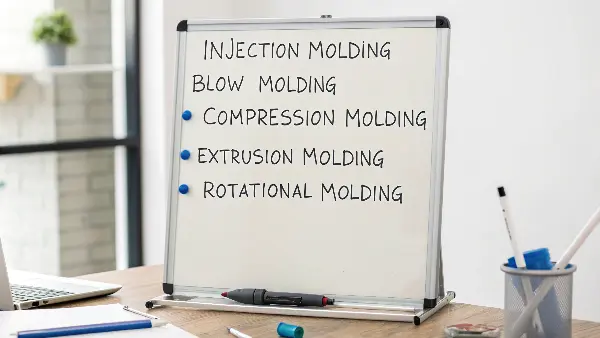
What are the five main methods of processing plastic?
Starting a new project with plastic parts can feel overwhelming. You have a great design, but how do you actually make it? The wrong choice can lead to poor quality, blown budgets, and production delays that hurt your business. You need a clear understanding of the top methods to ensure your product is made efficiently and effectively.
Use the five common families below as an initial screen, then include other routes when product form or material demands them. Compare geometry, feedstock transformation, volume, tolerance, surface, tooling, secondary work and validation rather than ranking a process as universally most effective.
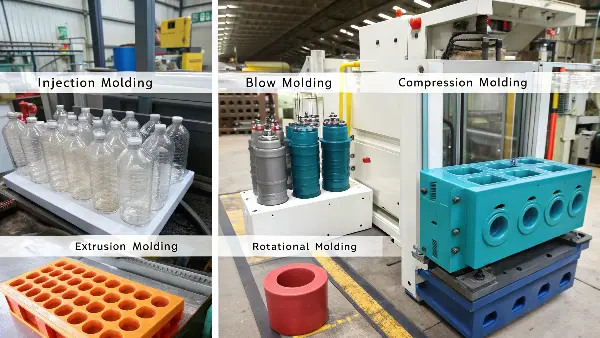
Match the process to product geometry, material transformation, volume, tolerance, surface, tooling budget and validation. A large hollow tank, continuous profile and small detailed component create different process candidates; the product requirement—not a popularity ranking—sets the route.
Injection Molding
Injection molding is a strong candidate for repeatable discrete parts when projected demand, geometry, material and quality justify the tool and process development. Cycle, cavity count, yield and automation determine accepted capacity; it should not be described as producing thousands or millions of identical parts. Compare tooling and validation cost with accepted-part cost over the required volume.
Blow Molding
If you need to make hollow parts, blow molding is your go-to. It’s similar to glass blowing. A tube of heated plastic, called a parison, is placed into a mold and inflated with air, pushing the plastic against the mold walls. This is how we get plastic bottles, fuel tanks, and coolers. It’s fast and efficient for hollow objects.
Compression Molding
This method is one of the originals. You place a pre-measured amount of plastic material (called a “charge”) into a heated mold cavity and then use a top force to compress it into shape. It’s excellent for making very strong, durable parts, often with thermoset plastics. You’ll see it used for electrical wall sockets, dinnerware, and heavy-duty rubber components. It’s not as fast as injection molding, but the tooling is often simpler and less expensive.
Extrusion Molding
Unlike the other methods that make distinct parts, extrusion creates long, continuous shapes. Molten plastic is pushed through a die to create a specific cross-sectional profile. Think of pipes, window frames, or straws. The extruded piece is then cooled and cut to the desired length. It’s a very cost-effective process for producing linear products in high volumes.
Rotational Molding
For large, hollow, and stress-free parts, rotational molding is the answer. Plastic powder is placed in a mold, which is then heated and rotated on two axes. The melting powder coats the inside of the mold evenly. It’s a slower process, but it’s fantastic for things like kayaks, large tanks, and playground equipment. Molds are less expensive than injection molds, making it great for lower production runs.
Do All Plastic Molding Processes Use the Same Steps?
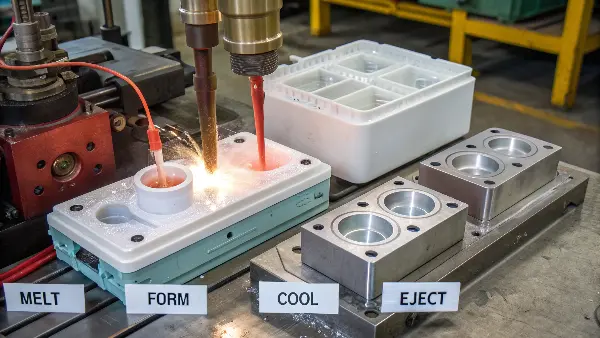
No. Thermoplastics are commonly heated to a processable state and cooled after shaping; thermosets and many elastomer compounds are shaped and then chemically cured, so they cannot simply be described as melting and solidifying. Blow, rotational, compression, transfer and reaction processes also move and form material differently.
For process selection, identify whether the feedstock is thermoplastic, thermoset or elastomeric; whether the product is discrete, continuous, sheet-based or hollow; and whether shaping depends on pressure, a parison/preform, rotation, compression, vacuum/air or chemical reaction. Then review secondary trimming, joining and inspection.
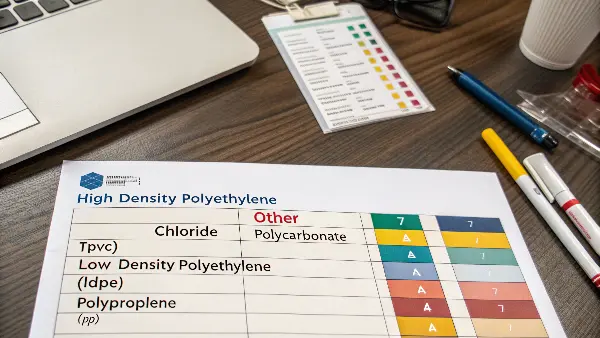
Resin Identification Codes Are Not a Molding-Process Selection Guide
A resin identification code is not a list of the seven plastics suitable for molding. ASTM’s public page for D7611/D7611M-26 states that the codes identify resin used in a manufactured article and are not recycling claims. Code 7 is an “other” grouping, not one material family.
Many grades inside and outside those code categories can be injection molded, extruded, blow molded or processed by another route. Select the exact commercial grade from rheology, thermal behavior, shrinkage, reinforcement, moisture, chemical/UV/heat, compliance and product tests. Use the code only where the applicable marking requirement calls for it.
| Material question | Evidence | Process implication |
|---|---|---|
| Does the material melt or cure? | supplier processing guide and chemistry | thermoplastic route versus cure-based route |
| Can it form the product geometry? | flow, draw, parison/preform or forming limits | candidate process and tooling architecture |
| Will the finished part meet use? | exact-grade mechanical, thermal, chemical and compliance data | trial and validation plan |
Are there other important types of moulding to know?
You’ve learned the big five, but you keep hearing about other methods like thermoforming or transfer molding. Are these just niche processes, or are they something you need to be aware of? Ignoring other available methods could mean you miss out on a more cost-effective or better-suited process for your unique product, leaving money on the table. Knowing a few more key techniques broadens your options and ensures you’ve truly found the best fit.
Yes, beyond the main five, it’s very helpful to know about thermoforming, transfer molding, and insert molding. Thermoforming is excellent for large, thin-walled parts like packaging trays. Transfer molding offers more precision than standard compression molding, making it ideal for parts with intricate details or embedded electronics. Insert molding allows you to mold plastic around a pre-placed item, like a metal screw or bushing, creating a single, robust component. These methods solve specific manufacturing challenges that the main five might not handle as efficiently.

Less-common processes can be appropriate when their feedstock, geometry and production advantages match the requirement. Compare representative tooling, secondary operations, accepted-part cost and supplier evidence before committing.
Thermoforming
This process is fundamentally different from the others. Instead of starting with plastic pellets, you start with a thin sheet of plastic. The sheet is heated until it becomes pliable and then stretched over or into a single-sided mold. A vacuum is often used to pull the sheet tight against the mold, which is why it’s sometimes called vacuum forming.
- When to Use It: It’s suitable for products with thin walls and large surface areas. Think of disposable cup lids, refrigerator liners, product packaging (like clamshells), and vehicle door panels.
- Key Advantages: Tooling is much cheaper and faster to make than for injection molding because you only need one side of the mold. This makes it ideal for prototypes and lower-volume production runs.
- Limitations: You can only make relatively simple shapes, and wall thickness can be inconsistent, especially in deep-drawn parts.
Transfer Molding
Think of transfer molding as a hybrid between compression and injection molding. Like compression molding, you start with a pre-measured charge of plastic. However, instead of placing it directly in the part cavity, you place it in a separate chamber (called the “pot”). A plunger pushes the now-molten material from the pot through channels (sprues and runners) into the closed mold cavity.
- When to Use It: It’s used for thermoset plastics when you need more intricate designs and tighter dimensional tolerances than compression molding can provide. It’s also great for molding delicate electronic components without damaging them.
- Key Advantages: It allows for more complex part geometry and the placement of delicate inserts. Because the mold is closed before the material enters, there’s less flash.
- Limitations: It creates more waste material than compression molding due to the runners and sprues, and cycle times can be longer.
Insert Molding
Insert molding is a variation of injection molding where a pre-formed object—the insert—is placed into the mold before the plastic is injected. The molten plastic then flows around the insert, securing it permanently within the part.
- When to Use It: This is the go-to process when you need to combine a plastic part with a non-plastic one, most commonly a metal component. Think of screwdriver handles with metal shafts, knobs with threaded brass inserts, or connectors with embedded electrical pins.
- Key Advantages: It creates a very strong mechanical bond, eliminates post-molding assembly steps, and improves the part’s overall strength and reliability.
- Limitations: It requires careful design of both the insert and the plastic part to ensure a good bond and prevent damage to the insert during the high-pressure injection process.
Injection Molding for Detailed Repeatable Parts
Injection molding melts and injects thermoplastic, elastomer or certain other compounds into a closed mold. It supports ribs, bosses, clips, textures, inserts and multi-cavity output, but requires upfront tooling and part features such as draft, gates, cooling and ejection.
Compression and Transfer Molding for Thermosets and Elastomers
Compression molding places material into a mold and applies heat and pressure; transfer molding meters material into cavities through a transfer system. These methods can suit rubber, thermosets, electrical components and parts where cure behavior or material loading is more important than fast thermoplastic cycles.
Blow, Rotational and Thermoforming for Hollow or Sheet-Based Products
Blow molding forms hollow containers and ducts, rotational molding creates large hollow parts at lower volumes, and thermoforming shapes heated sheet over a tool. Their wall-thickness, tolerance, tooling and material trade-offs differ from injection molding and should be evaluated at the product concept stage.
Extrusion and Reaction Processes for Continuous or Specialized Forms
Extrusion produces continuous profiles, film, tube or sheet. Reaction molding mixes reactive components in the mold and can support large or specialized parts. These processes may reduce some tooling or pressure requirements but introduce their own chemistry, curing, trimming and quality controls.
Choose by Product Risk and Production Reality
Compare volume, size, hollow or solid form, wall thickness, material, tolerance, surface, assembly, tooling budget, cycle and supply chain. A prototype or low-volume route may be appropriate while the design is changing, followed by production molding once requirements stabilize.
How Many Types of Plastic Molding Processes Are There? A Selection Guide: Buyer Review Checklist
- Define solid or hollow form, geometry, material, volume, tolerance and surface before choosing a process.
- Compare injection, compression, transfer, blow, rotational, thermoforming, extrusion and reaction options.
- Include tooling, cycle, trimming, assembly, inspection and material-handling requirements.
- Use prototype or low-volume methods when design uncertainty is still high.
- Select the process with the lowest total production risk, not just the lowest tool price.
FAQ
What is the most common plastic molding process?
Injection molding is widely used for detailed thermoplastic parts, but the best process depends on geometry, material, volume and performance.
Is thermoforming cheaper than injection molding?
It may require lower-cost tooling for some products, but trim waste, cycle, tolerance, sheet cost and production volume determine the total economics.
Conclusion
There is no useful universal count of plastic molding processes. Shortlist the routes that fit the product form and exact material, then compare tolerance, surface, volume, tooling, secondary work, quality evidence and lifecycle cost. Select from the finished-product requirement rather than a five-process or seven-resin list.