
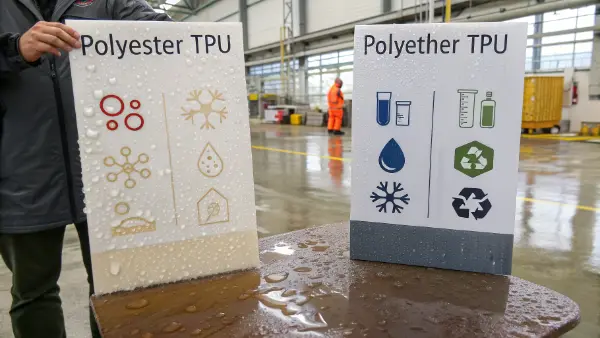
Choosing the wrong plastic can ruin your product. If your parts break down in water or melt under chemicals, you lose money and trust. But you can fix this by picking the right TPU base. Let me explain the differences so you can make the best choice for your manufacturing needs.
TPU comes in two main base chemistries: polyester-based and polyether-based. Polyester TPU offers higher resistance to chemicals, oils, and physical wear. It is ideal for dry, industrial uses. Polyether TPU is better at resisting water, humidity, and cold temperatures. It is softer and perfect for wet or damp environments. Both are safe for consumer products when they meet proper regulatory standards.
When you run a manufacturing business, material selection is everything. Over my years dealing with plastic manufacturing and injection molds, I have seen how the right grade of TPU saves money and lead time. Let us dive into the details so you can choose wisely.
What are the different grades of TPU?
Do you feel confused by all the plastic options? Picking a random TPU can lead to parts that fail too early. This hurts your quality and upsets your customers. Luckily, understanding the different grades makes it simple. Here is a breakdown of what you need to know.
The different grades of TPU are mainly categorized into two base chemistries: polyester-based and polyether-based. The difference lies in the soft segment of the polymer chain. Polyester grades are tougher, offering excellent abrasion and chemical resistance. Polyether grades are softer, flexible, and resist water and microbial attacks. Manufacturers can also customize these grades with additives to improve UV resistance or flame retardancy.
Let us look closer at these two main grades. When I help clients with injection molding projects, I always ask where the part will be used. The environment decides the grade. Every successful project starts by understanding these basic chemistry differences.
Polyester-Based TPU
Polyester TPU is the tough option. It is built to handle rough conditions on the factory floor. It is highly resistant to oils, fuels, and chemical solvents. If you need a part that will scrape against rough surfaces, this is the right choice. It has excellent cut and tear strength. I often see this used in industrial belts, wheels, and protective films. It also holds up well against heat aging. Over time, it will not degrade as fast in high-temperature settings. Plus, polyester-based TPU tends to be less expensive. This helps keep your manufacturing costs down while maintaining great quality.
Polyether-Based TPU
Polyether TPU is the flexible, water-resistant option. It stays completely stable when exposed to water, humidity, or cold weather. Because it resists hydrolysis and microbial attacks, it will not break down or mold in damp environments. It is also softer and more flexible by nature. This makes it a great fit for wearable tech, medical devices, and outdoor waterproof gear. When comfort and moisture resistance matter most, polyether is the winner.
Custom Additives
Sometimes, the base chemistry is not quite enough for a special project. You can customize both TPU grades with specific additives. For example, if your product sits in the sun all day, you can add UV resistance so it will not fade. If it needs to meet strict building safety codes, you can add flame retardancy. This flexibility is why TPU remains so popular in modern plastic manufacturing.
| Feature | Polyester TPU | Polyether TPU |
|---|---|---|
| Best For | Dry, abrasive, chemical environments | Wet, cold, damp environments |
| Key Strength | Oil and wear resistance | Water and cold resistance |
| Cost | Usually lower | Usually higher |
Is polyether TPU better than polyester TPU?
Are you wondering which TPU is the absolute best? Trying to find a single perfect material can cause delays in your lead time. The truth is, one is not automatically better than the other. The best choice depends entirely on how and where you use it. Let me explain.
Polyether TPU is not universally better than polyester TPU; they just serve different purposes. Polyether is better for wet, cold, and humid environments because it resists hydrolysis and microbes. Polyester is better for dry, industrial settings because it offers superior resistance to oils, chemicals, and abrasion. The better choice depends on whether the product faces moisture or aggressive chemicals during its daily use.
I get this question a lot. Clients always want to know which material is the ultimate "winner." But in plastic manufacturing, there is no single winner. It comes down to the environment your product will face. You have to match the plastic to the problem.
When Polyether Wins
If your part goes outside in the rain, polyether is better. It resists water perfectly. In damp environments, polyester would eventually break down and crumble. But polyether stays strong. It is also much better for cold temperatures. It stays flexible instead of getting stiff and cracking in the snow. This is why inflatable products, marine equipment, and waterproof cables almost always use polyether. Its softer feel also adds necessary comfort to wearable tech applications like smartwatches.
When Polyester Wins
If your part lives in a dry factory, polyester is usually better. It handles heavy wear and tear with ease. If the part touches oils, fuels, or harsh solvents daily, polyester is the safer choice. Polyether might swell or weaken around strong chemicals, but polyester holds its shape perfectly. Because it is usually cheaper, polyester is highly preferred for large-scale injection molding where water exposure is simply not an issue.
Facing Both Environments
What happens if your part faces both water and chemicals? This is where my experience in CNC machining and custom molding helps. You have to decide which threat is worse. If the part sits in water constantly but only sees oil rarely, go with polyether. If it is soaked in oil daily but only gets splashed with water sometimes, polyester is the smarter pick. You must always weigh the biggest risk.
What is the disadvantage of TPU?
Do you think TPU is a magic plastic with no flaws? Ignoring material limits can cause expensive product failures down the line. Every material has weaknesses, and TPU is no exception. Knowing the downsides helps you design better parts and avoid costly mistakes.
The main disadvantage of TPU is its specific environmental sensitivity based on its grade. Polyester TPU breaks down in water over time due to hydrolysis. Polyether TPU is more vulnerable to harsh chemicals and oils. Generally, TPU can also be more expensive than simpler plastics like PVC. Furthermore, it requires careful drying before processing, as any trapped moisture can ruin the final part during manufacturing.
TPU is amazing, but it is not perfect. When I help business owners plan their manufacturing, we always talk about the limits of the material. Knowing what can go wrong saves you time and money. If you ignore these disadvantages, you will pay for it later.
Sensitivity to the Environment
The biggest downside is that you must match the grade to the environment perfectly. If you use polyester TPU in a wet place, it will suffer from a process called hydrolysis. The water literally breaks the polymer chains apart. The part will weaken and crumble. On the other hand, if you use polyether TPU in an oily machine shop, the oils can weaken the plastic over time. You cannot just pick one standard TPU and use it everywhere. It requires careful planning.
Processing Challenges
Another disadvantage happens right on the factory floor. TPU loves to absorb moisture from the air. Before we put it into an injection molding machine, we must dry the plastic pellets completely. If the TPU is even slightly wet, the final part will have bubbles, streaks, or weak spots. This adds extra steps, special equipment, and more time to the manufacturing process.
Cost Factors
Cost is another important thing to watch. TPU is generally more expensive than basic, standard plastics. Polyether TPU, in particular, can be quite costly depending on the current market. While the quality is very high, you must balance the material price against your overall budget. However, innovations in TPU compounding are making the process more efficient. And since both grades can be recycled cleanly, you can support sustainable practices while controlling some waste costs.
Is TPU less toxic than PVC?
Are you worried about the safety of the plastics you use? Customers today care deeply about toxic chemicals in their products. Using unsafe materials can damage your brand reputation forever. Fortunately, making the right choice here is easy. Let us look at how TPU compares to PVC.
Yes, TPU is generally considered much less toxic and safer than PVC. Unlike PVC, TPU does not require harmful plasticizers like phthalates to make it flexible. It also does not release toxic chlorine gas when burned. Both polyester and polyether-based TPUs are considered safe for consumer products and meet strict regulatory standards. Innovations in TPU also mean lower emissions of volatile organic compounds (VOCs).
Safety is a very big deal in manufacturing today. As a business owner, you want materials that protect your customers and the environment. When comparing TPU to PVC, TPU wins the safety test easily. It is not even a close contest.
No Harmful Plasticizers
PVC is naturally a hard, rigid plastic. To make it soft and flexible, manufacturers have to add chemicals called plasticizers. Many of these are phthalates, which are known to be harmful to human health. TPU is completely different. It is naturally flexible because of its unique polymer chain structure. It does not need those toxic chemicals to be soft. This makes TPU a much safer and better choice for medical devices, food packaging, and wearable items that touch human skin.
Safer Manufacturing and Disposal
PVC contains chlorine. If PVC catches fire or is burned in a waste facility, it releases toxic chlorine gases. This is terrible for the environment and dangerous for people nearby. TPU does not contain chlorine. It burns much cleaner. Recent innovations in TPU compounding have also led to lower emissions of volatile organic compounds (VOCs). This means the air stays cleaner during factory production and inside the consumer’s home.
Meeting Regulatory Standards
From my years of experience in plastic manufacturing, passing safety tests is crucial for your business. Both polyester and polyether TPUs easily meet strict regulatory standards like the FDA and RoHS. They are widely accepted globally as safe industrial polymers. Plus, both types of TPU can be recycled. This allows you to build a safe, sustainable product that your customers can trust for years.
Choosing between polyester and polyether TPU comes down to your product’s environment. Polyester is your tough, chemical-resistant option, while polyether is your flexible, water-resistant choice. By matching the right grade to your needs, you improve quality and control costs. Master your material selection, and your manufacturing process will run smoothly.