
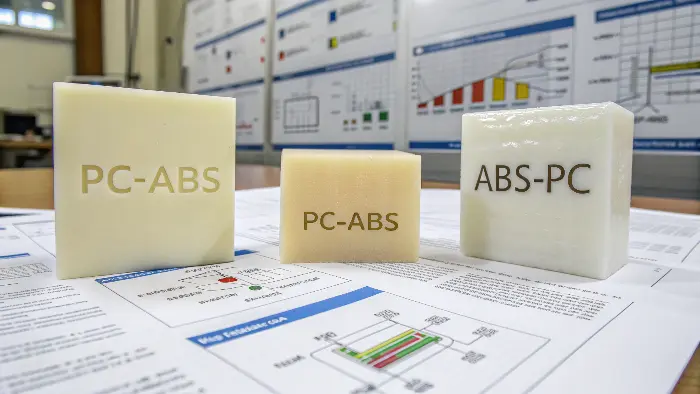
The selection is not a search for “the best of both.” Compare named PC and PC/ABS grades for the required impact, heat/load duration, flow, appearance, chemicals, UV, flame/electrical evidence, processing and cost.
PC/ABS alloy and standard PC are selected for different balances of toughness, heat performance, flow, appearance, chemical resistance and cost. Standard polycarbonate can provide strong impact and heat capability, while a PC/ABS blend may improve flow, processability, surface or low-temperature behavior in selected applications. The decision should come from the final part’s load, environment, regulatory needs and molding constraints.
Related CKMOLD resources: mold design, production injection molding, DFM analysis.
Screen PC/ABS when a named grade offers a useful balance of impact, heat, flow, surface, flame/electrical, chemical and cost requirements that the candidate PC or ABS grades do not meet as well. The choice remains application- and grade-specific.

Material selection and part design must be reviewed together. A grade that performs well in a datasheet can still fail through wall transitions, weld lines, residual stress, chemicals, assembly load or aging; define those conditions before comparing PC with PC/ABS.
What Properties Should You Check for PC/ABS?
PC/ABS is a family of compatibilized commercial blends, not one fixed composition. Suppliers formulate grades for different balances of flow, impact, heat, surface, flame, UV/weathering and regulatory needs.
| Property | Check on the exact grade |
|---|---|
| Impact/ductility | Test method, temperature, notch, specimen thickness, conditioning and aging |
| Heat/load | HDT load/specimen, long-term rating or property retention at service time and stress |
| Flow and molding | MFR test condition, wall/flow length, pressure, drying and appearance window |
| Chemicals/UV | Specific cleaner/fluid, applied stress, pigment, exposure and retained property |
| Flame/electrical/regulatory | Grade, color, thickness and current supplier recognition/declaration |
Do not use one 41 MPa tensile value, “common machinery” claim or best-of-both description across the family.
Is PC/ABS Stronger Than PC?
Not as a family-wide rule. “Strength” can mean tensile yield, stiffness, impact, ductility, creep, fatigue or retention after heat/chemicals. Compare named grades under the part’s temperature, thickness, notch, conditioning and aging conditions.
Some PC/ABS grades are designed for useful low-temperature impact or flow; selected PC grades may offer other heat, clarity or mechanical advantages. Neither family is universally brittle, more notch-tolerant or safer. Validate the production-like assembly.

Should You Specify a PC-to-ABS Ratio?
No. Commercial PC/ABS grades use proprietary base polymers, compatibilization and additives. A nominal 70/30, 50/50 or 30/70 ratio does not reliably predict heat, impact, flow, surface or cost.
Specify the required impact at use temperature, heat/load duration, flow/wall geometry, finish, chemicals, UV/weathering, flame/electrical evidence, color and assembly stress. Then approve a manufacturer, full grade and color from its current data and molded-part validation.
Do not ask a molder to create a blend ratio or assume that more PC always raises every heat/strength property and more ABS always improves flow, finish and price.

When Should You Screen an Alternative?
Screen ASA or PC/ASA when defined weathering/color retention is important; PMMA when optical performance is central; or other polymers when chemicals, heat, flame, wear or cost control the decision. These are candidate families, not drop-in replacements.
Compare named grades for the same geometry, impact, heat, chemicals, UV, flame/electrical, appearance and process requirements. A change may require new shrinkage, gate, drying, stress-cracking and assembly validation.
What ABS Limitations Matter in This Comparison?
Standard ABS grades may lose stiffness under load at relevant temperatures, weather outdoors, or stress-crack in particular chemicals. The rate and severity depend on grade, pigment/stabilizer, molded stress, thickness, climate and exposure.
Adding PC does not automatically solve those limitations. PC/ABS can also be vulnerable to cleaners, oils, UV/weathering and residual-stress cracking. Compare the exact ABS, PC/ABS, PC/ASA or other candidate and validate the final assembly after heat, chemical and weathering exposure.

Do PC-ABS and ABS-PC Names Define Composition?
No reliable industry-wide composition or property rule follows from the order of those names. PC/ABS, PC-ABS and ABS-PC may be used inconsistently for proprietary commercial blends.
Procurement should identify manufacturer, full grade, color and approved source. Review the current technical data and applicable certificate/recognition for flow, heat, impact, flame/electrical, chemicals and processing. A TDS reports results under stated methods; it is not automatically a certificate or proof of finished-part performance.

Select a Named Commercial Grade, Not a Blend Ratio
Select a named commercial grade, not a blend ratio. The RFQ/drawing should state impact at use temperature, heat/load duration, chemicals/cleaners, UV/weathering, flame/electrical evidence, color/texture, wall/flow, CTQs, assembly stress and applicable regulatory requirements.
When changing PC to PC/ABS, reopen drying and moisture control, melt/mold temperature, shrinkage, gate/pack, venting, surface, weld lines and stress cracking. Use production-like parts for thermal, impact, chemical and assembly acceptance; a family datasheet cannot approve the mold unchanged.
Primary technical sources checked: Covestro — Polycarbonate and PC Blends (commercial PC and PC/ABS portfolio distinctions); SABIC — CYCOLOY PC/ABS (commercial PC/ABS grade scope and property balance). Apply the cited scope to the exact grade, tool and acceptance plan.
What Standard PC Brings
PC is often considered where impact, toughness, heat capability and dimensional performance are important. It may suit transparent or technical housings, guards and structural features. Its sensitivity to moisture, residual stress, chemicals and thermal history should be included in the design review.
Why Use a PC/ABS Alloy
A PC/ABS blend can provide a different balance of flow, toughness, appearance, process window and low-temperature impact. It is commonly evaluated for housings, interior components and electrical parts where the blend’s surface or molding behavior offers a practical advantage.
Compare Heat, Chemicals and Flame Performance
Do not assume the blend retains every property of PC. Check heat deflection, continuous-use temperature, chemical exposure, flame rating, impact after aging and stress-cracking risk for the exact grade. Automotive and electrical requirements should be evaluated at the use condition.
Design the Mold for the Selected Material
Gate, wall thickness, venting, weld lines, rib transitions, drying, melt temperature, mold temperature and ejection influence both materials. PC/ABS may flow differently and can show its own shrinkage or appearance behavior. A material switch should trigger a fresh DFM and process review.
Validate Appearance and Assembly
Housings and trim parts often depend on texture, gloss, color, clips, screws, inserts and weld-line location. Test assembly stress, cleaners, heat cycling, impact, surface retention and dimensional fit on production-like parts. Choose the grade from evidence rather than a generic blend label.
PC/ABS Alloy vs. Standard PC: Buyer Review Checklist
- Define impact, heat, chemical, flame, appearance, flow and assembly requirements.
- Compare exact PC and PC/ABS grades using end-use temperatures and aging conditions.
- Review moisture, gates, vents, weld lines, ribs, inserts and stress-cracking risk.
- Re-establish the process window when changing between PC and PC/ABS.
- Validate housing or trim assemblies for fit, surface, heat, impact and chemical exposure.
FAQ
When is PC/ABS preferred over PC?
It may be preferred when flow, surface, low-temperature impact, processability or cost balance is more important than the maximum heat performance of a selected PC grade.
Can PC and PC/ABS use the same mold?
Often the same basic tool can be evaluated, but gate, shrinkage, drying, temperature, surface and process settings may require changes and validation.
Conclusion
PC/ABS is one family of engineered blends, not an automatic correction for every PC or ABS limitation. Select a named grade from the complete requirement and validate the molded assembly; supplier data and blend labels cannot guarantee the part will not fail.