
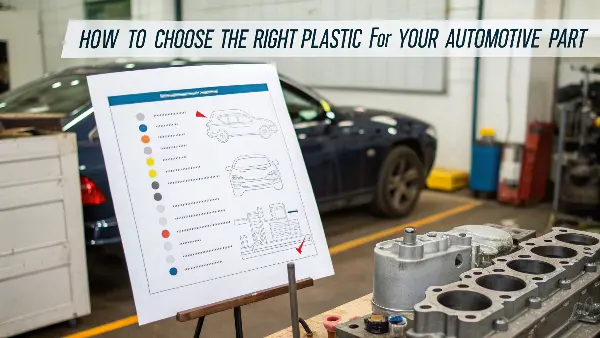
Struggling to keep up with the automotive industry’s demands for lighter, more fuel-efficient, and safer vehicles? Relying on traditional materials like metal can be heavy, costly, and limit your design freedom. You might be watching competitors innovate with advanced polymers while you’re stuck with outdated processes. This guide is your roadmap to understanding the essential plastics that are not just parts of modern cars—they are what make modern cars possible.
Modern automotive parts use multiple plastic families because no single material provides the best combination of weight, heat resistance, stiffness, impact, chemical durability, appearance and cost. Material selection should begin with the part’s location and duty cycle, then connect grade choice to molding behavior, validation and long-term supply control.
Related CKMOLD resources: plastic material selection, production injection molding, mold testing and validation.
The modern automotive industry relies heavily on a range of plastics for their unique properties. The most common is Polypropylene (PP), used for bumpers, dashboards, and interiors due to its low cost and versatility. Engineering plastics like Polyamide (PA/Nylon) are critical for under-the-hood components like engine covers and intake manifolds because of their high-temperature resistance and strength. Polycarbonate (PC) is chosen for its impact resistance and clarity in headlights and instrument panels, while ABS is a staple for interior trim and grilles.
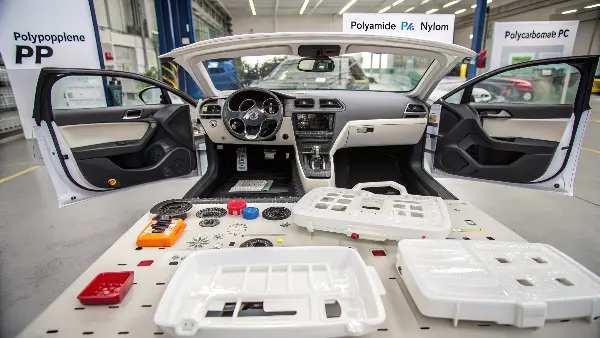
Now that you have a snapshot of the key players, you’re likely wondering about the specifics. It’s one thing to know that PP is used for bumpers, but it’s another to understand whyit’s chosen over other materials. The secret to successful and cost-effective manufacturing lies in matching the right polymer to the right application. To do that, you need to go beyond the names and get into the properties.
Why Is Polypropylene (PP) the Workhorse of Automotive Plastics?
You need a material for a high-volume part that must be durable, lightweight, and, most importantly, cost-effective. You’ve looked at some engineering-grade plastics, but the cost is just too high for components like interior door panels or trunk liners. This challenge of balancing performance and budget is a constant headache. A common observation is it all the time with clients who are trying to optimize their production costs without sacrificing quality.
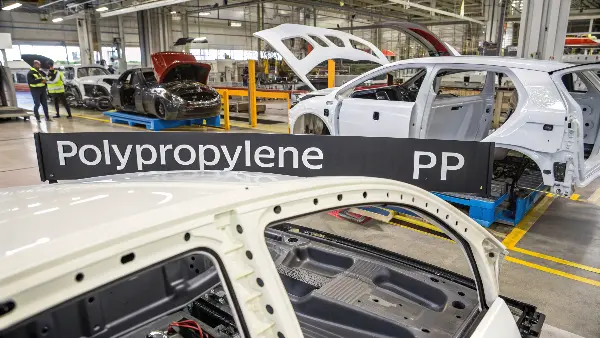
Polypropylene (PP) is the workhorse of automotive plastics because it offers an unbeatable combination of low cost, low density (making it very lightweight), excellent chemical resistance, and easy processability. These features make it the ideal choice for a vast range of non-structural and cosmetic parts, from bumpers and fender liners to dashboards and door trims. Its versatility allows it to be modified with fillers like talc or glass fiber to enhance stiffness and durability for different applications, providing a tailored solution at a budget-friendly price point.
Tailoring PP for the Job
You can’t use the same type of PP for a flexible fender liner as you would for a rigid dashboard. This is where fillers and additives come in.
- Talc-Filled PP: Adding talc increases the stiffness and dimensional stability of the part. This is suitable for large, flat components like interior trim panels that need to hold their shape over time and across a range of temperatures.
- Glass-Filled PP: For parts that need a bit more strength and impact resistance, we add short glass fibers. You’ll often find this in battery cases or structural brackets where a little extra toughness is required.
- PP Copolymers: These are blends that improve impact strength, especially at low temperatures. This is critical for bumpers. A bumper needs to be able to absorb a low-speed impact, even in freezing weather, without shattering.
The table below gives a simple breakdown:
| PP Grade | Key Property | Common Automotive Application |
|---|---|---|
| Homopolymer | High Stiffness, Hardness | Fan shrouds, small rigid parts |
| Copolymer | High Impact Strength | Bumpers, battery cases |
| Talc-Filled | Increased Rigidity, Stability | Dashboards, door panels, pillars |
| Glass-Filled | Increased Strength, Stiffness | Under-hood brackets, load floors |
A client of mine, who runs a business a lot in comparable programs, was manufacturing an interior pillar trim. Their original part was warping slightly after installation in the car. We analyzed the problem and switched them from a standard copolymer to a 20% talc-filled PP. The change was simple, the cost increase was minimal, and the warping problem was completely solved. It’s these small material adjustments that make a huge difference in final product quality.
How Do Engineering Plastics Handle Automotive Heat and Impact?
You have a part that needs to survive right next to a hot engine or a component that is critical for passenger safety, like a headlight lens. You can’t use a standard plastic like PP; it would melt or shatter. This is where many businesses get stuck. They either over-engineer the part with expensive metal or choose the wrong plastic and face field failures, which can be disastrous for their reputation and finances.
Engineering plastics like Polyamide (PA) and Polycarbonate (PC) handle the demanding automotive environment through their superior molecular structures. PA, commonly known as Nylon, offers excellent thermal resistance and mechanical strength, making it ideal for under-the-hood parts like engine covers and intake manifolds. PC provides outstanding impact strength and optical clarity, which is why it’s the go-to material for headlight lenses, instrument clusters, and other components that must endure impact without breaking.
The Powerhouses: PA and PC
Here’s a quick comparison to help you see the difference:
| Property | Polyamide (PA66, Glass-Filled) | Polycarbonate (PC) |
|---|---|---|
| Primary Advantage | High Temp & Chemical Resistance | Extreme Impact Strength & Clarity |
| Max Service Temp | ~150°C (302°F) | ~120°C (248°F) |
| Common Use Case | Engine Covers, Fuel Lines | Headlight Lenses, Instrument Panels |
| Key Weakness | Absorbs Moisture | Lower Scratch Resistance |
Choosing between them depends entirely on the job. If it’s hot and greasy, you lean towards PA. If it needs to be clear and take a punch, you go with PC.
What Are the Future Trends for Plastics in the Automotive Sector?
As a business owner, you’re not just thinking about today’s projects; you’re planning for the future. You see the automotive world shifting rapidly towards electric vehicles (EVs), sustainability, and more advanced manufacturing. Sticking with today’s materials and processes might make you obsolete in five years. You need to know what’s coming next so you can position your company to win future business.
The future of automotive plastics is being shaped by two major forces: sustainability and the rise of electric vehicles (EVs). This is driving innovation in recycled and bio-based plastics to meet environmental goals. For EVs, there is a huge demand for new materials for battery enclosures that are lightweight, flame-retardant, and structurally robust. Furthermore, advanced composites like carbon-fiber-reinforced plastics (CFRP) are moving from supercars to mainstream vehicles to achieve radical weight reduction, a critical factor for extending EV range.
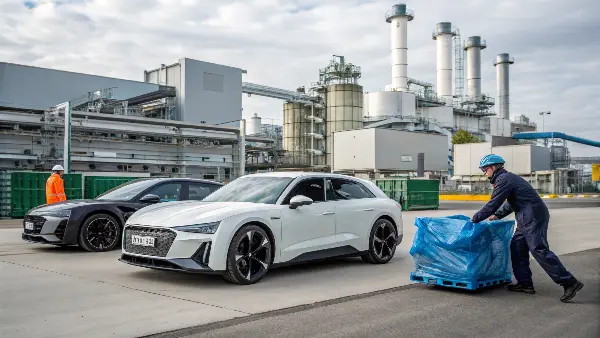
I’ve been in this industry long enough to see several major shifts, but what’s happening now is on another level. The transition to electric isn’t just swapping a gas engine for a motor; it’s changing the entire architecture of the car. This creates incredible opportunities for those who are prepared. We’re already working on molds for complex EV battery components that didn’t even exist a few years ago. It’s a new frontier, and the material requirements are pushing the boundaries of polymer science.
The New Automotive Landscape
-
The Electric Vehicle Revolution: EVs introduce a whole new set of challenges.
- Battery Enclosures: These are massive components that need to protect the batteries from impact, contain any potential fires (requiring high flame retardancy), and be as light as possible. This is driving the development of advanced plastic composites and multi-material solutions.
- Thermal Management: Managing heat from batteries and electronics requires plastics with specific thermal conductivity properties, something we do not worried about with a traditional radiator.
- Lightweighting: Range is everything for an EV. Every kilogram saved translates directly to more miles per charge. This has put a renewed focus on replacing metal with plastics and composites everywhere possible.
The material of tomorrow might be a flame-retardant, recycled polycarbonate composite designed specifically for an EV battery lid. The companies that learn how to design for and process these new materials will be the leaders of the next generation of automotive manufacturing.
How Do You Choose the Right Plastic for Your Automotive Part?
You’ve learned about the different types of plastics, from the workhorse PP to high-tech composites. But now you face the most critical question: how do you select the single best material for your specific part? Choosing the wrong one can lead to costly mold rework, part failures, and project delays. You feel the pressure to get it right the first time, but the sheer number of options can be overwhelming.
Choosing the right plastic involves a systematic process. First, define the part’s functional requirements: what loads must it bear (mechanical)? What temperatures will it see (thermal)? What chemicals will it touch (chemical)? Next, consider the manufacturing process (e.g., injection molding) and cost targets. Finally, use a material properties chart to compare candidates that meet your criteria. Often, the best choice is a balance of performance, processability, and price, not just the material with the highest performance specs.
A Practical Selection Framework
To avoid these pitfalls, you need a structured approach. I teach the production team to think through these three areas for every project.
-
Define the Part’s Job (Performance Requirements):
- Mechanical: Will it be a structural part? Does it need to be stiff or flexible? Does it need to withstand high impact?
- Thermal: What is the maximum and minimum continuous operating temperature? Will it experience sudden temperature swings?
- Chemical: Will it be exposed to fuel, oil, coolant, battery acid, or cleaning solutions?
- Environmental: Will it be visible to sunlight (UV exposure)? Does it need to meet specific flame retardancy standards (e.g., UL 94)?
- Aesthetics: Does it need a high-gloss finish, a specific color, or a textured surface?
-
Factor in Manufacturing and Cost:
- Process: Is the part designed for high-volume injection molding? Are there complex features that might require a specific material flow?
- Assembly: Will it be welded, glued, or snapped together with other parts?
- Cost: What is the target price per part? The cost of raw material is a huge driver here. Don’t choose a $10/kg high-performance plastic if a $2/kg engineering plastic will do the job.
| Material | Cost | Strength & Stiffness | Temp Resistance | Impact Strength | Common Applications |
|---|---|---|---|---|---|
| PP (Polypropylene) | $ | Low | Low | Good | Interior Trim, Bumpers |
| ABS | $$ | Medium | Medium | Very Good | Grilles, Interior Consoles |
| PA (Nylon) | $$$ | High | High | Good | Engine Covers, Manifolds |
| PC (Polycarbonate) | $$$$ | High | Medium | Excellent | Headlight Lenses, Displays |
| PC/ABS Alloy | $$$ | High | Medium | Excellent | Dashboards, Wheel Covers |
| PEEK | $$$$$ | Excellent | Excellent | Very Good | Drivetrain, Extreme-Use Parts |
Using this framework turns a confusing decision into a logical process of elimination. You start with your non-negotiable requirements, filter out materials that don’t qualify, and then make a final, balanced decision based on performance and cost.
PP for Lightweight and Cost-Effective Components
Polypropylene is common in interior, trim, under-hood and fluid-related applications where low density, chemical resistance or flexible behavior is useful. Reinforced and modified grades extend performance, but shrinkage, weld lines, odor, surface and temperature exposure must be checked for the location.
ABS and PC Blends for Appearance and Impact
ABS and PC/ABS materials can support housings, interior trim and visible components that need appearance, toughness and practical moldability. Surface texture, gloss, color, scratch behavior, heat exposure and stress cracking should be reviewed together with the assembly environment.
PA, PBT and Other Engineering Resins for Heat and Structure
Nylon can provide strength, fatigue and temperature capability but is sensitive to moisture and fiber orientation. PBT and other engineering grades may be selected for dimensional, electrical or thermal requirements. Fillers improve stiffness but can increase anisotropic shrinkage and mold wear.
Elastomers and Overmolding Add Functional Surfaces
TPE, TPU and related elastomers can add sealing, grip, vibration isolation or soft-touch behavior. Bonding, substrate preparation, compression set, chemical exposure and aging matter more than hardness alone. Overmolding requires a deliberate interface and reliable insert location.
Automotive Validation Goes Beyond the First Sample
A material must be evaluated through thermal cycling, humidity, vibration, chemical exposure, aging, assembly load and dimensional checks relevant to its location. The approved grade, colorant, supplier, filler and change-control rules should be documented for the vehicle program’s life.
Plastics Used in Automotive Manufacturing: Buyer Review Checklist
- Define part location, temperature, chemical, load, vibration, appearance and service-life requirements.
- Compare polymer family and grade data with actual flow, shrinkage, moisture and filler behavior.
- Review surface, color, weld lines, overmold bonding and assembly loads in DFM.
- Validate after relevant thermal, humidity, chemical, vibration and aging exposure.
- Control approved grade, supplier, colorant, filler and material-change documentation.
FAQ
What is the most common plastic in automotive parts?
Polypropylene is widely used, but automotive programs use many materials including ABS, PC blends, nylon, PBT and elastomers depending on the part function.
Why are glass-filled automotive plastics challenging to mold?
Fiber orientation, anisotropic shrinkage, moisture, abrasive wear and weld-line strength can affect dimensions and performance.
Conclusion
We’ve covered a lot of ground, from the everyday utility of Polypropylene to the high-tech performance of engineering plastics and future composites. It’s clear that plastics are not just an alternative material in cars; they are a core enabling technology. They are the key to building the lighter, safer, more efficient, and increasingly electric vehicles of today and tomorrow. The real challenge, and opportunity, lies in making the right material choice for each specific application.