
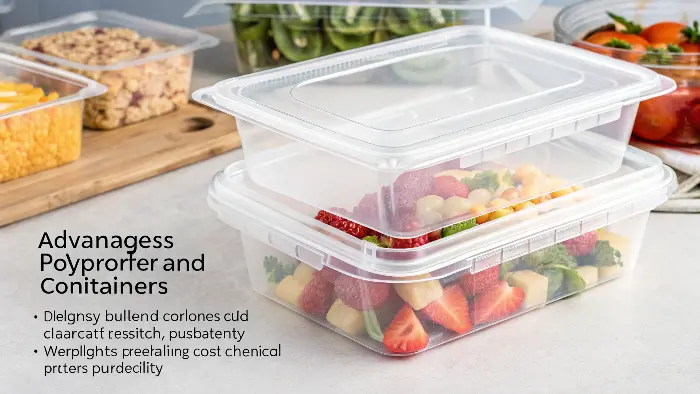
Selected polypropylene grades are common for microwaveable containers, but the resin name or melting point alone does not prove that a container is suitable. Intended food, heating, load, lid design, cleaning and finished-article evidence control the decision.
Polypropylene is widely considered for microwavable food containers because selected grades can combine low density, chemical resistance, fatigue performance, heat capability and practical injection molding behavior. It is not automatically the right answer for every food container: temperature, heating time, oil or sauce contact, lid function, transparency, odor, dimensional stability and market requirements must be evaluated for the exact grade and design.
Related CKMOLD resources: mold design, production injection molding, mold testing and validation.

Why Is PP Commonly Considered for Heated Food Containers?
Selected PP grades can combine low density, chemical resistance, moldability and useful heat performance, but PP is not microwave-suitable merely because its melting point is high. A container can soften or distort under load well below melting, and food—especially oil/fat—can create local temperatures and exposures that differ from water.
Define food type, fill temperature, microwave power/time, venting, repeated use, dishwasher cycle, lid/seal load and destination market. Compare the exact grade’s data and regulatory declaration, then test the production-like container and closure under the claimed conditions.
LyondellBasell’s Adstif HA849K page is one example of a PP grade described for hot-fill/microwavable packaging. It demonstrates why a grade-level claim is needed; it does not make every PP suitable.
Primary sources checked: LyondellBasell — Adstif HA849K (one PP grade example for hot-fill/microwavable packaging, not a family guarantee); FDA — Food Types and Conditions of Use (intended food, temperature and contact-time framework); FDA — Regulatory Status of Food-Contact Components (component identity, authorization and use limitations); EUR-Lex — Consolidated Regulation (EU) No 10/2011 (EU plastics, documentation and migration framework); ExxonMobil — Polypropylene Data-Sheet Library (grade-specific PP properties and processing evidence). The cited scope still has to be matched to the exact grade, tool, product and destination market.

Polypropylene Applications in Food Packaging
Polypropylene is utilized in many forms in food packaging such as films, containers, and trays. Each use addresses a specific packaging need.
Flexible Packaging
Polypropylene’s most common usage is in flexible packaging. BOPP films, in particular, are very popular in packaging for lidding snack, baking, and confectionary food packaging. Such films are appreciated for their strength, clarity, and for their capability of offering a superior barrier against moisture.
Moisture and Gas Barrier
Polypropylene films also protect food products from the penetration of moisture and gases, whose entry can destroy food quality.
Cups and Bottles
Polypropylene is also used in the production of cups and bottles for beverages and condiments. Its lightweight and preservation of product freshness are among the factors why polypropylene is a popular packaging material for single-use and reusable drink packaging.
Upright Containers
Lightweight rigid polypropylene containers are popular for yogurt, milk products, and ready-to-eat food. As a product packaging material, they are tough, rigid, resistant to stress cracking, and impact resistant.
Microwaveable Containers
Since polypropylene possesses high heat resistance, polypropylene is a popular packaging material for microwave-safe containers such that food might be reheated in the packaging.
Food Trays and Clamshells
Polypropylene clamshells and trays are common packaging for baked products, meat, and vegetables. Its high impact strength and rigidity make it a suitable packaging for safeguarding food against abuses in transit and storage.
Modified Atmosphere Packaging (MAP)
It is compatible with MAP packaging, in which the packaging atmosphere is controlled in a way to enhance the shelf life of fresh produce.
What Does “Microwave Safe” Need to Mean?
The finished article must be evaluated for its intended heating and food-contact conditions. Microwave energy primarily heats the food, but the container receives heat from the food, hot spots and contact geometry; it can also be affected by additives, color, aging, scratching and repeated cleaning.
Confirm material authorization, use restrictions and supplier declaration for the exact formulation. Validate deformation, leakage, closure opening, hot handling, odor/appearance and any applicable migration or use instructions. A recycling code or “PP” mark is not proof of this performance.

Which PP Benefits Matter to the Container?
Grade-specific stiffness/toughness, fatigue, chemical resistance, odor, clarity and processability can support containers and lids. Verify living-hinge cycles, seal retention, drop/top-load, stain/odor, flatness and reheat performance on the molded design. “Widely recycled” must be scoped to an actual collection and reprocessing route.
Use a current manufacturer data sheet—such as the ExxonMobil PP grade library—to compare exact candidates. Do not turn family descriptions into guaranteed container performance.

What Failure Modes Should the Validation Plan Cover?
- base/rim warpage and lid leakage after hot fill or microwave heating;
- localized softening, creep or handling deformation under food load;
- staining, odor, scratching and clarity change after intended cleaning cycles;
- hinge, snap and seal fatigue over the claimed reuse life;
- material/color/additive traceability and any migration/use limitation;
- misuse conditions that require instructions or warnings.
Do not attribute leaching to “low-quality or recycled PP” without composition and test evidence, and do not assume glass or Tritan is automatically a better substitute for the same design.
Match the Grade to the Heating Scenario
Define microwave exposure, hot-fill condition, repeated heating, cooling, dishwasher use, food chemistry and expected service life. Homopolymer, copolymer, clarified and impact-modified grades can behave differently in stiffness, impact, transparency, shrinkage and heat performance. Select from the actual use profile rather than the polymer name alone.
Design Walls, Ribs and Sealing Features
Uniform walls, controlled transitions and well-supported sealing surfaces reduce warpage and leakage risk. Ribs and corners should not create heavy sections that sink or cool slowly. Lids, snap fits, hinges and vents need enough fatigue and dimensional margin after molding and heating.
Control Gate, Cooling and Warpage
Large flat containers are sensitive to differential shrinkage and cooling imbalance. Gate position affects flow orientation, flatness, weld lines and lid fit. Cooling channels should support uniform temperature, while ejection should not bend a warm base or rim.
Consider Food Contact and Odor
The selected PP grade, colorant, additive and processing history should match the intended food-contact use. Keep resin dry and clean, control regrind and avoid thermal degradation that can create odor or discoloration. Finished-container testing should include sealing, leakage and repeated-use conditions where relevant.
Validate Heating and Assembly Performance
Test production-like containers with the actual lid, fill, heating profile, cooling cycle and use orientation. Measure flatness, seal force, leakage, hinge cycles, distortion, odor, appearance and fit after conditioning. A room-temperature sample cannot represent a hot food container’s full behavior.
PP Is Commonly Used for Microwavable Food Containers: Buyer Review Checklist
- Define microwave, hot-fill, cooling, food chemistry, reuse and cleaning conditions.
- Select PP grade from stiffness, impact, fatigue, shrinkage, clarity and thermal requirements.
- Design walls, ribs, rims, lids, hinges, vents and seals to remain functional after heating.
- Balance gate, cooling, ejection and flatness for container and lid fit.
- Validate leakage, distortion, odor, appearance and repeated-use performance on production-like parts.
FAQ
Is every PP grade suitable for microwave containers?
No. The grade must match heat, food-contact, impact, stiffness, fatigue, chemical and processing requirements for the specific product.
Why do PP containers warp after heating?
Differential shrinkage, uneven wall thickness, cooling imbalance, fiber or filler orientation, lid stress and the heating profile can all contribute.
Conclusion
PP is common in heated food packaging because suitable grades can offer a practical balance of performance and cost. The defensible decision is grade- and container-specific: define food/heating/cleaning conditions, design for flatness and sealing, control the molding process and validate the complete container and lid under the claimed use.
Microwave Use Needs Specific Evidence
Do not infer microwave suitability from the PP family name. Review the exact grade and article against the relevant FDA food types and conditions of use, then validate deformation, migration and closure performance at the claimed heating and reuse conditions.