
Precision medical device molding is not defined by a single tolerance or a resin marketed as “medical grade.” Suitability is established for the finished device through risk management, material and supplier controls, tooling, a validated process, inspection, packaging, sterilization where applicable, and documented change control.
This article is general manufacturing information for medical-device product and sourcing teams. It is not medical, regulatory or legal advice, and it does not determine whether a material or component is suitable for a particular device.
Begin With the Device and Its Risk
Translate the device function into measurable component requirements. Relevant inputs can include the type and duration of body contact, fluid exposure, load, temperature, assembly, cleanliness, particulate limits, biocompatibility strategy, sterilization method, shelf life and failure consequence. The applicable controls depend on the final device and market; they cannot be assigned from the polymer family alone.
The FDA explains that biocompatibility assessment considers the whole device in its final finished form, including processing and sterilization. The agency’s ISO 10993-1 guidance uses a risk-based framework rather than a universal list of tests for every plastic.
Control the Exact Resin and Its History
Specify the manufacturer and grade, additives, colorant, permitted regrind policy, drying or conditioning requirements, storage, lot traceability and change-notification expectations. “HDPE,” “PC” or “TPE” is not a complete material specification. A formulation, additive, color package or process change can alter extractables, mechanical behavior or sterilization response.
A supplier statement or USP Class VI result may contribute evidence, but it does not replace evaluation of the finished device for its intended use. See the separate risk-based HDPE medical-device guide for that distinction.
Convert Critical Requirements Into DFM Decisions
Medical-component DFM should connect each critical feature to molding and inspection. Review wall transitions, draft, knit-line location, gate vestige, vents, ejection, particulate traps, sharp internal corners, seal surfaces, insert retention, flash-sensitive interfaces and cleanability. Tolerance decisions should identify the datum system, measurement method, conditioning state and functional reason.
Use DFM analysis before steel cutting to separate mold-safe changes from changes that would require adding steel. Document accepted risks and unresolved questions.
Design the Mold for Repeatability and Maintenance
Tool design can affect contamination control and dimensional stability. Consider material-compatible steels and coatings, protected parting surfaces, accessible vents, balanced filling, cooling near critical geometry, controlled ejection, replaceable wear components and a maintenance plan. The appropriate solution depends on resin chemistry, annual volume, required tool life and manufacturing environment.
Establish a Process Window
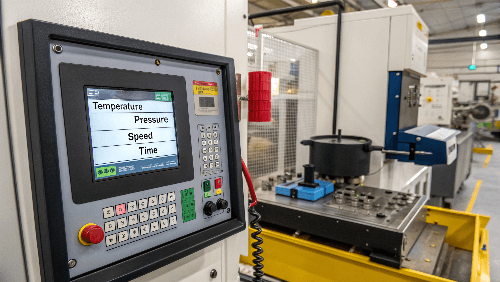
A validated process is more than a nominal recipe. The manufacturing team should understand which inputs affect critical outputs and demonstrate acceptable operation across justified ranges. Track the actual resin lot and conditioning, machine identity, barrel and mold temperatures, fill behavior, transfer position, pressure, cooling, cycle, cavity and inspection results as required by the quality plan.
| Control area | Question to close | Typical evidence |
|---|---|---|
| Material | Is the exact grade and additive package controlled? | Approved specification, certificate and lot record |
| Tool | Can the mold repeatedly form and release critical features? | Design review, maintenance record and trial history |
| Process | Which settings materially affect critical outputs? | Development data and justified operating ranges |
| Measurement | Can the inspection method resolve the requirement? | Datum plan, method, capability and calibration status |
| Change | What requires notification or revalidation? | Change-control agreement and risk assessment |
Account for Sterilization, Aging and Packaging
Gamma, electron-beam, ethylene oxide, steam and other processes can affect polymers differently. Evaluate the actual grade, dose or cycle, number of exposures, packaging and aging condition relevant to the device. Appearance after one exposure does not establish long-term mechanical or chemical suitability.
Plan Measurement Before T1
For tight-tolerance parts, agree the datum strategy, fixture, gauge resolution, temperature and conditioning state, cavity identification, sample size and reporting method before the first trial. A measured difference may come from molding, conditioning, the fixture or the measurement method. The plan should make those causes distinguishable.
Supplier Questions for a Medical Molding RFQ
- Which requirements are critical to quality, and how will each be controlled?
- What material, colorant, regrind and lot-traceability rules apply?
- What manufacturing environment and cleanliness controls are required?
- How will cavities, process records and inspection results be identified?
- What changes require customer notification, risk review or revalidation?
- Who owns the device validation strategy and regulatory submission evidence?
Primary Regulatory References
Medical Molding Questions
Does “medical-grade resin” make a device compliant?
No. Grade documentation may support material control, but the manufacturer remains responsible for the finished device’s risk assessment, validation and applicable regulatory requirements.
Can a dimensional tolerance be approved from one T1 run?
A trial can identify risk, but production acceptance generally needs an agreed measurement method and evidence from a controlled process appropriate to the program.
Who decides which biocompatibility tests are needed?
The device manufacturer should use qualified regulatory and biological-safety expertise to define the risk-based evaluation for the final device and intended contact.
For an engineer-led manufacturing review, provide the application, controlled drawings, material specification, volume, critical features and validation expectations through CKMOLD’s RFQ form. Review the broader quality-assurance workflow before supplier qualification.