
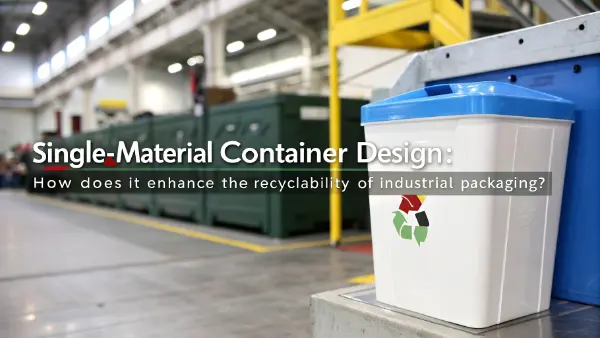
A container designed around one main polymer can reduce incompatible components in a recycling stream. It is useful only if the complete package meets its product-protection requirements and an identified collection, sorting and recycling route accepts that format and its residues. A PP body alone does not establish that its label, seal, pigment or contents are compatible with that route.
This article focuses on the component and tooling decisions involved in a mono-material redesign. For the wider choice between reuse, mechanical recycling and other end-of-life routes, see our container end-of-life design guide.
What determines the recyclability of packaging materials?
Start with the destination market and the actual collection channel. Confirm acceptance of the package format, size, color and previous contents with the relevant operator. Industrial collection arrangements may differ from household programs. The US EPA’s recycling guidance explains that a resin identification symbol does not establish acceptance by a local program; it is not an approval for a particular industrial container.
Sorting and material compatibility
Assess the finished package, including closures, handles, labels, adhesives, inks, fillers and any barrier layer. Their effects depend on the selected stream and separation process. Using the same polymer family can simplify this assessment, but does not prove sorting performance or remove contamination from the product.
RecyClass packaging guidelines distinguish streams by polymer, format and color, and assess features such as caps, labels and adhesives. Select the applicable guideline and its current version; test features outside its established scope instead of assuming that all PP or all PET combinations behave alike.
Evidence before claims
| Decision | Evidence to obtain | What it does not prove |
|---|---|---|
| Collection route | Operator acceptance for this format and product residue | A polymer code alone does not prove collection |
| Sorting and compatibility | Applicable guideline assessment and any required package tests | One polymer family does not guarantee separation or recyclate quality |
| Economics | Comparable quotations including material, tooling, rejects and handling | Removing a component does not guarantee a lower total cost |
| Environmental or fee claim | Market-specific assessment for the actual package and applicable scheme | A mono-material designation alone does not establish a fee reduction or compliance |
The RecyClass assessment tool’s scope separates technical recyclability from collection efficiency. Its report is not, by itself, sufficient evidence of regulatory conformity. Keep any packaging claim within the evidence actually obtained.
What is product design for recyclability?
It means considering the complete package and its intended recovery route during design, while retaining the function that protects the product. The objective is compatible materials and practical recovery; it is not a universal requirement that every closure and label be identical to the body resin.
The challenge of protection
Making everything from one material is not always easy. Sometimes, food or chemicals need special protection. We call this a barrier. Mono-material packaging is not automatically better in every single case. Some products need high oxygen or moisture barriers. Often, factories use mixed layers to get this protection. The real design task is to match the material choice to the product’s needs while keeping it recyclable.
Do not substitute a thicker single-polymer wall for a barrier layer on appearance alone. Compare the required oxygen, moisture or chemical protection and validate the candidate package under the specified contents, storage conditions and shelf life. A design that causes leakage or product loss has not met its primary requirement.
| Function | Redesign question | Qualification evidence |
|---|---|---|
| Seal and closure | Can the required seal work without an incompatible component? | Leakage, opening/reclosure and aging tests for the actual contents and conditions |
| Handle and load path | Can a compatible handle carry the specified filled mass? | Handle attachment, drop and sustained-load checks at specified temperatures |
| Label and identification | Does the complete label, ink and adhesive system fit the selected stream? | Supplier specification plus the applicable compatibility or sorting assessment |
How can a plastic container be redesigned for recyclability?
Use a component review before changing the mold. Record each part’s material, mass, function, attachment method and proposed end-of-life treatment. Separate confirmed facts from supplier assumptions.
| Step | Required decision | Record to retain |
|---|---|---|
| 1. Define the use | Contents, fill mass, temperature, storage, transport and closure duty | Product and package acceptance specification |
| 2. Select the route | Target market, collection channel and compatible package stream | Operator confirmation and dated guideline selection |
| 3. Review the bill of materials | Keep, replace, simplify or make components separable | Resin grades, additives, labels, adhesives and joining details |
| 4. Validate the redesign | Product protection, molding feasibility and recovery compatibility | Trial plan, measured results and unresolved limitations |
A resin or closure change can affect shrinkage, warpage, sealing fit, gate choice and ejection. Compare the exact candidate grades and geometry; do not assume that an existing tool can run an alternative resin without trials or modification. For a mold DFM review, provide the CAD model, current and proposed material specifications, sealing dimensions, filled mass and acceptance conditions.
Calculate any cost comparison using the same annual volume, accepted-part yield and service requirements. Include tooling changes, validation, packaging weight and handling charges. Leave savings and fee reductions unclaimed until the corresponding assumptions and external requirements have been checked.
What is an example of a single-material packaging redesign?
Illustrative design study, not a CKMOLD customer case: consider a PP tub for non-hazardous dry components, collected through an operator that accepts the relevant rigid-PP format. The proposed body, lid and handle use specified compatible PP grades. The label system is assessed separately. No measured recycling yield, cost saving or customer result is asserted.
| Component | Candidate approach | Release condition |
|---|---|---|
| Body | Specified PP grade and documented additives | Molding, load and dimensional checks; accepted collection route |
| Lid and seal | Evaluate a PP closure against the required protection | Keep a necessary gasket unless an alternative has passed the agreed sealing tests |
| Handle | Evaluate a compatible molded handle and attachment | Verify filled-load handling and transport performance |
| Label | Specify the complete label, ink and adhesive system | Verify compatibility rather than relying on a matching polymer name |
This example cannot be transferred directly to paint, chemicals, food or hazardous contents. Their residue, barrier, contact and transport requirements need separate assessment. Successful redesign also does not prove that recovered material will return to the same product or meet its original performance.
Conclusion
Use mono-material design as a way to reduce specific incompatibilities, with product protection and a documented recovery route as release conditions. Approve the mold and package against the agreed tests, then describe only the recycling benefits supported by the resulting evidence.