
Design a recyclable plastic container around the collection and reprocessing route available in its sales region. Then check the complete package: body resin, lid, seal, colour, label, adhesive and product residue. A simple material combination helps, but a resin code or a mono-material claim does not prove that the package will be collected and recycled.
This guide focuses on rigid container packaging. For housings and assemblies that need repair or dismantling, use the separate product end-of-life material and disassembly checklist. For packaging, select the matching material and format in the RecyClass packaging guidelines; rules for a PET bottle should not be copied into a PP tub specification.
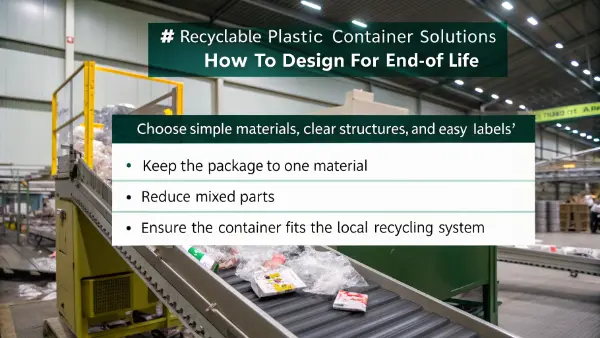
The opening image illustrates a sorting line. Its simplified design prompts are not a recyclability test result for a particular package.
How Should the Body, Lid and Attachments Be Combined?
Start by reducing unnecessary material combinations. If a seal, barrier or pump is needed to protect the product, assess its compatibility or separation route rather than removing a necessary function simply to call the pack mono-material.
One resin family does not mean one melting point or identical recycling behaviour. Grades, fillers, pigments and attached components still matter. Specify the complete bill of materials and assess the resulting package against the intended recycling stream.
Record the manufacturer and grade for the body and closure, each component mass, any coating or barrier, and the adhesive and ink system. Ask the recycler or assessment provider which combinations need testing before the design is released.
For a pump, insert or separate seal, document what remains attached after normal consumer use and what the recycling process can actually separate. Do not assume consumers will dismantle small components or that every metal part destroys a shredder.
Compare these choices before committing to the tool:
| Design choice | Engineering question | Required evidence |
|---|---|---|
| Use one plastic family | Are the actual grades and components compatible with the target stream? | Complete BOM and the applicable stream assessment; not a shared-melting-point assumption. |
| Assess metal or separate attachments | Can the unnecessary part be eliminated or the necessary part separated? | Documented package configuration and a verified separation route. |
| Review a barrier or multilayer | Is it required for product protection, and is this combination acceptable? | Barrier performance requirement plus recycling compatibility evidence. |
A compatible lid or integrated hinge may reduce separate parts, but the selected resin and geometry must still meet opening, closure, sealing and fatigue requirements. Validate those functions on representative molded samples.
Recycled content and recyclability are separate decisions. Qualify the proposed feedstock for the intended use, including its traceability, colour, odour and relevant mechanical performance. A recycled-content percentage alone does not demonstrate collection, sorting or reprocessing compatibility.
How Should Colour, Labels and Adhesives Be Verified?
Evaluate optical recognition on the complete decorated package. Pigment, label coverage and package presentation can affect sorting; appearance alone is not a test of near-infrared (NIR) detectability.
The RecyClass coloured-PP guideline distinguishes NIR-detectable dark colours from non-detectable colours. Its natural and white PP guideline has different colour and decoration conditions. This is why neither “all black plastic is unsortable” nor “clear plastic is always recyclable” is a sound specification.
Request evidence for the actual pigment and decorated pack, not an unrelated resin sample. A sorting result also does not establish the suitability or value of the final recyclate; those are separate acceptance questions.
Approve the facestock, ink and adhesive as a system. A “wash-off” description needs defined wash conditions and evidence of separation and residue behaviour. Do not assume that every process uses the same hot-water wash or that using the body polymer for a sleeve automatically makes the complete pack compatible.
Turn colour and decoration choices into checkable requirements:
| Container feature | Possible failure | What to verify |
|---|---|---|
| Colour | The complete package is not recognised or is unsuitable for its intended colour stream. | Pigment and decorated-package sorting evidence for the selected stream. |
| Label adhesive | Insufficient release or unacceptable adhesive/ink residues. | The specified label system under the applicable recycling test conditions. |
| Sleeve or label coverage | Decoration prevents recognition of the body material. | Complete-pack recognition and compatibility, including inks and separation. |
| Consumer information | A resin mark is interpreted as universal collection approval. | Local acceptance and correct component-specific disposal instructions. |
Give disposal instructions appropriate to the market and component arrangement. The US EPA explains that resin-identification symbols do not themselves establish local collection acceptance. Confirm whether lids should remain attached and which cleaning or separation instructions the local scheme actually requires before engraving or printing the artwork.
Should You Choose Reusable Containers or Single-Use Recyclable Ones?
Reuse and recycling address different stages of a package’s life. A reusable format needs a practical return and cleaning system as well as a durable container. For a single-use format, reducing material is useful only while the pack still protects the product and meets its handling requirements.
A returnable container can be a suitable choice where it completes enough service cycles and the logistics work. Compare losses, damage, cleaning, return distances and product protection. A thicker container is not automatically environmentally preferable, and no fixed five- or ten-year service life should be assumed without evidence.
For a simple material-use comparison, divide container mass by completed uses. Illustrative example only: a 0.5 kg container completing 20 uses represents 0.025 kg of initial container material per use. This is not a carbon-footprint result: it excludes washing, transport, replacements, losses and end-of-life processing.
Define service acceptance for the actual duty: leakage, closure function, stacking or drop performance, cleaning exposure and any product-contact requirements. Record why a container is retired instead of assuming that every returned unit is fit for another trip.
You have to look at your own business to choose the right path. Do your customers buy the product and throw the box away right away? Or do they keep the box to store things?
Choose the format against the delivery system:
| Container type | Use conditions | End-of-life plan |
|---|---|---|
| Single-use recyclable | A relevant collection route exists and the package protects the contents. | Verify acceptance, sorting and reprocessing of this complete format. |
| Reusable or returnable | Returns, cleaning and service acceptance are managed and recorded. | Define retirement criteria and a recovery route for worn-out units. |
| Lightweight single-use | Lower mass still meets product protection, handling and molding requirements. | Check recovery compatibility and total material use, including rejects and damage. |
For lightweighting, review wall distribution, ribs, closure interfaces and filling feasibility together. Confirm that material reductions do not increase damage or reject rates. Submit the CAD, resin and duty conditions for a container geometry and molding DFM review; geometry review supports manufacturability and does not certify recyclability.
What Can Digital Watermarks and Recycler Collaboration Prove?
Improved identification can support sorting where the necessary equipment is installed. It does not create a collection route, make incompatible materials compatible or guarantee a market for the output.
Digital watermarks require compatible marking, detection and sorting systems. AIM’s HolyGrail 2.0 project presentation reports measured industrial trial results and distinguishes detection, sorting and purity. Those results do not support a promise of completely accurate sorting or universal deployment.
Manufacturers and recyclers should agree which facility and stream are relevant, which package version is being assessed and what constitutes acceptance. Keep the test report tied to the bill of materials and artwork revision so later changes trigger the appropriate review.
Use the applicable RecyClass sorting and recyclability protocols when a feature needs evaluation. Keep sortability, compatibility testing and collection availability as separate evidence; passing one does not establish all three.
Ask for evidence at each decision:
| Strategy | Evidence to request | Limit to keep explicit |
|---|---|---|
| Digital watermarking | Marking/detection compatibility and results for the intended sorting route. | A trial does not prove universal deployment or perfect recovery. |
| Recycler collaboration | Named stream, package revision and agreed assessment method. | A discussion alone is not an approval or test report. |
| Consumer instructions | Market-specific collection and preparation requirements. | A label cannot create collection infrastructure. |
| Market requirements | Applicable requirements and documented review for the destination. | Avoid one worldwide compliance or recycling promise. |
Do not use a biodegradable or compostable claim as a substitute for this assessment. Compostable plastics require an appropriate collection and treatment route and should not be mixed into conventional plastic recycling merely because they are labelled “green”.
What Should Be Ready Before Mold Release?
Prepare the destination markets and recovery route, complete material/component list, artwork and adhesive specification, required package tests, expected annual quantity and any reuse duty. Identify unresolved recycling features before the material stack and tooling are fixed. Include these inputs in your container mold and molding RFQ so the design review and quotation use the same assumptions.