
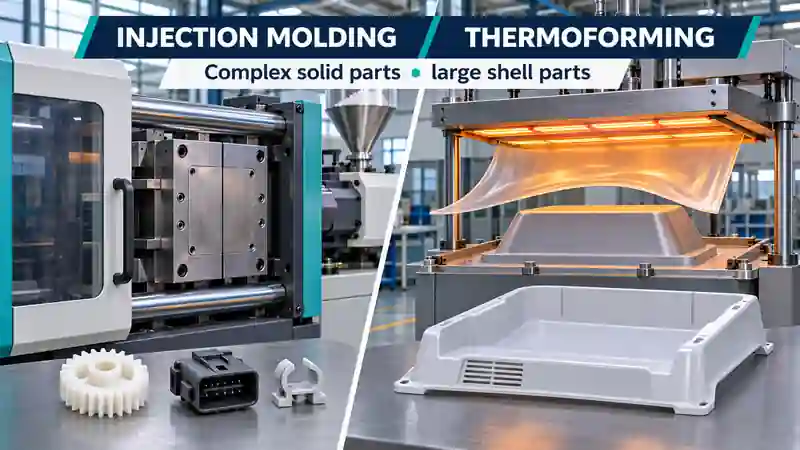
Both injection molding and thermoforming are used to convert thermoplastics into finished products, yet they are used to address different issues. Injection molding is used to produce complex, solid parts by filling a closed steel or aluminum mold with molten plastic and forming the part in the mold, which has tight, repeatable dimensions. Thermoforming applies heat to a plastic sheet and pulls or pushes it to fit a single-sided mold, making it the best choice for large, open, shell-like parts and much lower tooling budgets.
Most comparisons end at “thermoforming for low volume, and injection molding for high volume”. This is a good beginning, but it doesn’t take into account part size, geometry, tolerances, sheet cost, trimming and how your demand will increase. This guide will delve into the two processes in more detail, run through a break-even scenario and give you a roadmap when deciding.
Quick Answer: Which Process Should You Choose?
- Use heavy-gauge thermoforming for lower or medium annual volumes of open, large parts like panels, covers, liners and enclosures, where tooling costs are restricted and/or design changes are still possible.
- Use thin-gauge roll-fed thermoforming for high-volume packaging such as trays, clamshells and cups, often with multi-cavity tooling.
- Injection molding is used for parts of small to medium size that have ribs, bosses, snap fits, holes, threads, a controlled nominal wall design, where volumes are high, dimensions must be repeatable, or all sides need finished detail.
- Apply both to a product that requires both a large thermoformed shell and small injection molded brackets, clips or bezels.
How Does Injection Molding Work?
This process involves melting plastic pellets in a heated barrel and forcing the molten plastic under high pressure into a closed mold consisting of two or more parts. The plastic fills all cavities, cools against the mold walls, and the finished part is removed from the mold. Ribs, bosses, snap fits, internal walls, threads and textured surfaces can be produced on both sides of a part in one shot, with little or no secondary machining at all.
Molds may contain a single cavity or multiple cavities. One advantage of a multi cavity mold is that it produces multiple parts per cycle; hence, the per-part cost decreases dramatically as the volume increases. Understanding the number of mold cavities is also a critical element in the balance of tooling cost and cost of the parts.
How Does Thermoforming Work?
Thermoforming begins with the plastic sheet being extruded. The sheet is held in a clamp and heated until it is soft, after which it is shaped over or into a single-sided mold. Once it cools, the formed piece is separated from the rest of the sheet by cutting away the excess, typically using a CNC router or a die.
There are several types of thermoforming techniques:
- The vacuum forming process pulls the sheet against the mold using the vacuum. It is the cheapest type of tooling and is used for simpler shapes.
- Pressure forming brings the air pressure from the other side, further pressing the sheet into the mold. It is able to create sharper detail, crisp corners and textures more like injection molded.
- Twin-sheet forming is a process that forms two sheets and joins them together to create hollow, double-walled products, like pallets, ducts and tanks.
- Thin-gauge vs. heavy-gauge forming divides high-volume roll-fed packaging (trays, clamshells, cups) from cut sheet parts like equipment panels, liners and enclosures.
Injection Molding vs Thermoforming: Side-by-Side Comparison
| Factor | Injection molding | Thermoforming |
|---|---|---|
| Raw material | Plastic pellets | Pre-extruded sheet (cut sheets for heavy gauge, rolls for thin gauge) |
| Mold type | Closed, two-sided mold (steel or aluminum) | Single-sided mold (aluminum, composite, wood or printed for trials) |
| Tooling cost | High | Low to moderate |
| Tooling lead time | Weeks to months | Days to weeks |
| Part size | Limited by press and mold size | Very large parts possible |
| Geometry | Ribs, bosses, snap fits, holes, threads, internal features | Open shells, trays, panels, covers |
| Wall thickness | Controlled nominal wall, set by design | Varies with sheet, tool design, draw depth and forming method; check corners and deep draws |
| Finished surfaces | Both sides formed by the mold | One side contacts the mold |
| Dimensional precision | High and repeatable | Lower, especially on the side away from the mold |
| Secondary work | Often minimal | Trimming almost always; holes and cutouts often machined |
| Scrap | Runners and gates, often reground or avoided with hot runners | Sheet trim around the part, often reground |
| Design changes | Costly once steel is cut | Faster and cheaper to modify or remake the tool |
| Best fit | Medium to high volumes of detailed parts | Heavy gauge: prototypes, low to medium volumes, large parts. Thin gauge: high-volume packaging |
How Do the Costs Compare?
Most buyers begin the purchasing process by looking at the cost, and this is where simple rules deceive. Consider four costs, not one, and then compare them per accepted part.
Tooling. Single-sided thermoforming molds aren’t subject to injection pressure and can be made from aluminum, composite, or 3D-printed materials for trials, or even wood. Injection molds are significantly more costly, as they must contain molten plastic under pressure, have an accurate shut-off, cooling channels, and ejection. The price range is extremely broad, from a few thousand dollars for a simple vacuum form tool to six figures for an injection mold with multiple cavities. Don’t take any numbers posted on the internet as a quote.
Material. The sheet has already been extruded, which typically means that the cost per kilogram of thermoforming is higher than injection molding with pellets.
Per-part processing. Injection molding is quick, and the process can be completed with multiple cavities simultaneously, requiring minimal labor input. Heavy-gauge thermoforming often produces one or a few large parts per cycle, while thin-gauge roll-fed lines can run multi-cavity tools at much higher rates. For example, ILLIG lists up to 55 cycles per minute for its IC-RDKP 72k roll-fed pressure-forming machine; that is one machine’s rating, not an industry figure. Formed parts then require trimming.
Secondary operations. The common requirements that are often needed for thermoformed parts are CNC trimming, drilling, cutouts, and added fasteners and inserts. They can be incorporated into injection molded parts in the mold.
Cost per accepted part. Compare the cost of each good, finished part, not only the material price per kilogram. Account for part weight, sheet layout and material utilization, trim and runner scrap, permitted regrind, parts produced per cycle, and secondary operations such as trimming, drilling and assembly. Regrind availability and allowable use depend on the material and product requirements.
A Worked Break-Even Example
The numbers below are meant for illustration only and are chosen to show the arithmetic. Replace them with actual, comparable supplier quotes.
| Item | Thermoforming | Injection molding |
|---|---|---|
| Tooling | $15,000 | $60,000 |
| Cost per finished part (material, cycle, trimming) | $12.00 | $4.00 |
| Total cost at 2,000 parts | $39,000 | $68,000 |
| Total cost at 10,000 parts | $135,000 | $100,000 |
The break-even point is the extra tooling cost divided by the per-part saving: ($60,000 − $15,000) ÷ ($12.00 − $4.00) ≈ 5,600 parts. Thermoforming is less expensive total below that. Above the calculated break-even volume, injection molding has the lower modeled total cost, assuming the quoted costs and production scope remain comparable.
The true break-even number depends on part size, part complexity, number of cavities, material, and trimming cost. Make a comparison of the total cost for the useful life of the product and not the original order. To estimate injection mold size and tooling budget, use the injection mold cost calculator from CKMold. It does not estimate molded-part pricing or the full thermoforming cost, so those still need supplier quotes.
Which Process Gives Better Precision and Detail?
Tolerances. All surfaces are formed against a machined mold and therefore are held tighter and more repeatable in injection molding. In thermoforming, the tool-contact surface is usually better controlled, and it can differ from the opposite surface in finish and dimensional control. The other side is dependent on sheet thickness and the amount of extension of the sheet and, as such, will vary more. Pressure forming narrows the gap, but doesn’t close it.
Wall thickness. Injection molded walls are planned and designed. In thermoforming, the sheet stretches as it forms, and thickness distribution depends on the sheet, tool design, draw depth, heating, pre-stretch and use of plug assist. Deep draws and corners need particular attention, and minimum wall thickness should be checked for the actual part. A thicker starting sheet may be needed for deep draws, increasing weight and cost. In the case of injection molded components, wall thickness still needs to be carefully designed, but it is within the designer’s control.
Features. Ribs, bosses, snap fits, internal walls, threads, living hinges and small holes are natural in injection molding. Most of these are not possible to form with thermoforming. They are typically added on later by cutting, bonding or fastening.
Cosmetics. Both sides of the part can be finished with textured or polished surfaces by injection molding. One good surface is provided by thermoforming and sharp texture, and logos can be provided on that face by pressure forming.
How Do Part Size and Geometry Affect the Choice?
One of the first filters is part size. Injection molding needs a press large enough to clamp the mold, which is very costly if the mold is very large. Thermoforming is used to produce large parts, like machine covers, vehicle panels, refrigerator liners, and bathtubs, using relatively low-cost tooling.
The second filter is geometry. When the part is basically a shell, tray or cover with simple features, thermoforming is a viable choice. Injection molding is typically the preferred option if you need detail on both sides, many features, or close tolerances with other parts. If you’re molding small components and in a short run, check out our guide to injection molding large parts, small parts and short run production.
Which Materials Can Each Process Use?
Both processes use thermoplastics, but with different ranges.
| Material | Injection molding | Thermoforming | Typical uses |
|---|---|---|---|
| ABS | Common | Common | Housings, panels, enclosures |
| PC (polycarbonate) | Common | Common | Transparent covers, guards |
| PP (polypropylene) | Very common | Used, harder to form evenly | Containers, packaging, caps |
| HDPE | Common | Common in heavy gauge | Pallets, bins, tanks |
| PET / PETG | Used | Very common | Packaging, displays, trays |
| HIPS | Used | Common | Liners, trays, displays |
| Engineering resins (PA, POM, PBT, glass-filled) | Common | Rare | Gears, clips, structural and functional parts |
The widest choice is available with injection molding, which can be filled with glass or other engineering grades. Materials must be available in sheet form for thermoforming, which restricts the availability and/or expense of some specialty grades. Please read the information about the plastic materials offered by CKMold.
What About Waste and Sustainability?
Both processes are "green" or not, depending on the case. Thermoforming takes off parts from a large sheet, which leaves behind some trim that is typically reground and reused. Runners and sprues can also be reground, and hot runner molds can eliminate most of these scraps. Injection molding also eliminates the need for a sheet extrusion process. Material efficiency in producing the finished part, energy efficiency per part, and scrap recycling in the supplier’s process are more appropriate comparisons.
Common Mistakes When Choosing a Process
- Comparing the cost of the tooling only. If trimming is considered, as is per-part cost, a lower tool cost can result in a higher overall cost.
- Ignoring secondary operations. The added cost of holes, cutouts, inserts and assembly can be significant for thermoformed parts.
- Assuming the thermoformed walls are uniform. Inspect for minimum thickness at corners and in deep places.
- Locking in steel prematurely. If the design is still evolving, an injection mold might have to be reworked, which could cost a great deal.
- Failure to plan for expansion. If volume is going to increase significantly, decide how and when you will use injection molding.
Can You Start With Thermoforming and Switch to Injection Molding?
Yes, and lots of products go through this process. With thermoforming, you can get a product to market rapidly, test the market, and make necessary changes to the product design. After the demand has been established, an injection mold can reduce per-part cost and introduce features that thermoforming might not be able to do.
In the transition, the part typically should be reconfigured. A controlled nominal wall thickness, draft angle, ribs rather than thick walls, and placement of gates are required for injection molding. DFM analysis can be used to turn a thermoformed design into a moldable one before steel is cut.
There’s also a low-volume option for injection molding. Prototype injection molding is used to make molded examples in production grade resin. In contrast, low volume injection molding can be used to repeat batches of released parts with low annual demand.
When to Use Each Process: Scenario Guide
| Scenario | Better fit | Why |
|---|---|---|
| Large machine cover, a few hundred per year | Heavy-gauge thermoforming | Low tooling cost, large size, simple shell |
| Small electronic housing with bosses and snap fits, 50,000 per year | Injection molding | Features, tolerances, low unit cost |
| Food trays or clamshell packaging in very high volume | Thin-gauge thermoforming | Roll-fed, multi-cavity forming of thin, open shapes at high volume |
| Medical device enclosure, design still changing | Pressure forming first | Fast, affordable tool changes with good cosmetics |
| Mature product with stable, high demand | Injection molding | Lowest per-part cost and consistent quality |
| Large shell plus small brackets and clips | Both | Thermoform the shell, injection mold the small parts |
Quick Decision Checklist
- What is the size of the piece, and is it predominantly an open shell or a detailed solid part?
- What are your annual volumes now, and what will they be in 2-3 years?
- Are there ribs, bosses, snap fits, holes and threads required on the part?
- What are the tolerances, and where?
- Are both sides of the part to be finished?
- How much money and how much time are you willing to invest in tooling?
- Is the design complete or will it be subject to change?
If the majority of your responses are large, low volume, simple shape, and changing design, then heavy-gauge thermoforming is probably your best option. When they tie to fine details, tolerances, large production volumes, and a well-established product, injection molding is typically the more cost-effective choice.
Frequently Asked Questions
Is thermoforming cheaper than injection molding?
Nearly always for tooling. It is based on volume for finished parts. Generally, heavy-gauge thermoforming is more economical for small runs and injection molding is more economical once its higher tooling cost is spread over enough parts.
At what volume does injection molding become cheaper?
There is not a set count. Use actual quotes for your part to divide extra tooling cost by per-part savings to determine break-even volume.
Can thermoforming match injection molding tolerances?
Not usually. In thermoforming, the mold side is usually better controlled than the opposite side, and wall thickness varies with the sheet, tool and draw depth. Detail and consistency are enhanced by pressure forming, but injection molding is more precise.
Which process is better for prototypes?
For large prototype shells, thermoforming can be quicker and less expensive. For smaller parts that need production-like behavior, prototype injection molding provides samples in the final resin.
Getting the Right Process for Your Part
It is important to understand that thermoforming and injection molding are not competitors; they’re simply solutions to different problems. Thermoforming is the clear winner for large parts, low tooling cost and quick changes. Injection molding is the best choice for detail, precision, and high volume. The right answer is based on total cost at realistic volumes, in addition to geometry, tolerances and product growth.
CKMold is a company specialized in injection mold design, mold making and injection molding, and it has molding capacity of up to 1200T in-house. When you’re asking yourself if your part is ready to be molded in an injection molding machine or you want to switch from thermoforming to a mold, please use the request a quote page or contact jerry@ckmold.com with your CAD files, material, target tolerances, and expected annual volume. The team has the opportunity to discuss moldability, tooling possibilities and when injection molding is feasible for your program.