
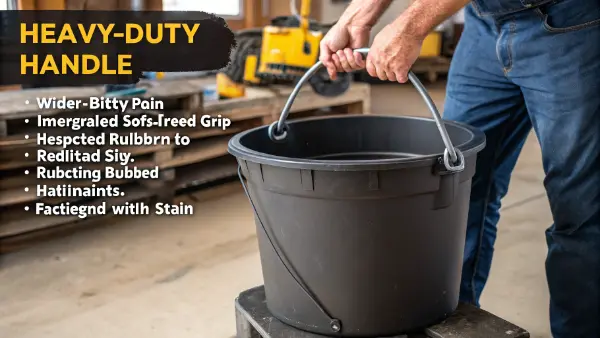
Integrated handles can improve bucket-carrying comfort when grip size, attachment geometry and materials suit the filled load, intended users and task. A wider contact area can distribute pressure across the palm, but handle design alone cannot eliminate pain or make an excessive load acceptable.
Start with a grip that fits the intended hand sizes and gloves, enough clearance around the fingers, and attachment points that control bucket tilt. A soft overmold is an option when its grip, retention and cleaning performance are demonstrated. Check carrying and pouring separately; neither a curved shape nor a soft material is automatically best for every user.
Before tooling, record the filled mass, contents, carrying distance, cleaning conditions and pouring task. Use these requirements in a DFM review of the handle and attachment geometry.
Which ergonomic factors should a bucket-handle review cover?
For a bucket design review, safety, comfort, ease of use, task efficiency and appearance are useful discussion areas. They are a practical checklist, not a complete ergonomic standard. Give load control and fit priority over cosmetic preferences.
Evaluate whether the user can lift, carry, set down and pour the intended contents with a secure grip and manageable posture. Record discomfort, slipping, finger clearance and unwanted bucket rotation during representative trials. Appearance does not demonstrate load capacity.
Define the load and users first
Define the intended fill level and maximum filled mass rather than assuming every liquid or solid has the same density. Include the expected hand-size range, glove use and whether the bucket must be carried one-handed or supported with both hands. These inputs make prototype comparisons meaningful.
Safety and Comfort
A dropped bucket can injure feet or spill hazardous contents. Review attachment strength, accidental release, finger traps and grip clearance alongside comfort. A larger grip can spread contact pressure, but an oversized section can be difficult for smaller hands to hold; compare prototypes with representative users.
Ease of Use and Productivity
A bucket must be easy to pick up, set down and stack. Pivoting handles can accommodate different grip positions, but their travel must be checked for pinch points and interference with the rim or lid. Evaluate the actual task sequence instead of assuming a more comfortable handle allows longer uninterrupted carrying.
Aesthetics
Clean contours and consistent surfaces can make inspection easier. Inspect parting lines, flash, sharp transitions and molding defects at the grip and attachment. A strong-looking handle still needs load and durability evidence.
Here is a table about these parts in bucket handles:
| Component | Benefit for the user | Example in bucket handles |
|---|---|---|
| Safety | Supports secure load control | Grip texture checked in relevant conditions |
| Comfort | Distributes contact pressure | Grip area and compliance matched to users |
| Ease of Use | Makes daily work simple | Pivot points for balance |
| Productivity | Supports the intended task sequence | Lightweight handle materials |
| Aesthetics | Makes finish and condition easier to assess | Clean and smooth shapes |
Use the table to identify review questions. It does not establish a safe carrying weight, required break schedule or guaranteed injury reduction.
How should carrying time and rest breaks be assessed?
Do not use a “30-second break every 30 minutes” schedule as a bucket-handling safety specification. The acceptable task depends on the load, distance, frequency, posture, surroundings and worker capabilities. A handle design cannot establish a universal carrying duration.
The California Department of Industrial Relations safer carrying guidance recommends assessing load stability, reducing heavy loads or using equipment where appropriate, alternating demanding tasks and taking rest breaks. Apply the workplace assessment to the task rather than assigning one fixed interval to every bucket.
Why Breaks Matter for Carrying
Where carrying is frequent or the route is long, consider smaller fills, shorter travel or a suitable cart before relying on grip changes alone. Rest arrangements complement these controls; they do not compensate for an unsuitable load or handle.
Combine task changes with grip design
A wider contact zone can reduce local pressure compared with a narrow contact line. Check that users can still close their hands securely around the grip. Do not treat this improvement as permission to carry a heavy bucket for 30 minutes.
Check contact pressure and discomfort
A narrow handle concentrates contact force. During supervised prototype evaluation, record where the grip presses into the hand and whether the user changes posture or loses control. Stop a trial that causes discomfort and revise the load, grip or task; do not use symptoms to justify a predetermined rest schedule.
Compare these handle features under the same load and task:
| Handle Feature | Action | Benefit |
|---|---|---|
| Wide grip zone | Spreads the heavy weight | Distributes contact force |
| Symmetrical shape | Helps control bucket orientation | Helps control unwanted tilt |
| Elastomeric grip | Adds soft cushioning | Changes contact feel; verify under use conditions |
Inspect molded contact surfaces
Smooth molding alone does not guarantee a safe contact surface. Inspect flash, parting-line mismatch, gate vestiges and sharp edges, including after wear and cleaning. Keep these acceptance criteria in the drawing and inspection plan.
What ergonomic principles should guide the handle design?
Review contact pressure, wrist posture, grip security and load balance together. Compare feasible shapes using the intended task; a drawing that looks ergonomic is not a substitute for handling trials.
Reduce concentrated contact force, allow a secure whole-hand grip where appropriate, and aim for a neutral wrist during the intended lift. Check hand clearance through the handle’s travel and during pouring. The grip shape must fit the task and user range rather than one idealized resting hand.
The Center of Gravity
Locate the attachment points so the suspended bucket remains controllable at the intended fill levels. Review how the load moves during lifting and pouring, including liquid movement. Handle position does not remove the weight of the contents; check the complete bucket and task across the intended fill range and handling sequence.
Natural Hand Shapes
Do not reject straight grips solely because they are straight. CCOHS hand-tool design guidance relates handle shape to force direction and neutral wrist posture, with fit and glove clearance also relevant. These principles inform bucket prototypes, but hand-tool dimensions are not automatically bucket specifications.
Choosing the Right Materials
A rigid molded grip may be sufficient for some uses. A soft cover can change friction and contact feel, but wet grip depends on texture, contamination, gloves and the exact compound. Compare samples in the intended conditions before selecting an overmold.
Here is a table of material choices for handles:
| Material Type | Potential role | Validation or cost considerations |
|---|---|---|
| Hard plastic (PP) | Potential structural core; grade-dependent | Wet grip must be evaluated |
| Thermoplastic elastomer (TPE) | Soft grip comfort | Needs a verified load-bearing structure |
| Overmolding | Combines structural core and grip surface | Additional tooling, bonding and quality controls |
Reducing Pressure
A molded grip around a narrow load-bearing handle can increase contact area without requiring a completely different bucket body. A broader center or compliant cover may help, but evaluate smaller hands, cleaning access and retention. For a two-material design, review substrate compatibility and mechanical retention through insert molding and overmolding design.
What handle design is the most ergonomic?
There is no single handle configuration that is most ergonomic for every bucket. Compare an integral grip, a pivoting bail with a molded grip, and an overmolded option against the same load, cleaning and user requirements. Include tooling, assembly and durability in the decision.
An overmolded handle with a broad grip zone is one candidate, not a universal winner. The core and attachment must carry the specified load, and the soft layer must remain attached after the relevant use and cleaning cycles. A simpler rigid grip can be preferable when it meets the same acceptance criteria with fewer interfaces.
Validate the handle and attachment
Before release, define static load, repeated lifting, impact and conditioning tests appropriate to the intended use. Inspect attachment roots, pivots, knit lines and retained deformation; include creep where sustained loading matters. Agree on load, duration, cycles and pass/fail criteria for mold testing and validation using the agreed service conditions.
Integrated Bottom Handles
An integrated side or bottom handhold can provide a second support point for pouring. Check access with gloves, finger clearance from the floor, stability and exposure to the contents. Test the pouring sequence with representative users; a second handle does not by itself prevent spills.
Light Weight and Symmetry
Avoid unnecessary handle mass while meeting the strength and durability requirements. Balanced attachment geometry can help control tilt, but verify it with the actual contents and fill range. Reducing section thickness solely to save weight can weaken the grip or attachment.
Review each candidate as a complete load path:
| Handle Part | Design Feature | Benefit to User |
|---|---|---|
| Core frame | Grade and section sized for the intended load | Carries the specified, validated load |
| Surface cover | Grooved soft rubber | Grip performance checked when wet and worn |
| Overall Shape | Grip geometry fitted to the user range | Fit evaluated across intended users |
| Attachment | Location matched to the lift and pour | Supports controlled lifting and pouring |
Customization Options
Adjustable or interchangeable grips may serve different hand sizes, but add interfaces that need retention, wear and cleaning checks. Choose adjustability only when the use study supports it. Keep the approved grip, material grade and attachment configuration under revision control.
Improve bucket ergonomics by matching grip fit, load balance and surface properties to a defined task, then validating the complete handle and attachment. Preserve realistic carrying limits and workplace controls. Release the design on documented trials and agreed acceptance criteria, and state the validated load range and handling conditions.