
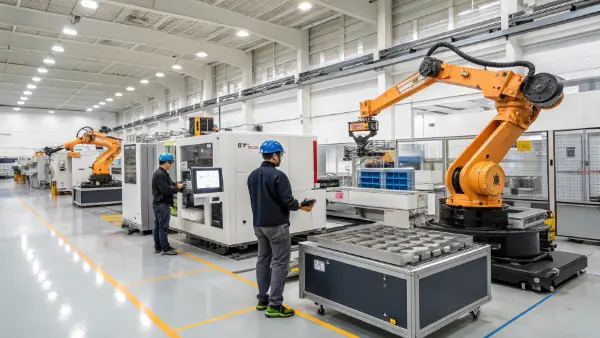
Making plastic buckets used to be slow and full of mistakes. When you rely totally on manual labor, costs go up, and human errors ruin your batch. But automation changes everything. I want to show you how modern factories use smart technology to build buckets faster, cheaper, and better. This helps you get reliable products on time, every time.
Modern bucket manufacturing facilities use robotic handling, automated conveying, machine vision inspection, and smart control systems. These technologies work together to handle heavy lifting, assemble parts, and check quality in real time. Common automation points include robotic arms for palletizing, CNC machines for precise mold cutting, and IoT sensors to predict maintenance. This setup improves consistency, speeds up output, and keeps workers safe.
Walking through a modern bucket factory today feels like stepping into the future. Everything moves smoothly, and the machines hum perfectly in sync. Let us look closely at the specific tools making this happen, and how they help your bottom line.
What is the role of automation in modern production technology?
Missing delivery dates because a machine broke down is a nightmare for any business owner. In the past, you only knew a machine was failing when it completely stopped working. Automation plays a huge role in fixing this problem. It gives us real-time data and complete control, so your production never stops unexpectedly.
The role of automation in modern production technology is to improve consistency, speed, and safety while reducing human error. It links machines, robots, and software so the whole production line acts as one system. Automation removes humans from dangerous or repetitive tasks, lowers labor costs, and uses data to optimize the supply chain. This means higher quality products made at a lower cost.
When I look at a modern factory floor, the main job of automation is not just to replace workers. Its true role is to make the whole process smarter and much more reliable.
Let us break this down. In plastic manufacturing, consistency is everything. If the temperature shifts slightly, a plastic bucket can warp or crack. Automated control systems, like PLCs (Programmable Logic Controllers), watch the machines every single second. They fix tiny temperature problems before a bucket is ruined. This keeps the quality perfect.
Safety is another huge role. Carrying heavy stacks of plastic buckets hurts backs. So, we use automated guided vehicles (AGVs) and robots to move things across the floor. This keeps people safe and speeds up the daily work.
I also see how data changes the game completely. We use IoT (Internet of Things) devices on our factory machines. These small sensors track vibration and heat. They tell us when a machine needs fixing long before it actually breaks. We call this predictive maintenance. It saves thousands of dollars in downtime and keeps your supply chain moving.
Furthermore, robotics and automation in bucket manufacturing reduce human error. When a person is tired, they might forget a step. A programmed system never forgets. It does exactly what it is told, every single time. At CKMOLD, we know that getting the injection mold right is the first step. But after the bucket comes out of the mold, automation takes over. From the moment raw plastic enters the hopper to the time the finished buckets are stacked on a pallet, automation ensures everything flows perfectly.
What are the 4 pillars of automation?
Trying to automate a factory randomly will waste your money. Buying a fancy robot without a solid plan just creates bottlenecks in other places. You need a strong foundation first. That is why understanding the four pillars of automation is so important for long-term manufacturing success.
The 4 pillars of automation are standardization, integration, data collection, and continuous improvement. First, processes must be standardized so they run the same way every time. Second, machines must be integrated to communicate with each other. Third, systems must collect real-time data to spot errors. Finally, that data is used for continuous improvement, making the factory more efficient over time.
I always tell people that good automation is built exactly like a house. You need strong pillars holding it up. If you miss even one pillar, the whole system will eventually fall apart. Let us look deeply at these four main pillars and how they work together.
1. Standardization
Before you can automate anything, your process must be standard. A robot cannot handle chaos. If a bucket’s shape or size changes randomly, the robotic arm will drop it. We have to use high-quality injection molds to make sure every single bucket is exactly the same. Only when the product is standardized can automation actually work.
2. Integration
This means making machines talk to each other. In a bucket factory, the molding machine needs to talk directly to the conveyor belt. If the molding machine slows down, the conveyor must slow down, too. We use advanced software to link them. This prevents jams and keeps the factory flow incredibly smooth.
3. Data Collection
You cannot improve what you do not measure. Automation systems collect massive amounts of real-time data. Sensors count exactly how many buckets are made. They track how much energy is used. Automated inventory management systems make sure we never run out of plastic resin. They check raw material levels constantly.
4. Continuous Improvement
This is where AI-driven predictive models come in. We take all that collected data and use it to get better. If we see a robot taking too long to stack a pallet, we adjust its path. If the machines can run slightly faster without losing quality, we make the change. Automation is never truly "done."
Here is a quick breakdown to make it easy to remember:
| Pillar | Purpose in Manufacturing | Real-World Example |
|---|---|---|
| Standardization | Keep parts identical | High-precision injection molds |
| Integration | Connect machines | Conveyors talking to PLCs |
| Data Collection | Track factory health | IoT sensors checking machine heat |
| Improvement | Optimize the process | AI finding faster robotic paths |
We use these four pillars to keep mastering the process every single day. It keeps your costs down and your quality up.
What are the 5 D’s of automation?
Deciding exactly which jobs to automate can be very confusing. If you pick the wrong tasks, your workers get frustrated and you lose money on useless machines. The easiest way to choose is to look for the 5 D’s. This simple rule helps you spot the perfect jobs for robots.
The 5 D’s of automation are Dirty, Dull, Dangerous, Difficult, and Dear (expensive). These are the five types of tasks that should always be given to robots instead of humans. Automating these jobs protects workers from harm, saves them from boring repetition, and lowers the high costs of manual labor. It lets human workers focus on safer and more creative tasks.
Whenever I walk through a factory, I use the 5 D’s rule to decide what needs automation. It is a very practical checklist. Here is exactly what these words mean in modern bucket manufacturing.
Dirty
Some factory jobs are just terribly messy. Greasing large machines or handling dusty raw plastic materials is not fun for anyone. Machines, however, do not care about getting dirty. We let automated systems handle the messy parts of plastic manufacturing. It keeps the human workspaces clean and healthy.
Dull
Imagine picking up a plastic bucket and putting a sticker on it 5,000 times a day. That is dull. Humans get bored, and when we get bored, we make careless mistakes. A crooked label looks bad to your customers. We use automated labeling lines because a machine will never get tired or lose its focus.
Dangerous
Safety is always a top priority. Moving heavy pallets of buckets or working near extremely hot injection molds can be dangerous. Robotic arms now handle all the heavy lifting. Automated guided vehicles (AGVs) move heavy pallets safely across the floor. This keeps our workers completely safe from injury.
Difficult
Some jobs are just too hard for humans to do perfectly and quickly. Cutting highly detailed injection molds requires insane precision. Humans cannot do it perfectly by hand every single time. So, we use CNC machines. They cut solid metal with high precision easily and quickly.
Dear (Expensive)
When manual labor slows down your production, it becomes very "dear," which means expensive. Automated assembly lines reduce labor costs and increase production speed dramatically. We also use automated machine vision to catch defects at full line speed. Catching a bad bucket early reduces scrap and saves a lot of money. By targeting these 5 D’s, we make sure our automation investment actually pays off for our clients.
What are the key automation technologies used in manufacturing?
Building a modern production line feels overwhelming with so many new tools available. If you pick the wrong technology, it might not fit your process or solve your real problems. You only need to focus on a few key technologies. Let us explore the exact tools that drive modern bucket factories today.
The key automation technologies used in manufacturing include robotic arms, automated conveyor systems, CNC machines, and machine vision inspection. Robotic arms handle heavy palletizing and material transfer. Conveyor systems seamlessly integrate the production flow. CNC machines cut precision molds, while machine vision uses AI to inspect buckets instantly. Additionally, IoT sensors monitor equipment health and optimize supply chains.
When we make buckets, we need everything to run like clockwork. Delays cost money. Let me share the specific automation technologies we rely on to Master Molding Right and deliver perfect products to you.
Robotic Arms and Material Handling
Robots are the true muscle of the modern factory. Many modern bucket manufacturing facilities use robotic arms for precise and efficient material handling. A fast robot can grab a hot bucket right out of the mold perfectly. It places it gently on the line. At the very end of the line, much larger robots stack the finished buckets onto shipping pallets. This completely removes all the heavy manual lifting.
Machine Vision and Quality Control
We must ensure uniformity. Nobody wants to buy a bucket with a hole in it. Automated quality control systems are implemented using cameras and artificial intelligence. These smart machine vision systems scan every single bucket for scratches, color issues, or shape changes as they move down the belt. They catch defects instantly, so bad buckets never reach your warehouse.
Smart Conveyors and AMRs
Moving items smoothly is vital. Advanced conveyor systems are employed for the seamless integration of production processes. They connect the molding, labeling, checking, and packing stations without any pauses. We also use Autonomous Mobile Robots (AMRs) to move materials safely around the warehouse without needing manual forklifts.
Data Tools and CNC Machining
Before we even make a single bucket, CNC machines are widely used for cutting and shaping materials with high precision. They build the perfect mold. Once production finally starts, real-time data analytics tools are used to monitor production efficiency. IoT devices track machine health so nothing breaks down. We even use AI-driven predictive models to optimize supply chain management. This ensures we always have the exact right amount of plastic resin on hand. By combining all these smart tools, we create a truly modern, unstoppable factory.
Conclusion
Automation is the absolute secret to building high-quality buckets quickly and safely. By using robotic arms, smart data, and precise CNC machines, we remove the dull and dangerous work from the factory floor. This lowers production costs and ensures you get reliable products every single time. When you embrace these smart tools, you build a business ready for the future.