
Home / Capabilities / Plastic Materials and Engineering Resins
Material selection for injection molding is a grade-specific engineering decision. A polymer family suggests a starting behavior, but final performance and process requirements depend on the manufacturer, grade, fillers, colorants, additives, moisture condition and service environment.
This page is a decision matrix rather than a collection of thin material pages. Use it to identify questions for DFM and quotation, then validate properties against the resin producer’s current technical data sheet and the customer’s product requirements.
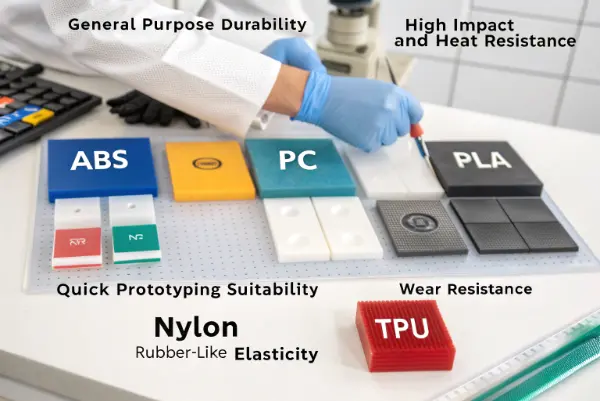
Producer and exact grade control final data
Moisture-sensitive resins need defined handling
Wear, corrosion, temperature and finish matter
Use current supplier TDS and project testing
Reviewed by CKMOLD project engineering • Last updated August 2026
The summaries support purchasing discussion; they are not numeric design data. Confirm each selected grade with the current producer technical data sheet.
Balanced toughness, stiffness and surface quality for enclosures and commercial components. Typical risks include sink at thick features, weld appearance, stress or chemical sensitivity. Drying and finish requirements depend on grade.
Low density, chemical resistance and living-hinge potential suit containers, covers and flexible features. Shrinkage and warpage can be significant, especially with uneven walls or orientation.
Tough, chemically resistant material used for containers and durable components. High shrinkage, stiffness variation and distortion must be addressed through geometry, cooling and grade selection.
High impact strength and transparency are available in suitable grades, but moisture, residual stress, chemical exposure and optical/cosmetic expectations require controlled drying and processing.
Combines features of PC and ABS for housings and engineered components. Grade ratios, flammability, impact and appearance vary; do not treat the blend name as one material.
Optical clarity, gloss and weathering can suit lenses, light guides and transparent covers. Brittleness, stress, scratches, drying and surface protection demand careful part and mold design.
Polyester grades support electrical, appliance and engineered applications. Drying, crystallization, glass reinforcement and mold temperature strongly influence process and dimensions.
Nylon offers strength, wear resistance and temperature capability, but absorbs moisture after molding. Conditioning state changes dimensions and mechanical behavior, so drawing and test requirements must define it.
Glass reinforcement increases stiffness and reduces some shrink but creates anisotropy, abrasive wear and visible fiber/flow effects. Gates, flow direction, steel and replaceable wear areas deserve added review.
Low friction, wear resistance and dimensional behavior suit gears, clips and mechanisms. Processing requires disciplined temperature/residence and safe venting; incompatible material contamination must be avoided.
Flexible materials support grips, seals, protective features and overmolds. Hardness, chemistry and adhesion differ widely; the exact substrate/overmold grades and service test must be selected together.

High-temperature or fluoropolymer families can impose demanding melt/mold temperatures, corrosion, venting, shrinkage, wear and material-handling requirements. CKMOLD does not accept a project from the family name alone; the exact grade, supplier data, part geometry, tool design and available machine configuration must be reviewed.
PEEK may suit severe mechanical, temperature or chemical environments; PPS can provide dimensional and chemical performance in reinforced grades; PFA supports specific chemical and high-purity applications. Suitability and process capability are verified case by case and never inferred from a generic website list.
Often reinforced for heat, chemical and dimensional performance. High mold temperature, venting, brittleness and tool wear require project review.
High-performance grades can demand elevated processing temperatures, controlled residence, suitable machine components and tool temperature.
Fluoropolymer processing, corrosion, temperature, melt behavior and application purity must be reviewed against the exact grade and equipment.
LCP, PEI, PPSU or other materials are evaluated only after the supplier grade, TDS, geometry, tooling and available processing capability are confirmed.
Temperature, chemical, UV, load, impact, friction, appearance, life and regulatory needs.
Use current producer TDS, approved supplier constraints and availability to identify candidates.
Check walls, flow, shrinkage, draft, gates, venting, drying, tool temperature, wear and corrosion.
Produce the samples or test geometry needed to evaluate the actual grade and process-dependent behavior.
Approve supplier/grade, colorant, certificate/lot needs, regrind policy and substitution route.
Only at a preliminary level. Reliable selection needs application, environment, load, temperature, chemical/UV exposure, appearance, life, compliance, quantities and geometry. Final data comes from the selected producer grade and project validation.
Moisture can degrade many resins or create splay, bubbles, property loss and dimensional problems. Drying temperature, time and dew point follow the exact grade’s technical guidance and material handling history.
A substitution can change shrinkage, color, flow, strength, flame rating, chemical behavior and processing. It should be treated as an engineering change with supplier data, trial and customer approval as required.
Reinforced resins can increase wear and create orientation-dependent shrinkage, warp and surface appearance. Gate, flow, steel, venting, replaceable inserts and cavity balance need added review.
No generic values are presented as design authority. Use the resin producer’s current TDS and safety documentation; CKMOLD reviews the grade against available equipment, tool design and project validation needs.
Include CAD, service environment, resin supplier/grade if selected, color, first and annual quantities, surface requirements, critical dimensions and any compliance or test need.
Use this short form for a general inquiry. For CAD upload, quantities and quality requirements, use the full RFQ page.