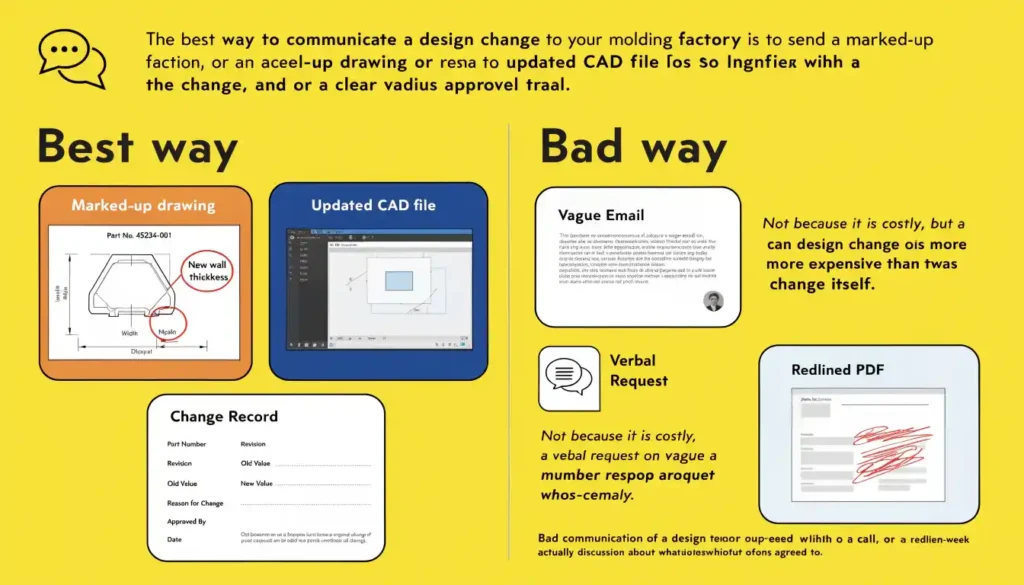
The best way to communicate a design change to a molding factory is to send a marked-up drawing or an updated CAD file together with a short written change record that lists the part number, revision, old and new values, the reason for the change, and a clear approval trail. Bad communication of a design change is more expensive than the change itself. Not because it is costly, but because a vague email, a verbal request on a call, or a redlined PDF with no clear owner can turn a two-day steel change into a three-week discussion about what was actually agreed to.
The advice on this subject ends with the phrase "communicate early and often." Yes, but it isn’t specific enough to change your request. This article outlines when, where, and what a molding factory must receive to implement a design change without wasting time, without taking a chance, and without a wall thickness change becoming a rebuilt mold that no one budgeted for.
Why "Just Tell Them What Changed" Isn’t Enough
Even a clear change isn’t always sufficient to describe verbally, leaving too much room for the factory to interpret. What "make the boss a little thicker" means to you is different than what it means to the engineer who is holding the mold design. Which boss? By how much is it thicker? Does the wall around it change as well as the boss? Will this impact the ejector pin location?
If no one answers those questions, someone at the factory makes a reasonable guess and answers them. On occasion, the guess is correct. If it’s not, you discover it at the T1 sample review, after cutting steel based on the incorrect assumption.
The solution isn’t to be more enthusiastic in your emails. It’s providing the factory with one of the following: a marked-up drawing, a changed CAD file, or a written change description linked to a feature, dimension, or callout number. If you can show the tooling engineer exactly where the change will be applied on the part in a way they can open and measure, you’ve already done the difficult part.
Know Which Kind of Change You Are Actually Requesting
Be familiar with the type of change you’re asking for. Some design changes are more expensive than others, and understanding the category of your change will impact the way you communicate.
Steel-safe changes
Molds are usually designed assuming that easy removal of steel is a given and easy re-addition of steel is not. A cavity can be intentionally undersized, and then the steel can be cut away to enlarge a feature without disturbing the rest of the mold, a process that a tooling engineer can use.
That’s why some dimensions are referred to as ‘steel safe’ in the original DFM review, with a clear margin of error for adjustment in one direction. If the requested change is in that direction, inform the factory that the dimension is already within the agreed steel-safe. This one sentence can make or break whether the job is a same-week adjustment or a mold rebuild quote.
New-feature changes
Adding a boss, rib, or snap feature that wasn’t part of the original design can be more involved than a simple edit, and in some cases, needs a new mold section. Depending on where the feature sits and how the mold was built, the tooling engineer may handle it as a local edit, a new insert, or a larger mold section. If the added feature could shift plastic flow or cooling, or risk warping or sink marks, a Moldflow re-check may be worth running before machining, but it isn’t required for every added feature.
You don’t need to classify the change with certainty. However, when you submit the change, naming your best guess (I believe this is steel safe, but please confirm) provides the molding factory engineer with a starting point rather than a blank drawing to interpret from scratch.
Weld-risk changes
When a change needs to be added in an area where there is no existing material in the mold, when a wall is already at minimum, or when a boss needs to be extended outwards rather than thinned, the factory will typically have to weld steel into the mold and remachine it.
This is more expensive, slower, and sometimes alters the life expectancy of the mold. In some cases, replacing the affected mold insert is a faster alternative to welding, so ask the factory whether that option applies before assuming a weld repair is the only path.
If it is a weld repair, let them know from the outset so their expectations are set accordingly. No awkward conversation ensues where the buyer thought it was a small change and the factory sent him a rebuild bill.
Submit the Change as a Marked File, Not a Description.
The one thing you can send that will help is a redlined drawing or a new 3D model, not a paragraph. A redline is a copy of your original drawing with the changes highlighted in a different color and a note explaining the changes and why.
A usable change submission contains at least:
- The drawing or model affected by the change, with the change marked visually at the exact location of the feature.
- If your drawing includes dimension or feature callouts, include the dimension or feature callout number.
- Old value and new value, expressed numerically (not adjectivally), e.g., 2.5 mm to 3.0 mm rather than "a bit thicker."
- Briefly, why the change was made (for fit, failure in field, cosmetic request, cost reduction)
- If you have a multi-cavity tool, whether this has an impact on one cavity or all cavities
That’s why the reason field is important. If it’s a functional failure in the field, it’s treated differently than if it’s a cosmetic preference; if it’s a functional failure, a factory that understands the reason you’re asking might have a better solution than the one you’re asking for. Without it, your engineer is merely an order taker, and you miss out on the skills you are paying for.
A Quick Change-Request Checklist:
Before sending the request, confirm your package includes: part number and current revision number; the new revision number the change will roll into; old and new dimensions with tolerances; the updated CAD file and marked-up PDF or drawing; written approval from the person authorizing the change; and agreement on how the change will be verified in the next sample round. Keeping these in one place reduces back-and-forth and gives the factory what it needs to price and schedule the work.
Use a Written Change Record, Even an Informal One
Larger manufacturers and regulated industries employ a formal Engineering Change Notice (ECN), which may be broken down into a change request, a change order authorizing the work, and a final notice confirming what was actually done. For a small project, you don’t need so much process. However, the rule is this: Any approved change must be in writing and include a date, description, and a record of agreement by both parties.
This is at least
- A unique identifier for the change (such as "Change 3" or a date-based label).
- What was asked for, and what was authorized (this is not necessarily the same as what was approved, and if the factory offered an alternative)?
- Who gave it their blessing and when?
- What is the first mold revision or round of samples in which the change is introduced?
This matters more than it sounds because, three months later, it becomes an unanswerable question: "Which version is this part actually built to?" It usually comes up at the worst time, when the factory pulls the wrong revision from storage or during a quality dispute.
In some factories, a revision letter and a brief reference code are engraved on the mold surface, but it’s not critical. If your supplier does this, you should ask what the current mark is before asking for a change, as you will know what you are starting with.
Time the Request Around Where the Project Actually Is
The same change can be cheap or expensive depending on when you raise it. The earlier you flag it, the less the factory has to redo.
Before DFM sign-off
This is the lowest-cost place to make changes. No machining has been performed. It’s all right to have a new CAD file and a brief explanation.
After DFM, before steel is cut
Now, the mold design has been settled around the current geometry, and the changes to the mold will require re-touching the mold design, not just the part file, and the cost is still relatively low. Flag it as early in this window as possible.
After steel is cut, before T1 sampling
This is where the steel-safe versus weld-risk classification begins to be important. Machining can be adjusted if it has not taken place, but if it has, the repair path is the solution.
After T1 sampling
The changes here are checked against actual molded parts, which is helpful information, but any change now impacts a mold that has already been through at least one trial cycle. A new trial round will be held shortly.
After production has started.
This is the most costly and slowest point of the change, as it usually involves removing a running mold from the production schedule and therefore impacting the delivery of all orders behind it, not only the order that is triggering the change.
This doesn’t mean late changes aren’t allowed. It’s the real question to pose to your factory: "Can you do this?" is not the question; it’s "Given the situation, how much time/money will this be, and will it impact what I’m already doing? A supplier who can tell you that, rather than simply saying yes to you, will be a good one to trust with the next change.
What to Expect Back From the Factory
A design change request must receive a specific response and not a one-line confirmation. At minimum, expect:
- The confirmation of what’s changing, restated in the factory’s own words, so that you can catch a misunderstanding before the actual machining begins.
- If it is a change, whether it is a steel-safe change or a weld repair
- Cost and lead time impact is not "a little extra," but a number.
- If it has an impact on other features, cooling, or cavity balance in a multi-cavity tool
- If a new sample round is needed, what will be measured
When a manufacturer says "yes" to every change, no matter how simple, that’s a red flag that might not be a relief. Or all the changes you’ve made so far were indeed insignificant, but it’s also possible that no one is checking the request against the mold design before approving it.
Common Mistakes That Slow This Process Down
- Only sending the change via text message. While it’s right to use WhatsApp or WeChat for a quick conversation, it’s not a suitable system of record. A change that is discussed in a chat thread and then not confirmed in writing on the actual drawing can easily get confused before approving it and before it’s cut out.
- Talking about the change when compared to a part rather than the drawing. For each person who looks at the part from a different perspective, "the side wall near the connector" has a different meaning. Removing the ambiguity is the callout number or marked location.
- Not making mention of whether the change is for all cavities. In a multi-cavity tool, this is a real and common cause of costly confusion. Be clear about which cavity you mean, or whether you mean all of them.
- Costs for design changes aren’t standardized across a project. There is no standard cost for design changes. A steel-safe trim on one feature and a weld repair on a similar-looking feature on a different part of the same part can cost vastly different amounts and will surprise the budgeter if they assume they’re the same.
- Failure to inquire about the disposition of parts already on hand. Existing inventory that was built to the old revision will not automatically receive the change if it’s approved during production. Reach out to ask if it was scrapped, used without changes, or reworked, and obtain a written description of the change and whether it was one of these three options.
FAQs
Does it require an Engineering Change Notice for a small tooling project?
Not exactly in the regulated-industry fashion, but there "must" be some written documentation: what changed, who approved it, and which sample or production run it applies to for the first time. Don’t skimp on documentation, just the paperwork format.
In the clearest possible terms, what is the difference (steel-safe vs. weld-risk changes)?
A small amount of metal is removed at the factory to adjust a dimension, usually faster and at a lower cost; this is called "steel-safe." Weld risk, having to re-add material to the mold and re-machine the weld, will increase time and expenses.
How can I check whether or not the change I requested is steel-safe?
The factory may be the only way to be sure, but based on your questions, it’s a safe bet that thickening a plastic wall or enlarging a cavity feature can be handled by removing mold steel. If you’re asking to make a plastic feature smaller or thinner, or to add new geometry, it’s likely a weld repair.
Can a change in design be requested after production has begun?
Yes, but it will likely be the slowest and most disruptive time to ask for one, as it will most likely require removing an active mold from the production schedule. Total downtime may be minimized if the change is not critical and can be scheduled with other planned changes.
If I don’t have the CAD software to create a correct redline, what should I send?
A picture or scan of the drawing with the changed dimension(s) marked by a handwritten note showing new and old dimensions is a viable alternative. The key is that the change isn’t just described in words; it’s clearly tied to a location on the part.
The Brief Version
To send a marked file, not a sentence. State old and new values as numbers. Explain the rationale behind the change. If you are asking about the project timeline, flag it, since the change affects cost more than the change itself. Practice getting it in writing, even informally, before the factory lays a hand on any steel. A good molding factory will also meet you halfway with clear answers regarding the cost, timing, and classification. One that says yes to everything without pushing back is worth a second look before you send the next change.