
Why Does Order Quantity Change the RFQ, Not Just the Price?
You have a part ready to quote, and the RFQ form asks for a quantity. You type in a single number — say 10,000 — and send it off. Three suppliers reply with three very different prices. The problem is rarely the number itself: one number cannot describe a real order.
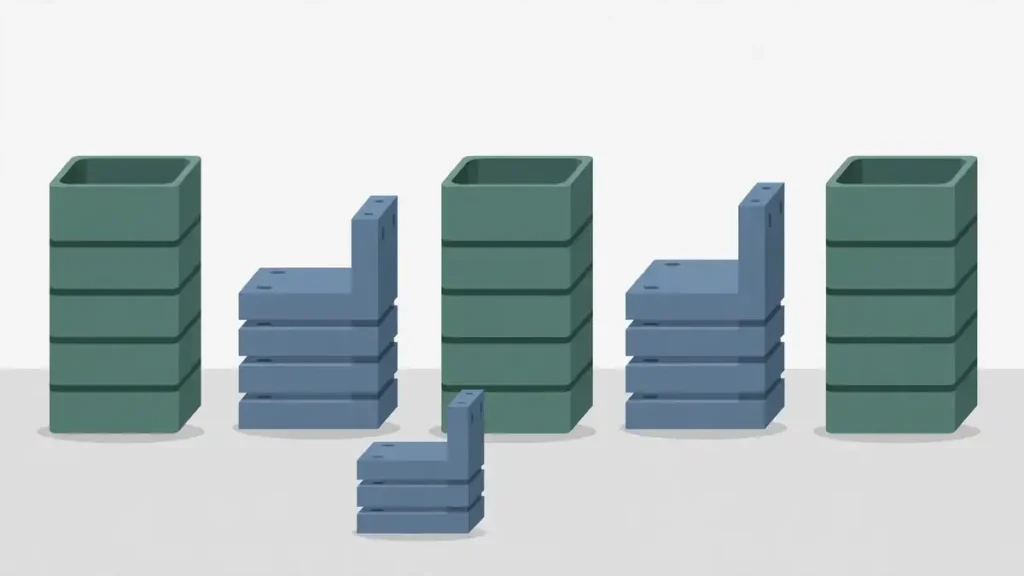
Give the supplier the whole quantity picture — first order, annual demand, batch size and repeat pattern — because each figure changes a different part of the quote: tooling, setup, material purchasing, scheduling and repeat-batch controls. A one-off order of 10,000 parts, an annual program of 10,000 parts in monthly batches, and a first batch of 10,000 parts inside a 100,000-part program are three different projects, even though the first number is the same.
Which Quantity Figures Belong in Your RFQ?
A supplier cannot price what it cannot see. At minimum, the RFQ should separate the quantity you need now from the quantity you expect over time. The table lists the twelve quantity items that shape a usable quotation — the first five belong in every RFQ.
| # | Quantity item | What to state | Why the supplier needs it |
|---|---|---|---|
| 1 | Part number and drawing revision | Exact part identity and revision | Quantities are meaningless if the revision changes mid-quote |
| 2 | First order quantity | Number of parts in the first release | Sets the first production run, setup and inspection scope |
| 3 | Estimated annual quantity | Parts per year, with the year defined | Drives tooling class, cavity strategy and material purchasing |
| 4 | Expected program lifetime and total quantity | Years in production and lifetime total | Determines whether tooling investment can be spread sensibly |
| 5 | Batch size and release pattern | Parts per batch and how often batches release | Sets setup frequency, scheduling and inventory |
| 6 | Repeat-order frequency | Monthly, quarterly, on-demand, or seasonal | Shows whether the process stays warm or restarts each time |
| 7 | Peak versus steady demand | Highest single-period demand and the normal rate | Tests whether capacity and tooling can cover the peak |
| 8 | Forecast confidence | Firm, likely, or indicative — and what could change it | Tells the supplier how much risk sits behind the numbers |
| 9 | Change tolerance | How much the quantity may move up or down | Defines the range the quoted price still covers |
| 10 | Inventory expectation | Who holds stock, and how much | Decides whether parts are made to order or made to stock |
| 11 | Shelf-life or ageing constraints | Any limit on how long parts or material may sit | Prevents overproduction of parts that degrade in storage |
| 12 | Pack quantity and delivery schedule | Parts per carton or pallet, and required delivery dates | Affects packaging, handling and freight planning |
If you only know some of these figures, say so — and mark which are firm and which are estimates. A supplier can work with an honest range, not with a single confident number that turns out to be wrong.
One-Off, Batch or Repeat: How Do the Economics Differ?
Quantity changes cost through three mechanisms, and confusing them is the most common reason a quote surprises a buyer. Fixed costs — tooling, DFM, trial work and launch — are paid once, so their cost per part falls as volume rises. Setup costs repeat with every batch: machine setup, material drying, first-part verification and changeover. Inventory costs grow when you produce ahead of demand: large batches lower setup cost per part but tie up cash and space, and risk holding parts a design change makes obsolete.
The table below shows how the same part can sit in three very different positions.
| Factor | One-off order | Batched annual program | Repeat-order program |
|---|---|---|---|
| Typical pattern | Single release, no repeat planned | Regular releases across the year | Ongoing releases over several years |
| Fixed tooling cost per part | Highest, spread over the fewest parts | Falls as annual volume grows | Lowest, spread over the program lifetime |
| Setup cost | Paid once | Paid per batch — batch size matters | Paid per batch, but predictable and plannable |
| Inventory risk | Low — make only what is needed | Moderate — balance setup against stock | Managed through agreed stock and release rules |
| Repeat consistency risk | Not applicable | Moderate — process restarts between batches | Highest — needs documented repeat controls |
| Best when | Trial, launch, or a short-lived product | Demand is steady and forecastable | The product is established and demand continues |
The practical point is that a bigger batch is not automatically cheaper: it is cheaper per part on setup, but can be more expensive overall once storage, cash and obsolescence are counted. The right batch size is a balance, and the RFQ is where that balance should be discussed — not discovered after the first delivery.
How Should You Read a Quote That Prices Several Quantities?
Many suppliers quote part prices at two or three quantity levels, for example 5,000, 25,000 and 100,000 parts. Those price breaks are useful only if you know what each includes — so before comparing them, ask four questions.
First, does the price at each level assume the same batch size? A price for 25,000 parts in one run is not comparable with 25,000 parts in five batches of 5,000 — the second carries five setups, and the quote should show that.
Second, is tooling in the part price, shown separately, or amortized over a stated volume — and what happens if the program stops early?
Third, what yield and inspection scope sit behind the price? A lower unit price built on an optimistic yield or lighter inspection is not the same offer as a higher price with agreed inspection and reporting. Get the assumptions in writing.
Fourth, how long is the price valid, and what moves it? A quote valid for thirty days is a different commitment from one that holds for a year. For a two-year program, ask whether repeat-batch pricing is fixed, reviewed per batch, or indexed to a stated material basis.
For a structured way to judge the answers you get back, see our guide to comparing injection mold quotes globally.
An Illustrative Example: The Same Part at Three Quantities
The numbers below are a hypothetical planning illustration, not a CKMOLD quotation or a market price benchmark. They use a simple cost model: total cost equals fixed tooling and launch cost plus quantity multiplied by recurring cost per accepted part, plus setup cost per batch.
Assumptions for this illustration only: fixed tooling and launch cost USD 22,000; recurring cost per accepted part USD 0.90 (USD 0.40 material, USD 0.35 molding and labor, USD 0.15 secondary work, inspection and packaging); setup cost USD 450 per batch; yield, inspection scope and packaging are the same in all three cases. Freight, duty, tax, inventory cost and financing are excluded.
| Scenario | Quantity | Batches | Calculation | Total | Cost per accepted part |
|---|---|---|---|---|---|
| One-off order | 5,000 | 1 | 22,000 + (5,000 × 0.90) + (1 × 450) | USD 26,950 | USD 5.39 |
| Annual program | 25,000 | 5 × 5,000 | 22,000 + (25,000 × 0.90) + (5 × 450) | USD 46,750 | USD 1.87 |
| Repeat program | 100,000 | 10 × 10,000 | 22,000 + (100,000 × 0.90) + (10 × 450) | USD 116,500 | USD 1.17 |
Three lessons follow. First, the one-off order carries the whole tooling cost on 5,000 parts, so its per-part cost is more than four times the repeat program’s — same part, mold and process. Second, the annual program’s five setups add USD 2,250 that a single 25,000-part run would not carry; the buyer should know that cost and decide consciously whether smaller batches are worth it. Third, the repeat program looks cheapest per part only if the 100,000-part forecast is real — if demand stops at 25,000, the buyer has paid for tooling sized for a program that never happened. Forecast confidence, not just forecast size, is what makes a low unit price credible.
Run the same calculation with your supplier’s quoted figures and your own batch plan, changing one input at a time. That sensitivity check is worth more than any single quoted price.
How Should You Split Annual Demand Into Batches?
Annual demand is a planning number; batches are what actually get made, inspected, packed and shipped. Splitting the year into batches means balancing five pressures.
Demand timing comes first. If your customer orders monthly, monthly batches match consumption and keep stock low. If demand is seasonal, larger pre-season batches may be unavoidable — state the seasonality so the supplier can plan press capacity around it.
Cash and storage come second. Every part made ahead of need is cash on a shelf, and for large or heavy parts warehousing alone can erase the setup saving of a bigger batch. State who holds the stock and for how long.
Design-change risk comes third. A product still being refined should not be produced in a year’s worth of batches at once; smaller early batches limit the parts a revision affects. If you expect a design change, say so and ask how the supplier handles revisions between batches.
Material purchasing comes fourth. Some resins and colorants are bought in minimum lot sizes or carry long lead times, so a batch plan that ignores the material lot size can force a rushed purchase or a delay.
Capacity and scheduling come fifth. A supplier schedules press time around confirmed batches, and even a provisional release calendar lets it reserve capacity and flag conflicts early. A surprise urgent batch costs more than a planned one.
Start with a first batch small enough to confirm the process and the market, then grow batch size as demand stabilizes — and write the split into the RFQ, so every bidder prices the same plan.
What Does a Repeat Order Need to Stay Identical?
The first batch proves the mold and process can make an acceptable part; the fifth proves the system can do it again. Repeat consistency is not automatic — it comes from controls agreed before production starts, not improvised at the second order.
The controls that matter most are the least dramatic: approved part and tool revision, exact resin grade and color, recorded process settings, inspection plan, and packaging instruction. At CKMOLD, our production injection molding route reconfirms revision, resin and color, quantity, schedule and any approved engineering change before each production run, and production follows the released samples and requirements rather than a single good first batch. Ask any supplier what it reconfirms before a repeat run.
Three items deserve a line in the RFQ. First, the approval reference: the sample, revision and inspection record repeat batches are judged against. Second, first-part verification: which dimensions and appearance checks run after setup before the full batch is released. Third, the change rule: no revision, material, color, process or supplier change without review and approval before the next run. Engineering changes are normal; uncontrolled changes are the problem.
Trial and approval evidence belongs in the same conversation. If your program needs first-article inspection, capability data, material certificates or a customer-specific report format, state it at RFQ stage, so the effort and samples are planned and priced then, not added after the mold is built. Our mold testing and validation page explains what evidence each trial stage produces.
Keep the same identification on every batch: cavity identity, batch or lot marking and a retained sample trace a problem to a specific run. That traceability costs little when set up at the start and a great deal when reconstructed after a complaint.
What If Demand Is Uncertain?
Most real forecasts are uncertain, and pretending otherwise helps nobody. If you are unsure about annual demand, say so in the RFQ — and give the supplier something it can price.
State the range, not just the midpoint: "annual demand 15,000 to 30,000, most likely 20,000" beats a single figure of 20,000 that nobody believes. Ask for prices at two or three quantity levels inside that range, with the batch size stated for each.
Ask what happens at the edges: if demand doubles, can the tool and schedule cope, or would a second cavity set or mold be needed? If demand halves, does the tooling still make sense? Our guide to how to determine the right number of injection mold cavities explains how annual volume interacts with cavity count and total cost: a tool built for a volume that never arrives is an expensive lesson; one built too small is a bottleneck.
Consider a staged commitment: a smaller first batch, with a defined path to larger repeats once the market confirms demand. Protolabs describes the same logic for short-run tooling — setup and tooling costs must be amortized across the order quantity, with the tipping point to production molding around 10,000 parts in its service model — see Protolabs’ short-run injection moulding guide. The Protolabs Network injection molding guide gives the same shape from the other side, recommending injection molding from around 500 units, with a pilot run of 500 to 10,000 parts before scaling to 100,000 or more. Treat those thresholds as reference points from other suppliers’ models, not as CKMOLD limits: CKMOLD does not publish one universal minimum order quantity, because resin, color, setup, cavity count, cycle, inspection and secondary operations change the economic batch size for each part. Share your initial and annual demand, and the project-specific recommendation comes from the RFQ review.
Finally, agree a review point: revisiting the forecast every quarter, with a defined way to adjust batch size and price, survives contact with reality far better than a program locked to a single annual figure agreed in January.
What Should You Send With the RFQ?
A quantity plan is only useful with the rest of the project. Send the STEP file and the 2D drawing with critical dimensions marked, the resin grade or required properties, the quantity table from this article, key tolerances, surface finish and color, the delivery region, and timing — first samples and first production delivery. If the part has mating components, say so — assembly fit is often where a quantity decision meets a quality decision.
Our project flow runs from defined requirements — CAD, drawings, resin, quantities, finish, critical dimensions, target date and destination — through engineering approval with DFM and a mold concept, then build, trial and correction, then release to production, where approved samples and process information transfer into production, inspection, packaging and repeat-order planning. An RFQ that already contains the quantity picture lets that flow start on the engineering questions.
Conclusion
Order quantity is not a single number on a form. It is a plan: how many parts first, how many per year, how many per batch, how often repeats come, and how confident the forecast is. Suppliers quote against that plan whether you write it down or not — a written plan gets comparable quotes, honest setup costs and repeat batches that match the first. State the figures, state the uncertainty, ask for prices at more than one quantity level — and read the quote by total program cost, not the lowest unit price on the page.
To put a quantity plan in front of our engineering team, complete the Request a Quote form with your first order, annual demand and batch pattern, and email your STEP file and 2D drawing separately to jerry@ckmold.com — a first response is normally sent within one business day. If your project is still at the discussion stage, the contact page is the right starting point.
Frequently Asked Questions
Can I start with a small first batch and scale up later?
Yes — for a new product it is often the sensible route. State the small first batch and the expected larger repeat pattern in the same RFQ, so the supplier can confirm whether the tooling and process support scaling.
Does a bigger batch always lower the unit cost?
Not always. A bigger batch spreads setup cost over more parts, lowering the unit price — but it also increases inventory cost, cash tied up in stock and the parts exposed to a design change. The lowest unit price and the lowest total program cost are different answers.
What happens if my forecast changes after tooling is built?
It depends on what was agreed. If the RFQ stated a range and a change tolerance, the supplier can usually adjust batch size and scheduling within that range. If the forecast was a single firm number and then changes sharply, tooling scope, cavity count or pricing may need review — which is why stating forecast confidence and a change tolerance matters more than getting the forecast exactly right.