
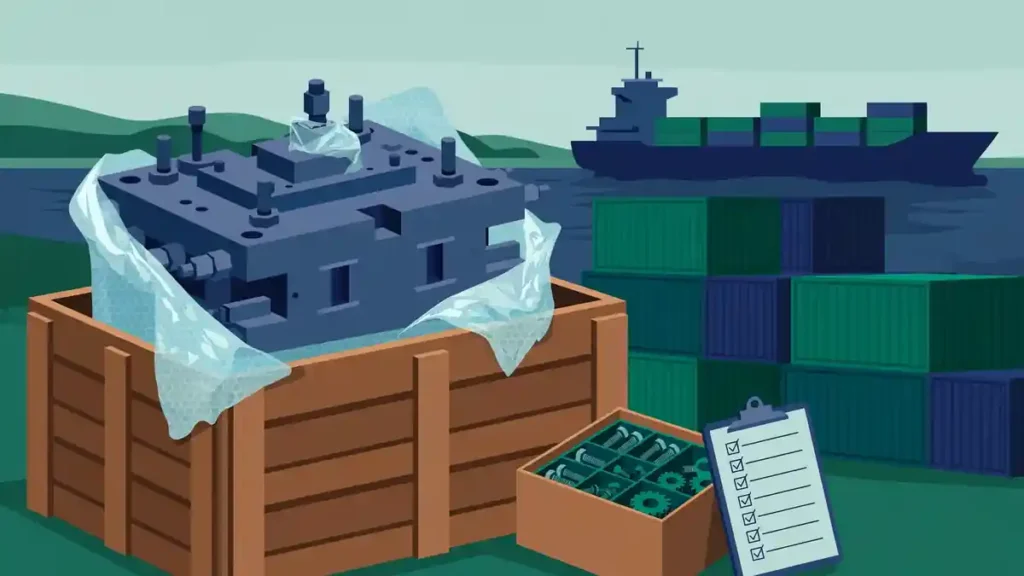
You are buying a mold in China to run in your own plant — in Mexico, the United States, Europe or elsewhere. The mold that works in the builder’s press can still fail in yours if the locating ring, ejector pattern, water connections or hot-runner controller do not match.
An export mold is ready to order when the RFQ defines your receiving machine, your component standards, your acceptance evidence and your handover documents — before the design starts. Everything discovered after T1 costs more and ships later.
An export mold is not simply a mold that happens to be shipped overseas. It is a transferable manufacturing asset: designed for a defined destination, validated against the receiving machine, and handed over with the files, spares and records your plant needs to run it. This guide walks through the four decisions that decide whether that transfer works — machine compatibility, component standards, acceptance and handover — with the checklists to put in your RFQ.
What Makes an Export Mold Different from a Production Mold?
When a supplier builds a mold for its own production, the mold only has to work on the supplier’s presses, with the supplier’s utilities, controllers and maintenance team. When the mold ships to your factory, every one of those assumptions has to be replaced with your plant’s reality — and replaced before the design is frozen, because a locating ring, a clamp pattern or a hot-runner connector cannot be changed cheaply once the steel is cut.
That is why the handover starts at RFQ. Our export injection mold program is built around this point: the tool is designed and validated against the receiving machine, utilities, component standards, documentation, ownership and acceptance plan the customer supplies. If tie-bar clearance, locating interface, ejection, hot-runner controls, water standards or release documents are discovered only after T1, changes become slower and more expensive.
Two consequences follow. First, the trial parameters from the builder’s press are a starting reference for your plant, not a recipe you can copy — your team must redevelop the process around its own machine, material handling and local conditions. Second, the mold’s value is not proven when it opens and closes; it is proven when it produces acceptable parts at the required rate, on your machine, with a process your team can repeat and maintain.
What Machine Information Must the RFQ Include?
The single most useful document in an export mold RFQ is the destination machine sheet: one page that describes the press the mold will run on. Without it, the builder designs against its own machines, and the differences surface at installation.
| Machine-sheet item | What to state | Why it matters |
|---|---|---|
| Mold envelope | Maximum mold size, thickness, daylight, platen and tie-bar clearances | A mold that does not fit cannot be installed |
| Locating ring and nozzle | Ring diameter, nozzle radius and orifice | The mold must seat and seal on your barrel |
| Clamp interface | Clamp slots or bolt pattern, support requirements | The mold must fasten to your platens |
| Ejection | Machine ejector pattern, available stroke, coupling, return requirements | Ejection must match the tool’s system |
| Water and hydraulics | Connection standard, port location, circuit identity, flow need | Cooling circuits must connect and flow |
| Electrical and hot runner | Voltage, connector type, zone count, thermocouples, controller compatibility | A hot runner needs the right controller to run |
| Robot and handling | Part and runner drop, gripper access, eject position, lifting limits | The cell must unload and handle the tool |
| Installation direction | How the mold enters the press and how it is lifted | Handling limits decide crate and rigging design |
Send the machine sheet with the RFQ, not after the design review. If your plant runs more than one candidate press, name the primary machine and state whether the mold must also fit a secondary one — designing for two presses is a different job from designing for one, and it should be priced as one.
If you do not have a machine sheet, ask your press manufacturer for the machine’s interface data, or ask the mold builder what format they need. A builder who starts design without it is guessing at your plant.
How Do I Specify Component Standards — DME, HASCO or My Own?
Mold components — the mold base, guide pins and bushings, locks, springs, hot-runner system, connectors and water hardware — are where export molds most often create a maintenance problem. A component your plant cannot buy locally becomes a spare-parts delay every time it wears out.
The rule is simple: name the standard in the RFQ. If your plant standardises on DME mold bases — the US standard DME created, with A-Series, B-Series, T-Series and other assemblies — say so, with the series and any mandatory models. If your plant uses HASCO or another European standard, name that instead. The builder should record brand and model in the bill of materials, check availability and lead time, and bring any deviation to you for approval before purchase — not after the parts are ordered.
If you have no fixed standard, ask the builder to propose components against mold function, expected service life, the support available near your plant, maintenance and price — and keep the proposal subject to your approval. Two questions decide whether the proposal is sound: can your maintenance team buy the wear parts locally, and are the critical spares identified in the quotation rather than discovered at the first breakdown? Equivalent substitutions need a controlled review, because a "similar" guide pin with a different tolerance or hardness is not the same part.
What Should the Acceptance Plan Cover?
Acceptance is where export mold projects most often go wrong, because the buyer and the builder mean different things by "approved." Write the acceptance plan into the RFQ as a sequence of stages, each with an objective and a piece of evidence — so approval is a recorded decision, not a feeling.
| Stage | Objective | Evidence that closes it |
|---|---|---|
| Approve design basis | Release machine sheet, part revision, resin, component standards, mold life, documents and acceptance criteria | Signed design-basis record |
| T0 technical trial | Check safe mold operation, fill, actions, ejection, water and electrical function, major steel issues | Trial notes and correction list |
| T1 sample review | Evaluate corrected samples by cavity against appearance, dimensions, assembly and function | Cavity-labelled samples and dimensional report |
| Final release trial | Confirm agreed corrections, process record, sample quantity, documents, spares and mold condition | Release record signed by the buyer |
| Pack and transfer | Apply preservation, nameplate, labels, tool protection and crate for the approved route | Photographs of released condition and crate |
The trial stages are decision stages, not guarantees. Our mold testing and validation process explains how T0, T1 and later trials each answer different questions, and why repeating the same test without a written decision does not move the project forward. For an export mold, the final release trial has one extra job: reconfirming the destination machine and utility interfaces, the hot-runner and controller details, and the handling arrangements before the tool leaves China.
One practical point: agree the sample plan before the trial, not after the parts are made. Quantity, cavity separation, conditioning time, retention samples and shipping method should be written down while they can still be changed. Samples mixed across cavities, or shipped before they are labelled, lose the traceability that makes a dimensional report meaningful.
What Does Mold Life Mean in an Export Quote?
"Mold life" on a quotation is often a bare number, and a bare number is not a specification. The widely used shorthand is the SPI mold classification from the Society of the Plastics Industry — now the Plastics Industry Association — which rates molds by expected life and construction. The cycle figures are published planning figures, not a guarantee: mold life cannot be guaranteed because part design, resin and molding conditions vary, and the classes count cycles, not parts — a four-cavity mold makes four parts per cycle.
| SPI class | Published planning life | Typical use |
|---|---|---|
| Class 101 | 1,000,000+ cycles | Very high-volume production, hardened steel throughout |
| Class 102 | Up to 1,000,000 cycles | Medium-to-high volume, abrasive resins, tight tolerances |
| Class 103 | Under 500,000 cycles | General production programs, the common starting point |
| Class 104 | Up to 100,000 cycles | Low-volume production, non-abrasive resins |
| Class 105 | Up to 500 cycles | Prototype tooling only |
The classification is explained in detail in Boyd Corporation’s classification of plastic injection molds, a US manufacturer’s summary of the SPI system. Use the class as a way to compare quotations like with like: two builders quoting different classes are quoting different tools, and the cheaper one may simply be the shorter-lived one.
In your RFQ, do not write only "long mold life." State the expected annual volume and program length, ask which SPI class is quoted, and ask what steel and hardness that class implies for the cavities, cores and mold base. Record the agreed service-life definition, operating conditions and exclusions in the purchase order — a definition written after the mold is built is a disagreement waiting to happen.
What Documents and Spares Should Arrive With the Mold?
A mold without its documents is a liability your plant inherits. Build the release package while the tool is being built, and list it in the RFQ so nothing is assembled in a hurry at the end.
| Handover item | What to require |
|---|---|
| Design files | Released 3D mold assembly and scoped 2D drawings in agreed formats, with part and tool revision identity |
| BOM and components | Purchased-component list, approved suppliers and models, agreed spare items for wear or failure risk |
| Material records | Mold steel or material certificates where included, tied to the quoted tool materials |
| Trial parameters | Press, resin, drying and key setup information from the approved trial — as a starting reference, not a universal recipe |
| Sample and dimensional reports | Cavity-identified samples and reports for the dimensions, appearance or tests in the acceptance plan |
| Ownership and nameplate | Customer ownership, mold number, part number and revision, weight and handling information |
| Spares | Wear and failure-risk items agreed in the quotation, packed and inventoried |
| Preservation and packing | Water circuits drained and protected, rust prevention applied, slides and loose items secured, parting surfaces protected, released condition photographed |
Before packing, the tool should be cleaned, protected and photographed in its released condition, with the crate, lifting points and centre of gravity matched to the approved air or sea route. Export-appropriate wood packaging and the required marks are part of the job, not an afterthought — and the documents and spares should be inventoried in the crate, not loose in a separate parcel that can travel on a different flight.
What About Shipping, Incoterms and After-Sales Support?
The commercial terms decide who pays for freight and insurance, and where the risk of loss or damage passes from seller to buyer. Name an Incoterms 2020 rule and a named place in the contract — for example FCA Shenzhen or DAP your plant — and check what it actually allocates before you sign. The International Chamber of Commerce publishes the Incoterms 2020 rules, the current edition of the eleven three-letter trade terms, in force since 1 January 2020. A term without a named place is incomplete, and a term chosen for a low freight quote can leave you paying for insurance or destination handling you did not expect.
After-sales responsibility should be agreed in the same way. Installation questions, trial feedback, documentation and correction needs can be reviewed using agreed files, photographs, measurements and process information. On-site support or a major service visit is a separate scope and should be quoted separately when it is required — not assumed. The cleanest arrangement is a written follow-up path: who to contact, what evidence to send, and what response the builder commits to. Our guide to typical payment structures for a new mold project explains why milestone payments should follow verifiable deliverables, including design approval and sample acceptance — the same principle applies to the final holdback on an export mold, released only when the agreed trial or release conditions are met.
What to Send to Start an Export Mold RFQ
An export mold RFQ that gets a comparable, buildable quotation contains the part files and the destination together: the STEP file and 2D drawing at a stated revision, the resin and the expected annual volume, the destination machine sheet, the component standard your plant uses, the SPI class or service life you need, the hot-runner controller details, the sample and report list you will accept against, the spares you need packed with the tool, the target release date and the shipping destination. Send it through a request for quotation and email the part files and machine sheet separately to jerry@ckmold.com.
The mold that arrives ready to run is the one whose destination was defined before the design started. Put the machine, the standard, the acceptance evidence and the handover list in the RFQ — and the tool that lands in your plant will be the tool you ordered.
FAQ
Can I run the mold on a different press from the one used in the builder’s trial?
Only after redeveloping the process. Trial parameters from the builder’s press are a starting reference: clamp, shot, temperatures and cycle settings must be re-established on your machine, with your material handling and utilities. Budget time for that setup; it is part of the transfer, not a failure of it.
Who owns the mold?
Ownership should be stated in the purchase order and on the mold nameplate. CKMOLD retains the approved tool for trials and production unless the commercial agreement says otherwise — so if the tool is yours and it ships to your plant, say so in writing before the build starts.
What if my plant uses a different hot-runner controller from the builder’s trial controller?
Confirm controller compatibility before the build, not at installation: manifold and nozzle models, heater and thermocouple zones, voltage, connector type and wiring standard. If the trial controller differs from your production controller, that difference must be visible in the acceptance plan rather than discovered after the mold arrives.