When you are looking for a custom injection mold, one of the initial things that you will need to work out is how to pay for the mold. Selecting a mold project is not an off-the-shelf option. These contracts require custom tooling, an iterative engineering process, and milestone payments, unlike a typical PO for ready-to-ship products. Understanding how these payments are structured, what each includes, and where you can negotiate will help you budget more accurately and avoid surprises.
This guide explains the contract terms that benefit both parties, tooling payments, and production order payments. When ordering from a local supplier or from an overseas supplier such as CKMold, the same principle holds: make all payments contingent on a deliverable that can be checked.
Why mold projects use milestone-based payments
Injection molds are made-to-order assets, so the supplier commits engineering, material and machining capacity before the first accepted sample. Lead time and price depend on part geometry, steel, cavities, actions, runner system, validation and capacity; fixed market bands are not reliable enough to set payment terms. That early commitment is why a deposit is often negotiated.
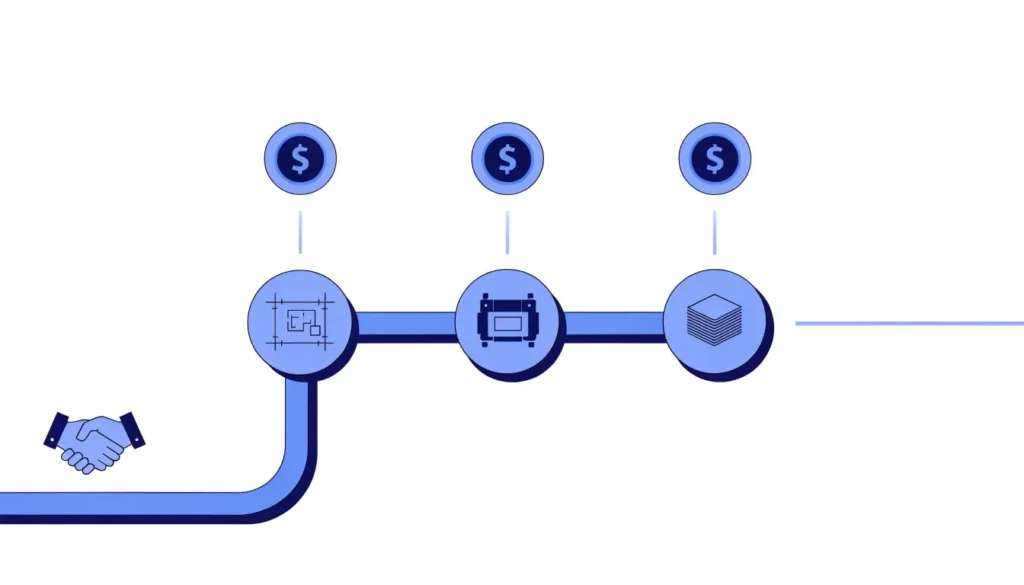
The buyer, on the other hand, must verify the mold is to specification before paying the full amount. Milestone-based structures divide the overall cost across verifiable milestones, such as design approval, first sample approval, and final acceptance. Contractual leverage is maintained at every decision point, and the buyer’s cash flow is protected. Variations of this approach are used by mold makers in China, the U.S., Europe, and Southeast Asia.
Common payment structures for mold tooling
The structures below are examples, not universal standards. The actual percentages and milestones depend on the project and on what both parties agree in the contract.
Two-milestone structure (a common example)
The simplest way to split the mold cost is a 2-payment structure:
50% deposit upon confirmation of the purchase order. This gives the supplier the capital to design the mold, order the mold steel and start mold production. The deposit becomes payable after both parties confirm the purchase order, project scope, and agreed payment terms. The PO should include the following details: mold design, steel grade, cavity count, expected cycle time, agreed service-life definition, operating conditions and exclusions, and the timeline for delivering the mold. Cancellation and refund conditions should be discussed and documented separately.
50% is due as a balance once the T1 sample is approved. The other 50% is paid once the supplier has manufactured first-article samples (also known as T1 samples), which are then submitted to the buyer for approval and acceptance against the agreed dimensional and functional specifications. The 50/50 split is a widely used arrangement, including among mold manufacturers in China, but it is one option rather than a fixed rule.
Three-milestone structure (an example for more complex projects)
A 3-milestone structure can provide an extra level of control for projects with complex engineering or a higher tooling value.
For example, a 40% deposit is due upon confirmation of the PO. 30% is due upon design approval, which occurs when the buyer approves the final mold design (parting line, gate, ejection, and cooling channels). This is a formal project stage at CKMold, with annotated design documents submitted before steel cutting. The final 30% is due after the T1 samples pass inspection and are approved.
More installments do not automatically reduce buyer risk. In this example, 40% upfront plus 30% at design approval means 70% of the tooling price may be paid before machining starts. What protects the buyer is linking each payment to evidence that can be checked.
Some buyers will negotiate 30/30/40 or 40/40/20, where the last number is the amount they will hold back until parts are validated for production. The principle is the same: one payment, one clearly defined deliverable.
What triggers each payment milestone?
A good mold purchase order clearly defines what evidence is required before each payment release:
Deposit release: A PO confirmed by both parties, with the agreed project scope, specifications, mold steel grade, cavity count, agreed service-life definition and conditions, delivery schedule, and payment terms.
Design approval payment: Paid after the buyer signs off the 3D mold design review (gate type and position, cooling channel design, ejector pin design, any side actions or lifters).
T1 sample approval payment: Approval is based on the evidence agreed for the project, such as a dimensional inspection report, material certification, surface finish verification, and functional testing, with written buyer approval. Measurement methods should suit the feature and tolerance; CMM inspection is useful for critical or complex dimensions but is not mandatory for every feature or every project. T1 approval does not automatically mean the mold is approved for production. In automotive projects, a PPAP submission may be required, but its level and content depend on the customer’s requirements and the project scope.
Final acceptance (when applicable): The holdback is released once the agreed trial or pilot run shows that cycle times, dimensional stability, and reject rates meet the agreed criteria. Trial duration, quantities, production conditions, and acceptance criteria should be agreed for each project rather than taken from a fixed shot count. CKMOLD’s mold testing and validation process explains how T0, T1, and correction trials are planned, recorded, and released.
Export molds vs. molds retained for production: For a mold that will be shipped to the buyer or another molder, acceptance usually needs to be completed before shipment, including trial samples, measurement reports, process records, spare parts, documentation, and tool condition, because corrections are harder once the mold has left the toolroom. For a mold that stays with the supplier for ongoing production, acceptance can be linked to production trials or a pilot run under actual production conditions, with maintenance responsibilities defined for the production period.
Example payment-milestone table (percentages and triggers are set in each contract):
| Milestone | Percentage | Payment trigger | Required evidence | Cumulative paid |
|---|---|---|---|---|
| Deposit | 40% | Both parties confirm PO, project scope, and payment terms | Confirmed PO with specifications and delivery schedule | 40% |
| Design approval | 30% | Buyer signs off final mold design | Annotated 3D mold design and DFM review | 70% |
| T1 sample approval | 20% | T1 samples meet agreed criteria | Dimensional report, material certs, functional test results, written approval | 90% |
| Final acceptance | 10% | Agreed trial or pilot run completed | Trial records and release decision against agreed criteria | 100% |
Payment terms for production orders
Payments for production orders are not tooling payments. A common arrangement for overseas orders is a 30% deposit and a 70% balance before shipment. In this 30/70 example, the buyer pays 30% when placing the production PO, and the 70% balance is due after production and the agreed pre-shipment checks are completed, before the goods are dispatched.
Net 30/60 after shipment is an option for known clients with a good history.
For high-value or first-time transactions, letters of credit (L/C) can provide payment security for both parties.
Question that is repeatedly asked: Are any production parts included in the cost of the tooling? Typically, no, since tooling and production pricing and payment are separate. Production quantities are also different from trial samples: T0 and T1 samples are made to check the mold, not to fill an order. The quotation should specify how many trial samples are included, what testing is included, and who pays for sample shipping. Some suppliers will even offer amortized tooling (mold) costs, tying the price of the mold into the per-part cost for a minimum order volume. This reduces initial capital investment, increases the cost of the individual part, and can leave tool ownership unclear. If you are thinking about transferring the mold to another supplier later, it’s usually better to pay for the tooling separately and own the mold than to have its cost amortized into the part price.
Tooling ownership and transfer clauses
Who owns the mold, and the conditions for moving it, depend on how you pay for it. If the buyer pays for the mold in full, the mold should normally become the buyer’s property. This should be documented in the purchase order, including:
- when ownership transfers and which payment conditions must be met first;
- who is responsible for maintenance and repairs while the mold stays with the supplier;
- the condition the mold must be in at handover (for example, production-ready and supported by agreed trial results);
- the documentation to be handed over, such as mold drawings, steel certificates, and maintenance records;
- who pays for crating, shipping, and any other transfer costs.
If a supplier is reluctant to accept clear ownership language, ask why and agree the terms in writing before the deposit is sent. Unclear ownership terms create risk for both parties, even when neither side intends a dispute.
CKMold coordinates tooling, trials, and production support, which helps keep ownership records, maintenance history, and transfer documentation consistent. The buyer has one point of contact for warranty claims, maintenance, and tool modifications.
When the per-part price includes the cost of the tooling, the supplier will usually keep ownership of the tool until the volume commitment is fulfilled. Be sure to include in the contract what happens if the volume commitment is not met or the relationship ends early.
How mold scope changes the milestone structure
Do not infer a payment structure from a tooling price band. Instead, increase the number of evidence-based milestones when the tool has more cavities, actions, hot-runner content, qualification work or export deliverables.
Illustrative negotiation examples—not market norms: a short prototype tool may use a deposit and an acceptance balance; a complex production tool may add mold-design approval, machining, T1 evidence and pilot-run acceptance milestones. Percentages should reflect the supplier’s committed cost, the buyer’s verification points and the remedies in the agreement.
For a complex flow or cooling risk, a mold-flow study can help assess fill balance, weld-line placement and cooling before steel is cut. Simulation does not guarantee the molded result or replace physical trials. Use the injection mold cost estimator for a preliminary tooling budget, then request a formal engineering review and quotation for the defined project.
International payment considerations
For an export tool, state the invoice currency and the named-place Incoterms® 2020 rule. FOB is for sea or inland-waterway delivery on board the nominated vessel; FCA is often considered where a container is handed to a carrier before loading. An Incoterms rule allocates delivery, cost and risk responsibilities, but it does not define tool quality, payment acceptance or delivery-date remedies.
Wire transfer (T/T) is the norm for payment using the international banking system. Bank fees apply to each transfer, so a project with 3-4 milestones will involve more transfer charges than a single payment. Confirm the sending, intermediary, and receiving bank fees with your bank before agreeing on the number of installments.
Documentary credits that expressly incorporate UCP 600 are examined on the presented documents. They do not establish that a mold meets dimensional, cycle or quality requirements, so the commercial contract must define acceptance evidence separately.
Red flags within payment terms
100% prepayment required for a large mold. Full prepayment on a high-value mold leaves the buyer with little leverage if the mold does not meet specifications. Whether it is acceptable depends on the project, the amount, and the protection in the agreement.
There are no specific acceptance criteria for T1 samples. When the PO isn’t specific about what is acceptable (dimensional tolerances, surface finish, or material cert), the approval milestone becomes subjective, and disputes are likely. Have this in writing before the project starts.
Unclear tooling ownership terms. If a supplier will not confirm the buyer’s tooling ownership in writing, clarify the reason and agree on ownership timing, payment conditions, and transfer terms before any deposit is paid.
Payments based on dates instead of deliverables. If it’s written as "30% due 4 weeks after deposit," the buyer has no way to withhold payment if the deliverable doesn’t meet expectations.
No corrective-action cost provision. If T1 samples fail spec, who pays for rework, new steel, additional trials, or new batches of resin? The PO should distinguish supplier nonconformance against approved requirements from customer-requested design, material, or specification changes. This should be settled in the PO, not negotiated once the problem appears.
Frequently asked questions
What is the most common percentage of the injection mold’s value for a deposit?
There is no universal deposit percentage. A 50% deposit is one possible arrangement, while larger or more complex projects may use a smaller deposit and more milestones. Negotiate against committed supplier cost, verification points, project risk and the remedies in the contract.
Can I negotiate payment terms with a mold maker?
Yes. The most negotiable aspects are the deposit percentage, number of milestones, holdback amount after T1 samples and credit terms for production orders. Suppliers are more willing to be flexible when the buyer offers something in return: an earlier design freeze, a faster approval process, or a multi-year volume order.
Should I pay for the mold upfront or have it amortized into the part cost?
Separate tooling payment can make ownership and part pricing easier to document, while amortized tooling can reduce initial cash outlay but ties recovery and ownership to volume or termination terms. Neither model guarantees ownership or transfer rights; write the title-transfer, shortfall and early-termination rules into the agreement.
If the mold is not on-spec after I have made the deposit, what happens?
It depends on the cause. If the mold does not meet the approved requirements because of a supplier nonconformance, the supplier is normally responsible for the corrective actions (mold modification, further trials, re-machining). Customer-requested design, material, or specification changes are usually charged to the buyer. Where the cause is unclear, it should be investigated before costs are allocated. The remaining payment is leverage; it stays in your account until you receive samples that meet the agreed criteria.
If the mold still does not meet specifications after repeated trials, options such as a partial refund or a mold rebuild should follow the terms agreed in the PO rather than applying automatically after a set number of trials.
How can I confirm a milestone is complete before making a payment?
Acceptance criteria for each milestone should be written in the PO. The buyer reviews and approves the annotated 3D mold design. For T1 samples, the buyer checks the agreed evidence, such as dimensional reports using appropriate measurement methods, material certs, and functional test results. Process capability (Cpk) data from a pilot run may be needed for critical dimensions before the mold is released for production.
Conclusion
Payment terms should mirror the actual engineering and acceptance sequence. A deposit can release design and material purchasing; later payments can follow approved mold design, documented trial evidence, agreed corrections and final acceptance or shipment.
Prefer verifiable deliverables over calendar dates, while recognizing that the negotiated contract controls payment rights and remedies. Define acceptance criteria, ownership timing, corrective responsibility and evidence for each milestone before the deposit. This reduces—not eliminates—budget and leverage risk from quotation through production.