
TPE, TPU and silicone are material families, not safety ratings. For a consumer product, compare exact grades under the same skin/food contact, temperature, chemical, mechanical and market requirements. Safety documentation and functional durability must both be verified.
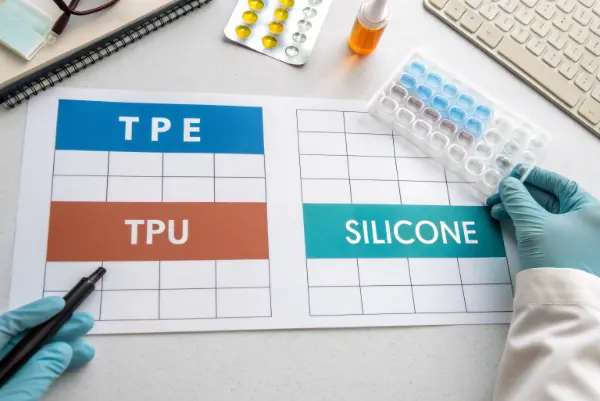
First separate chemistry from product claims
TPE is an umbrella term that includes several thermoplastic elastomer families. TPU is one specific thermoplastic polyurethane family and can vary by polyol chemistry, hardness and additives. Silicone elastomer is a different crosslinked system. A claim for one grade cannot be generalized to the entire family.
Engineering comparison for consumer products
| Decision factor | General-purpose TPE | TPU | Silicone |
|---|---|---|---|
| Typical strengths | Broad hardness range, colorability, overmolding and process efficiency | Abrasion, tear and load-bearing performance in suitable grades | Broad temperature capability and elastic recovery in suitable grades |
| Common concerns | Compression set, oil migration, tack and grade-specific chemical resistance | Moisture during processing, hydrolysis for some grades, yellowing and cost | Cure/post-cure control, longer cycle, flash and more difficult thermoplastic recycling |
| Hard/soft integration | Many substrate-specific overmold grades | Specialty grades can bond to selected substrates | Often needs primer, compatible substrate or mechanical retention |
| Surface feel | Can range from dry to tacky | Often higher abrasion resistance and a more technical feel | Stable rubber-like feel; dust pickup varies with finish/formulation |
| End of life | Thermoplastic, but mixed-material articles may not fit local streams | Thermoplastic; mechanical or chemical routes depend on grade and infrastructure | Cured network does not remelt in ordinary thermoplastic recycling |
The table supports candidate screening only. It does not establish compliance, service life or superiority.
Define “safe” for the actual product
- Contact: intact skin, mouth, food, children’s use or no direct human contact
- Exposure: sweat, sunscreen, detergent, oil, alcohol, heat, UV and wear
- Hazards: detachable small parts, tearing, sharp insert exposure, leakage or loss of insulation
- Market: applicable chemical restrictions, food-contact rules or children’s-product requirements
- Lifetime: single use, occasional cleaning or repeated multiyear service
Terms such as latex-free, BPA-free or phthalate-free should be supported by a current declaration for the exact grade and formulation. They are not substitutes for a complete restricted-substance and product-safety review.
Verification plan
- Write a common requirement set before asking suppliers for materials.
- Shortlist exact grades and document manufacturer, color and additives.
- Compare regulatory declarations with their stated use conditions and exclusions.
- Prototype the production geometry and, where relevant, the final substrate interface.
- Condition parts using the expected heat, chemicals, UV, sweat and mechanical cycles.
- Repeat functional, appearance, bond and dimensional tests after conditioning.
- Freeze the approved material and require written approval for substitutions.
Choosing among the three
Consider a substrate-specific TPE when overmolding efficiency, color, moderate service conditions and a broad hardness range dominate. Consider TPU when abrasion, tear, flex or load-bearing performance is central and the grade’s moisture/hydrolysis behavior is acceptable. Consider silicone when the validated temperature, compression or biocompatibility requirements justify its tooling and curing process. A hybrid design can be valid, but every interface adds validation and end-of-life complexity.
Information needed for a molding review
Provide the function, target hardness and thickness, rigid substrate, chemical/thermal exposure, required declarations, annual volume and acceptance tests. CKMOLD can compare molding and tooling implications through material selection support, DFM analysis and overmolding services. Submit the specification and CAD through request a quote.