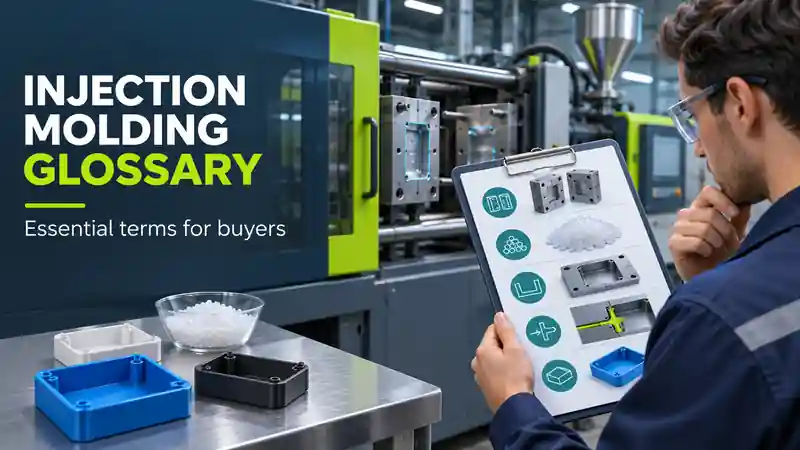
Quotes from a mold maker can be as foreign as another language: T1 samples, SPI B-2, hot runner, Class 101, PPAP. Each of these has an impact on the price, timing, and ownership of the tool, and it would be helpful to know them beforehand before signing anything.
This glossary is written for buyers. It includes all of the following terms you will encounter in quotes and DFM reports: Tooling, Design, Process; plus sampling, quality, and commercial terms which will determine the smoothness of the project. The entries explain the definitions and significance of the terms to you.
Quick Reference: Terms Buyers Hear Most
| Term | What it means | Why it matters to you |
|---|---|---|
| Mold (tool) | The steel or aluminum tool that shapes the part | Usually the highest upfront cost |
| Cavity | The hollow in the mold that forms the part | More cavities mean more parts per cycle and a higher mold price |
| DFM | Design for manufacturability review | Finds costly problems before steel is cut |
| T1 sample | First parts sent to you from the new mold | Your first real check of fit, look and dimensions |
| SPI finish | Standard grades for mold surface polish | Sets part appearance and adds tooling cost |
| Mold class | SPI class for an intended production range | Matches mold build quality to your volume |
| Cycle time | Time to make one shot | A main driver of part price |
| MOQ | Minimum order quantity | Sets how small each production run can be |
| Tooling ownership | Who owns the mold | Decides whether you can move production later |
| ECN | Engineering change notice | Formal record of a design change, often with a cost |
Mold and Tooling Terms
Mold (tool). The tool used to form the plastic. The terms "mold," "tool," and "tooling" are synonymous in most quotes. A mold is fabricated from tool steel or aluminum, and contains cavities, cooling channels and an ejection system.
Cavity and core. Typically, the cavity is the visible, cosmetic portion of the part, while the core is the inner portion of the part. Plastic comes to fill in the gap between them.
A-side and B-side. The two parts of the mold. A-side is the stationary half on the injection side and the B-side is the movable half that typically contains the ejector system. Cosmetic faces tend to be on the A-side.
Multi-cavity molds, family molds. One-cavity mold is used to make one part per cycle and multi-cavity mold is used to make several copies of the same part. Different parts, like the top and bottom of a housing are produced in a single shot with a family mold.
Parting line. The normal seam where the two mold halves meet. It may leave a visible witness line on the part, so agree on the parting-line location and cosmetic acceptance before mold approval.
Sprue, Runner and Gate. The route the melt will follow into the part. The sprue moves the plastic from the machine nozzle into the mold, the runners distribute the plastic across the cavities and the gate is the small opening leading into the part. The location of the gate influences the quality of the appearance, weld lines, and packing out of the part.
Hot vs cold runner. A cold runner cools with each shot and is discarded as scrap or regrind. A hot runner keeps the plastic in heated channels, reducing waste and potentially lowering cycle times, but increasing the costs of the mold.
Ejector pins. Pins that force the finished product off the core. They may leave behind small round marks, so make sure you agree on where these marks should be. Keep them off cosmetic faces where feasible, since placement depends on the part and ejection requirements.
Slides and lifters. Moving mold parts that form undercuts. The slides move horizontally on opening of the mold and the lifters move at an angle when the part is ejected. All of them contribute to the expense and upkeep.
Mold steel. P20, H13 and S136 are common grades. Mold life, quality of polish, corrosion resistance and cost of the mold are influenced by the grade.
Prototype, bridge and production tooling. Early parts are commonly produced in a prototype mold, usually made of aluminum, which is cheaper and faster than a production mold. A bridge mold is used to bridge the gap between the building of the production mold and the demand. A production mold may be made of aluminum or steel, selected according to the required volume and tool life.
Mold life. The number of cycles before the mold needs major repair. It depends on the quality of steel, plastic (glass-filled grades will wear molds faster) and maintenance.
Part Design Terms
Draft angle. Very slight taper on walls to ensure that the part can be removed without dragging. Textured surfaces require more draft than polished surfaces.
The thickness of the wall (nominal wall). The thickness of the main body of the part. Consistent walls help reduce the risk of sink and warpage, but they do not prevent every defect or void.
Ribs and bosses. Ribs are thin walls that make the part stiffer without adding thickness to it. Bosses are cylindrical protrusions designed for inserting screws or inserts. As a starting point, rib and boss walls are commonly designed at about 40 to 60% of the adjacent wall to reduce sink marks, but the right ratio depends on the material, geometry, mold design and strength requirements.
Undercut. Any feature which prevents the part from being ejected straight from the mold, e.g. a side hole, clip or internal thread. Undercuts require slides or lifters or collapsible cores, so eliminating them will reduce mold costs.
Radius (fillet). A rounded corner. Most molded designs incorporate radii because of the stress concentration and flow limitation at sharp inside corners.
Tolerance. The allowed variation from a nominal dimension. More time and attention to mold building and process control is required to maintain tight tolerances which results in higher costs; use them only where needed.
Shrinkage. When plastic cools it shrinks, and shrinkage varies with the resin, part geometry and molding conditions. Mold dimensions are compensated for the selected resin’s shrinkage.
Insert molding, over molding. When a part, like a threaded brass insert, is inserted into a mold, insert molding is used to form plastic around the part. Overmolding is adding a second material to a molded part, for example, a soft grip on a hard handle. CKMold offers insert molding and overmolding.
Process and Production Terms
Shot. Injection of plastic into the mold, once. This can be one or several parts that are shot.
Cycle time. Time for one shot: Inject + Pack & Hold + Cooling + Mold Open & Eject. Cooling can be long and since press time is charged by the hour, cycle time is a major contributor to part cost.
Clamp tonnage. Clamp tonnage is the force needed to keep the mold closed against melt pressure. It is estimated from the total projected area of the cavities and runner system and the expected cavity pressure. Press selection also depends on shot capacity and mold dimensions. CKMold has in-house presses up to 1200T.
Pack and hold. It is noted that the machine maintains pressure on the molten plastic as it is shrinking to force more plastic into the mold. Too little results in sink marks and too small features.
Resin. Raw plastic in the form of pellets. Give the proper grade (not simply "ABS" or "nylon") because there are many different grades.
Regrind. Runners and rejected parts comminuted and combined with new material. It is cost-saving but some applications do not allow it, or limit it, so specify your rule in the RFQ.
Masterbatch. Concentrated colored pellets blended with natural resin. Usually less expensive than purchasing pre-colored compound.
Mold flow analysis. Simulation which predicts plastic flow in the mold, the location of weld lines, the location of air traps, and the possible warping of the part.
Secondary operations. Any work performed after molding such as ultrasonic welding, pad printing or assembly. Secondary operations and assembly are handled by CKMold.
Defect Terms
Flash. Excess plastic that can form along the parting line or around pins. It is a defect, not a normal parting-line mark. It is frequently a sign of mold wear, insufficient shut-off or excess pressure.
Short shot. A part that is not completely filled.
Sink marks. Dents on the surface over thick sections due to core shrinking when skin has set.
Warpage. Bending or twisting after molding, caused by varying shrinkages in different areas. It is often caused by unequal cooling.
Weld line (knit line). A visible line where two flow fronts meet. It can also be a weak spot.
Burn marks. Dark marks from trapped air which overheats as the melt compresses it. They can typically be resolved by making adjustments with the venting and/or slower injection.
Flow lines. Wavy lines or rings on the surface, usually around the gate, due to a change in the flow rate and/or the temperature of the melt.
Voids. Bubbles in thick sections. They could be present but not visible to the naked eye; they impair the strength of the part.
Sampling, Quality and Approval Terms
T0, T1 and T2 samples. The "T" is for trial. The "T1" refers to the first sample(s) sent to the customer from the new mold, and the subsequent sample(s) are called T2 and T3 trials, which are conducted after corrections of the mold. In addition, there is an internal T0 trial for some molders. Labels can vary by supplier, so define each trial’s purpose, material and color, sample quantity, cavity coverage, reports and acceptance criteria in the quote or purchase order.
FAI (first article inspection). Inspection of initial parts against the drawing, recorded in a report. Specify the inspection scope; a full dimensional check means every drawing characteristic is measured.
Golden sample. An approved part that has been retained as a reference for future lots, especially for color and appearance.
PPAP. A document package from the automotive industry that demonstrates that a process can consistently produce good parts is called Production Part Approval Process. Non-automotive customers may request a PPAP-like package, but its contents are customer-defined. See AIAG PPAP-4.
Cpk. A measure of how well a process remains within the tolerances. The higher the Cpk the greater the margin, and many customers have a minimum requirement for critical dimensions. Cpk is meaningful only for a stable, defined process.
SPI surface finish. A conventional set of grades of mold polish. Grade A is diamond-buffed and shiny; Grade B is paper-polished; Grade C is stone-polished and Grade D is blasted to provide a matte finish. Each has three levels, written as a full grade code such as SPI B-2. The higher the polish, the higher the cost, and harder steel may be needed. Other texture standards are VDI, Mold-Tech, etc. SPI describes the mold finish; the final part appearance can also vary with resin, color, geometry and molding conditions, so approve a physical sample for cosmetic requirements. See the PLASTICS AR-106 mold finish guide.
SPI mold class. A number between 101 and 105 that describes mold construction for an intended production range. It does not guarantee actual mold life. See PLASTICS AR-101 mold classifications.
| SPI class | Approximate cycle guidance | Typical use |
|---|---|---|
| 101 | 1,000,000 or more cycles | Very high volume production |
| 102 | Not exceeding 1,000,000 cycles | Medium to high volume |
| 103 | Under 500,000 cycles | Medium volume |
| 104 | Under 100,000 cycles | Low volume, non-abrasive materials |
| 105 | Not exceeding 500 cycles | Prototypes |
These classes are a guide only. Actual mold life depends on the part, resin, molding conditions and maintenance, so define the guaranteed shot count and maintenance terms in the contract. The mold testing and validation and quality assurance of CKMold are described.
Commercial and Contract Terms
Request for a quotation (RFQ). A quality RFQ should contain a 3D CAD model, a 2D drawing that has critical tolerances, material grade, color, finish and annual volume.
Tooling cost vs piece price. The tooling costs are one time and piece price is charged per part. Calculate total cost over the life of the product. The injection mold cost calculator provided by CKMold provides an approximate tooling cost.
Payment milestones. Mold payments can be divided into a portion paid at order and balance paid upon sample approval.
Lead time. Request two figures: time to first sample and time to ship each production order.
Minimum order quantity (MOQ). The minimum run that a molder will make. Very small runs are expensive due to setup time and material waste.
Tooling ownership. Who legally owns the mold after you pay for it. Get it in writing.
Mold transfer. Transferring an existing mold to another molder. CKMold supports mold transfer.
Mold storage. What happens to an idle mold. Inquire about the storage, maintenance, and duration of storage.
An engineering change notice (ECN). A written statement of a change in a design. Usually, changes after cutting steel are more expensive.
Terms That Often Get Confused
| Terms | The difference |
|---|---|
| Mold vs die | Same idea, but "mold" is used for plastics and "die" is more common in die casting and stamping |
| Cavity vs core | The cavity forms the outside of the part, the core forms the inside |
| Gate vs runner | The runner carries plastic to the part, the gate is the opening into it |
| Insert molding vs overmolding | Insert molding molds around a loose part, overmolding molds over a molded part |
| Bridge mold vs production mold | A bridge mold covers early demand, a production mold is built for the full run |
| T1 sample vs FAI | T1 is the trial shot, FAI is the inspection of first-article parts to an agreed scope |
| Sink mark vs void | A sink is a surface dent, a void is a bubble inside the part |
Frequently Asked Questions
What should an injection molding RFQ include?
Provide 3D CAD and a 2D drawing, the exact resin grade, color, surface finish, critical tolerances, annual volume and any certification / inspection requirements. The better the RFQ, the more similar the quote will be to the actual price.
What is the difference between a T1 sample and a production part?
A T1 sample comes from the initial trial of a brand new mold and often reveals small fixes. Sample approval does not automatically lock the process or release production, so agree on the approval and release steps with your supplier.
Who owns the mold after I pay for tooling?
This will depend on your contract. Many buyers pay for the mold and then own it, but it depends on the terms, so be sure to have them written into the contract.
What does SPI mean in injection molding?
SPI is the Society of the Plastics Industry (now Plastics Industry Association). It is a commonly used standard for mold surface finish grades and mold classes.
Talk to a Molder Who Explains the Terms
Being familiar with these terms will enable you to read a quote effectively, ask better questions, and identify any gaps that could become expenses. CKMold is able to build injection molds and run production with in-house molding capacity of up to 1200T. If you are looking for a new part, please submit your CAD with your material, finish, tolerances, and quantity expected at CKMold and the team will go through the details in your quote.