
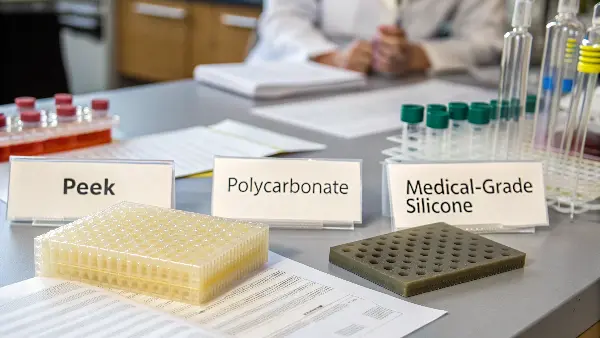
Using poor plastic to make a medical device can result in the failure of the product, regulatory nightmares, and even patient injuries. You may be concerned that your device will not pass stringent biocompatibility tests, to require expensive re-design and project delays at the expense of your business. The key to making a safe and confident decision is to know the main characteristics of medical-grade plastics. This is a guide that will take you through all that you should know to choose the right material.
Choosing a biocompatible plastic for a medical device starts with the finished device and its patient contact, not with a material marketing term. Contact type and duration, body location, sterilization, chemical exposure, mechanical load, manufacturing residue, colorants, additives and the destination-market submission all influence the evaluation. A material that has been used in one device is not automatically suitable for another device or process.
Related CKMOLD resources: mold testing and validation, production injection molding, mold design.
Choose a medical-device plastic by matching a named commercial grade to the device’s contact, duration, mechanical load, chemicals, sterilization or cleaning, manufacturing process and regulatory evidence plan. PEEK, polycarbonate, polypropylene, silicone and other families contain different grades; none is automatically suitable because of its family name.

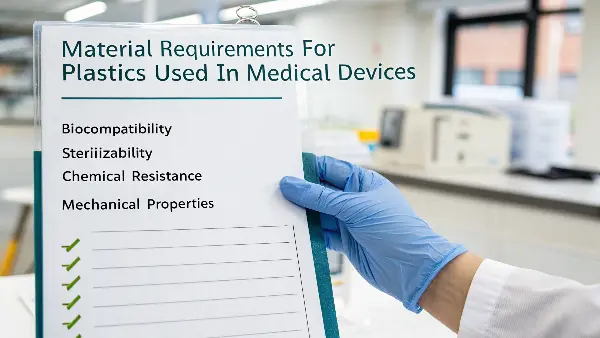
What are the 4 material requirements for plastics used in medical devices?
Material selection should start with intended use, body-contact nature and duration, device classification and the applicable risk-management and regulatory plan. Biocompatibility, sterilization/cleaning compatibility, chemical behavior and mechanical performance are useful workstreams, but they are not a universal four-item approval checklist.
A medical-device material cannot be released from four universal pass/fail properties. Define finished-device contact and duration, patient population, function and load, formulation/color/additives, manufacturing residues, cleaning, packaging, sterilization and aging. Use those inputs in a qualified biological and regulatory risk assessment for the target market.
Illustrative selection scenario — not a CKMOLD customer project. A diagnostic housing changed from one ABS grade to a PC grade only after comparing exact formulations, device contact, gamma dose and aging, color/impact retention, chemicals, molding and regulatory evidence. “Medical grade” and polymer family alone cannot prove the change is safe or effective.
1. Biocompatibility
Biocompatibility is evaluated in relation to the finished device, its intended contact and the biological risks. It is not an intrinsic promise that a resin can never cause allergy, toxicity or immune response. FDA guidance uses a risk-based ISO 10993-1 framework and considers material formulation, processing, residues and sterilization where applicable.
2. Sterilization and Reprocessing Compatibility
Do not approve or reject a polymer family from a generic sterilization table. Steam temperature/time/pressure and cycle count, radiation type/dose, ethylene-oxide conditions/aeration, chemical concentration/time and aging can each change color, dimensions, strength, extractables or interfaces.
For every candidate, obtain exact-grade supplier evidence with test conditions, then test the production-like device after the maximum specified manufacturing, cleaning, sterilization and aging sequence. Include bonded, welded, printed, coated and overmolded interfaces.
3. Chemical Resistance
Medical environments are full of chemicals, from harsh cleaning agents and disinfectants to bodily fluids and drugs. The plastic you choose must be able to resist these substances without degrading, cracking, or swelling. For example, the housing of a blood glucose meter needs to withstand frequent wiping with alcohol-based cleaners. If the plastic cracks, the sensitive electronics inside could be damaged.
4. Mechanical Properties
Finally, the plastic must be able to do its job. This comes down to its physical and mechanical properties. Does it need to be rigid and strong like a surgical instrument handle? Or flexible and soft like medical tubing? Key properties to consider include tensile strength (resistance to being pulled apart), impact resistance (toughness), and flexural modulus (stiffness). You must match these properties to the real-world demands of the device.
Which Plastics Can Support a Medical-Device Program?
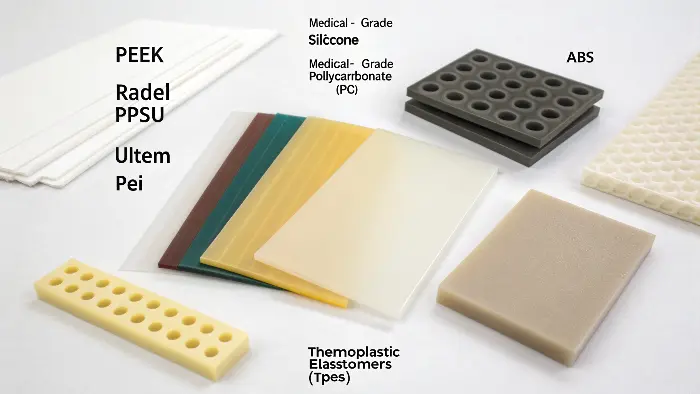
No polymer family is inherently biocompatible for every device. PEEK, PEI/PPSU, PC, PP, POM, TPE, silicone and other families contain grades with different formulations, supplier controls and evidence. Select a named grade only after defining finished-device contact, duration, mechanical/chemical duty, cleaning or sterilization and the target-market evidence plan.
| Candidate role | Questions to resolve |
|---|---|
| Rigid housing or connector | Contact status, impact, cleaners, heat, flame/electrical, assembly stress and traceability |
| Wear or moving feature | Load, speed, counterface, lubrication, particles, dimensions and sterilization |
| Seal, grip or flexible path | Extractables, compression set, bond, kink/fatigue, fluids and sterilization |
| Implant or prolonged contact | Device-specific biological, chemical, mechanical, degradation, sterilization and regulatory evidence |
Ask for the supplier’s current grade/formulation identification, change policy, traceability and applicable test reports. A phrase such as “medical grade” or one ISO 10993 result is not complete device clearance.
What Is the Role of Biocompatibility in Material Selection?
Biocompatibility is a risk-based evaluation of the finished device in its intended contact. FDA guidance referencing ISO 10993-1 considers the nature and duration of contact together with formulation, components, manufacturing, residues, cleaning, sterilization and other available evidence.
The evaluation may use chemical characterization, existing relevant data and biological testing as appropriate to the risk. It is not a universal checklist of cytotoxicity, sensitization and irritation tests for every device, and passing one endpoint cannot rule out all adverse responses.
The device manufacturer and qualified regulatory or laboratory specialists should document why existing material/process evidence is applicable and what additional evaluation is required.
How Should Common Medical Plastics Be Screened?
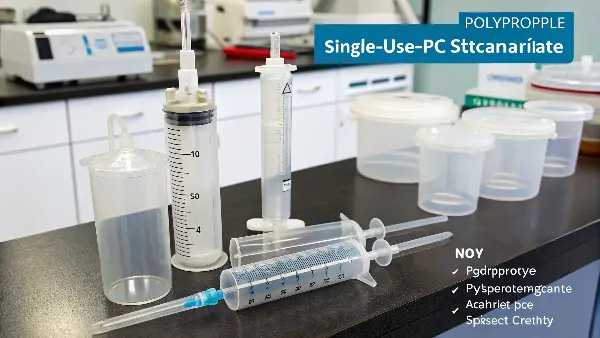
Usage frequency does not make a material safe for a new device. PP, PC, PE, POM, TPE, silicone and high-performance polymers serve different components, but the exact grade and finished-device evidence control suitability.
- PP or PE candidates: check contact, additives, impact, creep, hinge/flex duty, chemicals, sterilization or cleaning, and traceability.
- PC candidates: check impact, clarity, stress cracking, cleaners, heat, radiation/steam response, assembly load and aging.
- POM or wear candidates: check friction/wear, particles, chemicals, dimensions, sterilization and contact evidence.
Do not infer that most disposables use one family, that every PP grade is autoclave-resistant, or that every PC grade is the premium reusable choice.
When Can a Polymer Be Preferable to Metal?
Compare complete device requirements rather than assuming polymers are lighter, safer, more flexible or less reactive in every design. A polymer may combine geometry, reduce mass, provide selected imaging behavior or suit high-volume processing; a metal may be preferable for stiffness, wear, thermal duty, conductivity, barrier or repeated service.
| Decision | Compare on the finished device |
|---|---|
| Mechanical duty | Load, creep, fatigue, impact, wear, joints and dimensions over life |
| Biological/chemical risk | Contact, formulation, corrosion or degradation products, extractables/leachables and cleaning/sterilization |
| Imaging/electrical | Actual modality, fillers, thickness, artifacts, insulation or conductivity requirements |
| Total cost | Tooling, material, process, validation, inspection, assembly, sterilization, scrap and lifecycle service |
Neither “biocompatible plastic” nor “medical metal” is a safety guarantee. Release the selected material and process with device-specific evidence.
What is the best biocompatible plastic?
Everybody wants to have the best material to make their product out of. It is a natural and significant question to put. However, you may fear that choosing the most expensive or highest-performing plastic, such as PEEK, would be spending unnecessary money because there is no value addition to your particular device. Conversely, you are afraid that a good enough material could contain a latent fault that will manifest itself in the future. The fact is that there is no such thing as the best plastic. The correct plastic, however, most certainly does.
Long-term implantation cannot be assigned to “medical-grade silicone” as a family. Implant location, duration, mechanical duty, formulation, sterilization, extractables/leachables, degradation and regulatory evidence determine whether one specific material and device design are appropriate.
Start with the device rather than the resin price. Define contact and duration, load, temperature, chemicals, cleaning/sterilization, imaging, assembly and regulatory evidence, then shortlist exact grades that can be validated in the finished device.
Factor 1: How Will It Contact the Body?
Document contact type, tissue or fluid path, frequency and cumulative duration using the applicable regulatory framework. Intact-skin contact, external communicating devices and implants have different risk questions, but no category automatically approves ABS, PC, PEEK, silicone or UHMWPE.
For long-term or implant contact, define mechanical duty, degradation, wear/debris, sterilization, extractables/leachables and the complete device evidence. “More than 30 days” is a contact-duration category, not a list of pre-approved materials.
Factor 2: How Will It Be Sterilized?
Match the exact grade and finished assembly to the specified sterilization process, dose or steam cycle, maximum repetitions and aging. Some stabilized or specialized grades behave differently from generic family expectations, so do not universally reject PP or approve PEEK, PPSU or PC by name alone.
Factor 3: What Are the Physical and Mechanical Demands?
Translate use into measurable stiffness, strength, creep, fatigue, impact, flex/kink, wear, transparency, temperature, chemical and dimensional requirements. Compare exact grades after the specified manufacturing, conditioning, cleaning/sterilization and aging.
A clear polymer is not automatically suitable for a fluid path, and PEEK or PP is not universally more chemical-resistant than PC or ABS. Test each relevant fluid, concentration, time, temperature and applied stress on the final or representative assembly.
Factor 4: What is the Cost vs. Performance Trade-off?
Compare current quotations and total qualified-device cost. Material price is only one input; include tooling, cycle, scrap, inspection, validation, sterilization, assembly and supply risk. Choose the lowest total-cost option that meets the complete requirement, not a fixed family price multiple.
Build a Device-Specific Material Evidence Package
A medical material file should support the finished-device risk assessment. Ask the material supplier for the exact grade/formulation identification, current technical and regulatory statements, change-notification policy, lot traceability and relevant test reports with test article and conditions.
Ask the molder for resin/lot and colorant traceability, drying and process records, mold-release/cleaning controls, regrind policy, contamination controls and production change history. Ask a qualified laboratory or regulatory specialist to define whether existing evidence is applicable and what chemical characterization, biological endpoints, sterilization/aging or other tests are needed for the final device.
Do not interpret a resin certificate, USP classification or one ISO 10993 test as universal device clearance. Final responsibility and test strategy remain with the device manufacturer and qualified specialists.
Primary technical sources checked: FDA — Biocompatibility Assessment Basics (finished-device, contact and manufacturing evidence); FDA — ISO 10993-1 Guidance (risk-based biological evaluation of medical devices). Apply the cited scope to the exact grade, tool and acceptance plan.
Define Contact and Duration First
Classify whether the device contacts intact skin, breached or compromised surfaces, blood, tissue or circulating fluids, and whether contact is brief, prolonged or permanent. The exposure profile drives the biological evaluation strategy and the material and process evidence that may be needed.
Evaluate the Final Formulation and Process
Resin, colorant, lubricant, mold release, cleaning agent, regrind, sterilization and processing history can affect the final device. The molded article should be evaluated in its finished form or with a documented scientific justification for the test article. Do not treat a base-resin certificate as complete device evidence.
Check Sterilization and Service Conditions
Steam, radiation, ethylene oxide, chemical sterilants, temperature, humidity and repeated use can change dimensions, strength, color, extractables or surface condition. Test production-like parts after the actual sterilization and aging profile, including assemblies and bonded interfaces.
Design for Clean, Repeatable Manufacturing
Medical molds need controlled surfaces, venting, ejection, cooling, material handling and traceability. Avoid unnecessary retention pockets and uncontrolled lubricant transfer. Mold revision, cavity identification, resin lot, process record and inspection data should support the quality system.
Use a Risk-Based Regulatory Plan
Biocompatibility evaluation is tied to device contact and risk. FDA guidance on ISO 10993-1 describes a risk-based approach and emphasizes the device’s final form and intended contact. The manufacturer and qualified regulatory or laboratory specialists should define the applicable test and submission strategy for the target market.
Choose a Biocompatible Plastic for Medical Devices: Buyer Review Checklist
- Define body contact, duration, patient population, sterilization, chemicals and service conditions.
- Qualify resin, additives, color, lubricants, mold release, cleaning and processing history.
- Evaluate final-form or scientifically justified test articles, including assemblies where relevant.
- Control mold surfaces, material lots, cavity traceability, process records and contamination risk.
- Use a qualified, risk-based biocompatibility and regulatory plan for the target market.
FAQ
Does a medical-grade plastic automatically make a device biocompatible?
No. The finished device, formulation, processing, contact condition, sterilization and applicable regulatory evaluation determine suitability.
What is the first step in selecting a medical plastic?
Define the intended body contact and duration, then map temperature, sterilization, chemicals, mechanical load and manufacturing constraints to a qualified material and risk plan.
Conclusion
Material selection is a risk-based process that aligns a named grade, finished-device design, manufacturing and evidence with intended use. The four workstreams above help organize the decision, but they do not by themselves establish safety, regulatory compliance or clinical performance.