
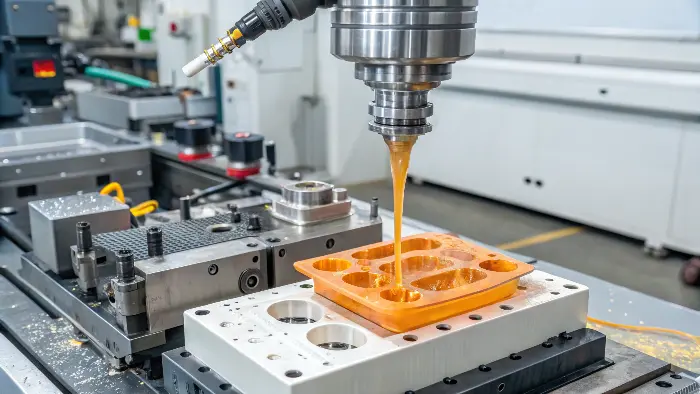
Automotive injection molding serves both visible surfaces and hidden structural or functional components. Interior and exterior parts see different combinations of heat, UV, moisture, chemicals, vibration, impact, handling and appearance expectations. A suitable design links material grade, mold layout, surface, assembly and validation to the part’s location on the vehicle.
Related CKMOLD resources: production injection molding, mold design, mold testing and validation.
So, What Exactly is Automotive Injection Molding Anyway?
You hear “injection molding” thrown around, but what does it really mean when we’re talking about cars? Confused about how this one process can create so many different automotive parts, from tiny clips to massive bumpers? It’s all about versatility and precision.
Automotive injection molding is a specialized manufacturing process used to produce a vast array of plastic components for vehicles. It involves injecting molten thermoplastic or thermosetting polymers into a custom-designed mold cavity under high pressure, allowing for complex, high-precision parts to be made rapidly and consistently.
Think about it – the automotive industry is a beast! They demand incredible precision, super high quality, and parts that can withstand everything from scorching summer heat to freezing winter cold, not to mention constant vibration and, sometimes, impacts. Automotive injection molding is the workhorse that makes so much of this possible. It’s not just about squirting plastic into a shape; it’s a highly engineered system. We’re talking about parts like intricate dashboard assemblies, interior door panels with integrated speaker grilles and armrests, tough exterior bumpers, aerodynamic trim pieces, light housings, and even critical under-the-hood components like engine covers or fluid reservoirs. One day we’d be working on a mold for delicate interior switchgear, the next for a robust fender liner. The core principle is the same, but the specifics – the type of plastic, the complexity of the mold, the tolerances required – vary massively. For a business owner like the buyer, who’s focused on efficiency and product quality, understanding that this process can deliver such diverse components with repeatable accuracy is a big deal. It means car manufacturers can design vehicles with more intricate features, better aesthetics, and improved safety, all while keeping an eye on production costs and weight reduction (which is huge for fuel efficiency!). It’s really the backbone of modern car component manufacturing. We at CKMOLD have helped many clients navigate the specifics of their automotive projects, ensuring the molds we design and the parts produced meet these stringent industry standards. It’s a fascinating field, generally pushing the boundaries of what’s possible with plastics.
| Aspect | Automotive Injection Molding Application | Benefit for Car Manufacturers & Consumers |
|---|---|---|
| Interior Parts | Dashboards, door panels, center consoles, trim, seat components, HVAC vents | Enhanced aesthetics, ergonomic designs, integrated features, noise reduction |
| Exterior Parts | Bumpers, grilles, spoilers, mirror housings, fender flares, light housings | Aerodynamic efficiency, impact resistance, weight reduction, styling freedom |
| Under-the-Hood | Engine covers, air intake manifolds, battery trays, fluid reservoirs | Heat resistance, chemical resistance, lightweighting, complex geometries |
| Safety Features | Airbag housings, seatbelt components, interior pillar covers | Strength, impact absorption, consistent performance |
What Goes Into Making the Actual Plastic Injection Mold Itself?
So we know plastic gets injected into a mold, but what is this “mold” thing really made of? It sounds simple, but the mold is where the real magic and a lot of the upfront work happens, especially for complex automotive parts. A plastic injection mold is a highly engineered tool, typically made from hardened steel, consisting of two main halves (A-side and B-side). Key components include the cavity (shapes the part’s exterior), core (shapes the interior), sprue, runners, gates (direct plastic flow), cooling channels, and an ejection system. Oh boy, the mold! That’s where so much of my passion lies, and it’s truly the heart of the injection molding process. They’re not just simple blocks of metal; they are intricate pieces of engineering that can cost a fair bit and take weeks, sometimes months, to design and build. For automotive parts, which often have complex geometries, tight tolerances, and need to produce millions of units, the mold has to be top-notch. Let’s break it down a bit. You’ve got the mold base , which is like the foundation holding everything together. Then, the most critical parts are the cavity and the core . The cavity, usually on the “A-side” or stationary half of the mold, forms the external surfaces of the plastic part. The core, on the “B-side” or moving half, forms the internal surfaces. When these two halves clamp together in the molding machine, the space between the cavity and core creates the shape of the part. Then you need a way to get the molten plastic in. That’s where the sprue bushing , runners , and gates come in. The sprue is where the machine’s nozzle connects to the mold. Runners are channels machined into the mold face that distribute the molten plastic from the sprue to the gates, which are small openings that lead directly into the cavity. The design of these is critical for ensuring the plastic fills the mold evenly and without defects. Cooling channels are also super important. They circulate water or oil through the mold to control the temperature and help the plastic solidify quickly and uniformly. If cooling isn’t right, you can get warped parts or long cycle times. And finally, once the part is solid, you need to get it out! That’s the job of the ejection system , which usually involves ejector pins, sleeves, or plates that push the part out of the mold cavity when the mold opens. For complex automotive parts with undercuts or internal threads, molds can also have slides and lifters – moving components within the mold that create these features and then retract before ejection. Designing and building these molds, especially for a client like the buyer who expects reliability and precision for his automotive components, is a real craft. It requires skilled designers, toolmakers, and high-precision machinery. At CKMOLD, we’ve spent years perfecting this, because we know a good part starts with a great mold.
| Mold Component | Function | Importance for Automotive Parts |
|---|---|---|
| Mold Base | Foundation holding all components securely | Provides stability for high-pressure injection cycles |
| Cavity (A-Side) | Forms the external shape of the plastic part | Defines aesthetics, fit, and finish of components like dashboards |
| Core (B-Side) | Forms the internal shape of the plastic part | Creates internal features, mounting bosses, ribbing for strength |
| Sprue/Runners/Gates | Channel molten plastic from machine nozzle to the cavity | Ensures proper fill, minimizes defects, affects cycle time |
| Cooling System | Regulates mold temperature for solidification | Critical for dimensional stability, preventing warpage, cycle time |
| Ejection System | Pushes the solidified part out of the mold | Ensures clean part removal without damage, allows automation |
| Slides/Lifters | Create undercuts or complex internal/external features | Enables complex designs like snap-fits or integrated clips |
Interior Components Combine Appearance and Touch
Instrument panels, consoles, bezels, handles, vents and trim may need texture, gloss control, scratch resistance, color consistency and low visual defect risk. Hidden ribs and bosses provide stiffness and assembly, but they can create sink, warpage or read-through on visible surfaces.
Exterior Components Need Environmental Durability
Grilles, covers, brackets, trim, light-related components and underbody parts can face UV, temperature changes, water, road chemicals, impact and vibration. Material stabilization, filler choice, coating or surface strategy and gate or weld-line placement should reflect the service environment.
Use Overmolding and Inserts When They Add Function
TPE or TPU can add seals, grip or vibration isolation, while metal inserts can support fastening, conductivity or structural load. Bonding, insert location, thermal expansion, substrate preparation and flash control must be validated in the final assembly.
Manage Warpage and Stack-Up
Large automotive panels and complex housings are sensitive to directional shrinkage, cooling imbalance, fiber orientation and fixture effects. The mold should be reviewed for gate, cooling, ejection and reference datums, and the part should be measured in both free and assembly conditions.
Validation Must Follow Vehicle Reality
Thermal cycling, humidity, UV, vibration, chemical exposure, scratch, impact, assembly force and aging may be relevant. The approved material, color, texture, process, inspection fixture and revision should be traceable throughout the program.
Injection Molding in Automotive Interiors and Exteriors: Buyer Review Checklist
- Define vehicle location, temperature, UV, chemical, vibration, impact and appearance requirements.
- Review visible surfaces, ribs, bosses, gates, weld lines, texture and warpage in DFM.
- Validate overmold adhesion, insert position, flash, thermal expansion and assembly.
- Measure free-state and fixture-state dimensions against the actual stack-up.
- Document grade, color, texture, process window, inspection and environmental validation.
FAQ
What plastics are common in automotive injection molding?
PP, ABS, PC/ABS, PA, PBT, POM and elastomers are among the families used, with the exact grade determined by location and performance.
Why is automotive surface control difficult?
Large visible areas reveal gloss, texture, color, weld lines, sink, warpage and gate evidence under changing light and viewing angles.
Conclusion
Automotive injection molding is clearly the engine driving the creation of countless car components, inside and out. It offers precision, design flexibility, material variety, and the scalability vital for this massive industry. CKMOLD is dedicated to helping you understand and leverage this powerful technology.
Vehicle-Interior Flammability Is Test-Based
For U.S. occupant-compartment applications, consult the applicable vehicle standard and the official NHTSA FMVSS 302 laboratory test procedure. Material name or supplier marketing does not establish compliance of the finished component.