
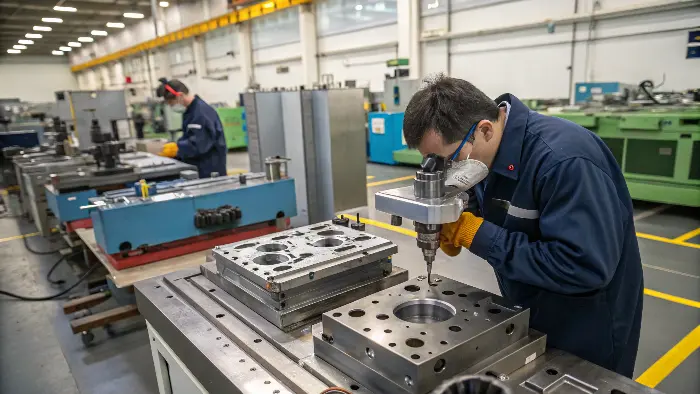
P20, H13 and S136 are not quality levels and none is automatically the best steel for an entire mold. Select the exact producer grade and supply condition for the duty of each component: resin wear or corrosion, required surface, thermal and mechanical load, tool size, heat treatment, maintenance and contractual life conditions all matter.
Initial steel price is only one cost input. Machining, heat treatment, polishing, repair, spare inserts, maintenance and downtime can change total ownership cost. The practical goal is a documented component-level steel map that meets the accepted part and maintenance requirements without paying for properties the project does not use.
Related CKMOLD resources: mold design, production injection molding and mold repair and modification.
What is the difference between H13 steel and P20 steel?
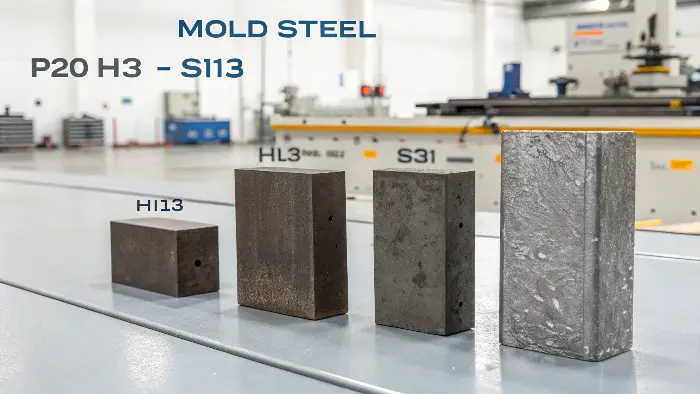
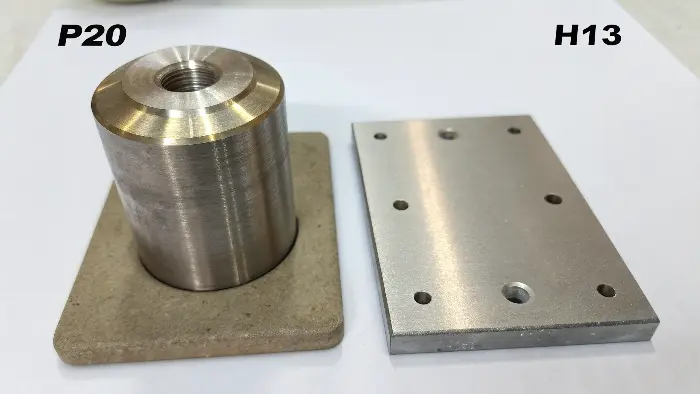
P20 and H13 describe steel families or specifications, not one universal delivered condition. Confirm the producer, exact grade, supply condition, certificate values, heat-treatment route and the mold component being selected. For example, Uddeholm describes Impax Supreme as a modified P20-type, prehardened mold steel supplied at about 290–330 HB. Its published condition is not a guaranteed hardness for every product sold as “P20.”
Uddeholm’s Orvar Supreme technical brochure identifies the grade as an H13-type hot-work steel supplied soft annealed at approximately 180 HB and intended to be heat treated for service. The working hardness must be selected with section size, toughness, thermal loading, wear, heat-treatment capability and the steelmaker’s instructions. H13 can be appropriate for hot runners, gates, slides or other thermally or mechanically demanding components without requiring the entire mold to use H13.
| Decision | P20-type prehardened steel may fit when | H13-type hot-work steel may fit when |
|---|---|---|
| Component duty | Machinability, predictable prehardened condition and moderate wear are priorities | Heat checking, hot hardness, thermal cycling or localized wear is a design driver |
| Heat treatment | Avoiding through-hardening distortion is valuable | A controlled hardening, tempering and inspection route is available |
| Evidence to request | Producer, certificate, delivered hardness, cleanliness and repair/weld guidance | Producer, certificate, heat-treatment specification, achieved hardness/toughness and dimensional inspection |
What is S136H material?
S136 and S136H are supplier designations used for corrosion-resistant mold steels; the exact chemistry, condition and properties must be confirmed on the producer’s certificate. A corrosion-resistant, polishable stainless mold steel can be valuable for corrosive resins, humid storage, cooling-channel exposure, demanding optical surfaces or reduced rust-related maintenance, but it is not automatically the only acceptable steel.
As a producer example, Uddeholm describes Stavax ESR as a modified 420 stainless mold steel combining corrosion resistance, wear resistance and polishability for suitable cores and cavities. ASSAB’s plastic-mold steel selection guide shows that multiple grades can address corrosion, polishability, toughness, wear and dimensional stability. Treat cross-reference names as approximate starting points until chemistry, cleanliness, supply condition and heat treatment are confirmed.
Illustrative selection scenario—not a CKMOLD project: a transparent component molded from a resin with a corrosion or deposit risk may justify comparing a stainless ESR cavity steel with a protected non-stainless option. The decision would use the optical specification, resin and additives, planned volume, cooling-water control, maintenance access, tool size, heat treatment and supplier test certificates. It should not be presented as proof that one named steel guarantees an optical result or a fixed number of cycles.
What is P20 mold steel used for?
P20-type prehardened steels are commonly considered for mold bases, plates and cores or cavities where their delivered hardness, machinability, section availability, polishability and repair route meet the project requirements. They are not automatically limited to prototypes, and they are not automatically suitable for every high-finish or abrasive-resin application.
Before selecting P20 for a critical surface or wear location, confirm the exact producer grade, inclusion cleanliness, hardness uniformity through the section, polish or texture requirement, resin fillers, gate and shutoff wear, cooling-water exposure and planned refurbishment. Localized hardened inserts or a different steel for gates, slides and wear areas can be more economical than assigning one steel to the whole tool.
How Should You Select Steel for Each Mold Component?
There is no single best steel for an entire mold. Select by component and failure mode. Start with the exact resin and fillers, expected annual and total volume, surface/texture requirement, corrosion environment, part size, gate and shutoff loads, cooling layout, heat-treatment access, repair strategy and contractual life/maintenance terms.
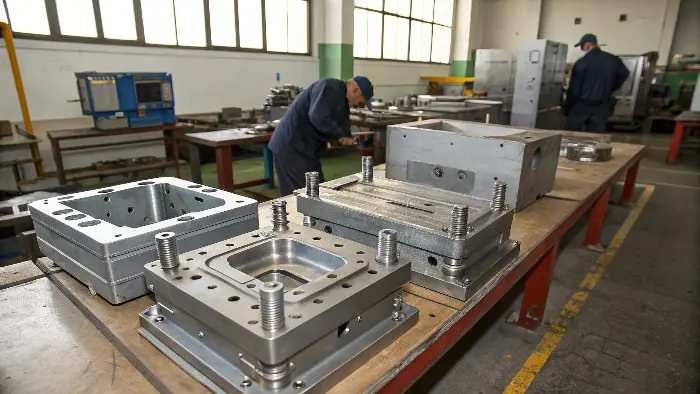
| Project question | Why it changes the steel decision | Evidence to obtain |
|---|---|---|
| Is the resin abrasive or corrosive? | Glass/mineral fillers, flame-retardant packages and corrosive by-products can change wear or corrosion risk | Exact grade/SDS, filler content, supplier processing guidance and wear/corrosion plan |
| What surface must be accepted? | Optical polish, gloss, texture replication and cosmetic repair place different demands on cleanliness and heat treatment | Finish specification, approved plaque/sample, steelmaker polish guidance and acceptance method |
| Which component carries the risk? | Cavity, core, insert, gate, slide, wear plate and mold base do not need identical properties | Component-level material map and certificates |
| What is the service plan? | Cooling-water quality, storage, lubrication, cleaning and preventive maintenance affect actual life | Maintenance schedule, spare-insert plan and measurable end-of-life criteria |
Basic Requirements for Mold Steel Materials
Hardness and wear resistance of steel are significant in mold manufacture. This is because molds wear continuously when molten plastic is being injected into them, mainly when the plastic contains hard fillers like glass fibers, which tend to be damaging. Molds also encounter impacts during operation, for which a certain toughness is needed in order not to crack. During high-temperature plastic processing, the need for wear-resistant steel is greater, and hence, there is a need to use high-performance mold steel.
Minimal Heat Treatment Deformation
Mold steel hardens during heat treatment, making machining more challenging and hence more expensive. Steel materials with consistent internal structures that show minor deformation under heat treatment are required to increase manufacturing efficiency and lower costs. These materials support the accuracy and durability of the mold by not developing excessive internal tensions or deformities.
Polishing Performance
The high-quality mold steel should have a very high purity with fine and uniform structure in order to impart a reliably polished mold surface. Any pores, impurities, or other surface defects on the mold surface will adversely affect the appearance of the product. For instance, S136 steel is renowned for its outstanding polishing characteristics.
Weldability Molds
It will also experience wear and accidental damage during use, and sometimes the design changes need modifications. The weldability of mold steel is thus very important as it will determine the ease and feasibility of mold repairs and alterations.
How Should Mold Life Be Estimated and Contracted?
Mold life should be written as a target with conditions, not inferred from the steel name alone. Separate four ideas in the quotation and purchase documents: the buyer’s target cycles; the supplier’s estimated life under stated assumptions; any warranted obligation and exclusions; and the actual cycle count observed under documented operation and maintenance.
A useful estimate considers resin and fillers, part geometry, cavity count, gate and shutoff wear, steel producer and condition, heat treatment, hardness, surface treatment, cooling-water control, molding pressure/temperature, flash or corrosion limits, preventive maintenance and repairable inserts. “End of life” also needs a measurable definition—for example, inability to hold an identified dimension, unacceptable flash at a named shutoff, corrosion/polish damage beyond an agreed repair limit, or repair cost above an agreed threshold.
| Buyer / supplier checkpoint | Record before approval |
|---|---|
| Target and assumptions | Annual/total accepted parts, cavities, resin grade/fillers, machine and cycle assumptions, finish and tolerance |
| Steel and treatment | Producer/grade, certificate, delivered and final hardness, heat-treatment and surface-treatment records |
| Acceptance | T1 and production-trial conditions, cavity-level dimensions/appearance, maintenance interval and spare inserts |
| Life tracking | Cycle counter, maintenance/repair log, wear measurements, deviations and criteria for refurbishment |
Where P20 Fits
P20 is commonly considered for general-purpose mold bases, cores and cavities where machinability, availability and balanced cost are important. It can be a practical choice for many commodity resins and moderate production demands, but the specified condition, hardness, heat treatment and surface requirement still matter. P20 is not a substitute for a corrosion-resistant grade when the resin or environment demands one.
Why H13 Is Used for Thermal and Wear Demands
H13 is a hot-work tool steel used where repeated thermal cycling, higher hardness and greater wear resistance are important. It may suit demanding tooling, hot areas and applications with more severe thermal conditions. Proper heat treatment, stress relief, machining allowance and polishing practice determine whether the steel’s potential is actually achieved.
What Makes S136 Valuable
S136 is a stainless mold steel selected when corrosion resistance, polishability or clean cavity maintenance is a priority. It is often considered for clear parts, humid environments, corrosive additives or applications where rust-related surface defects would be costly. Stainless steel still needs correct cooling, handling and preventive maintenance; it is not maintenance-free.
Evaluate Resin and Surface Together
Glass fiber, mineral filler, flame retardant packages, PVC-like chemistry, moisture and aggressive cleaning can change the wear or corrosion risk. A mirror polish, optical texture, EDM surface or fine grain requirement can also influence the steel and processing route. Choose steel from the cavity surface and actual resin, not from the mold name alone.
Compare Total Cost of Ownership
Include machining time, heat treatment, polishing, corrosion protection, expected repair, spare inserts, downtime and replacement risk. A lower initial price may be unattractive if maintenance interrupts a high-volume program. Conversely, an expensive steel may add little value to a short-run prototype tool that will not see the relevant wear or corrosion exposure.
P20 vs. H13 vs. S136 Mold Steel: Buyer Review Checklist
- Define volume, cycle count, resin, filler, corrosion exposure and expected tool life.
- Match steel condition, hardness, heat treatment and machining route to the cavity function.
- Review polish, texture, optical, dimensional and corrosion requirements together.
- Include maintenance, spare inserts, downtime and repair risk in the cost comparison.
- Record the actual steel certificate and heat-treatment evidence for traceability.
FAQ
Is S136 generally better than P20?
No. S136 can add corrosion resistance and polishability, while P20 may be a sensible cost and machining choice for a less demanding application.
When should H13 be considered?
H13 is worth evaluating when thermal cycling, wear, hardness or demanding hot areas create requirements beyond a general-purpose mold steel.
Conclusion
P20-, H13- and stainless mold-steel families solve different component-level risks; none is universally best and none guarantees a fixed cycle count. A defensible selection identifies the exact producer grade and condition, maps materials to the mold components, documents heat treatment and certificates, and defines finish, maintenance and life acceptance in measurable terms.
For a steel-selection and tooling review, provide the part drawing, resin grade and fillers, annual and total volume, surface specification, critical tolerances, operating environment and maintenance expectations through the RFQ page. Send CAD separately to jerry@ckmold.com after the form submission when needed.