
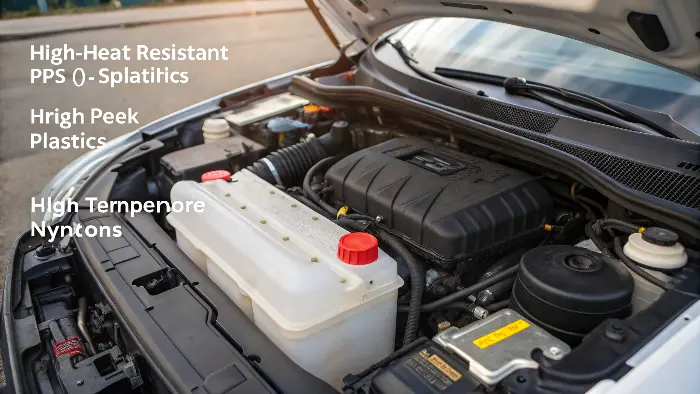
Selecting a high-heat plastic starts with temperature over time under load, plus fluids, moisture, electrical or flame requirements and dimensional limits. A family name or maximum temperature headline cannot identify the best material.
High-heat plastic selection is not decided by a single temperature number. An automotive or industrial part may experience continuous heat, short peaks, mechanical load, vibration, chemicals, moisture, electrical demand and repeated thermal cycling at the same time. Materials such as PPS, PEEK, PEI, PAI, high-temperature polyamides and engineered blends can perform well, but only when grade, reinforcement, geometry, mold design and validation are considered as one system.
Related CKMOLD resources: mold design, production injection molding, mold testing and validation.

Which Plastic Is Suitable for High-Heat Service?
There is no single best high-heat plastic. Define continuous and peak temperature, duration, mechanical load at temperature, chemical/fluid exposure, humidity, electrical/flame requirements, dimensional tolerance, life and test method. A short-term heat-deflection result cannot by itself predict long-term loaded service.
Candidate families can include heat-stabilized polyamides and polyesters, PPS, PEI, PEEK/PAEK and others. Exact grade, reinforcement, conditioning and processing history matter. Compare supplier curves or grade data at the actual temperature and environment rather than a family-wide maximum.
Primary sources checked: Victrex PEEK Injection Molding Guide (PEEK-family handling, machine, mold and processing considerations); Celanese Fortron PPS Design Manual (PPS-family design guidance and need for grade-specific data); SABIC ULTEM 9085 Product Page (example of a commercial high-heat amorphous grade and its supplier data). The cited scope still has to be matched to the exact grade, tool, product and destination market.

How Should a 100°C Requirement Be Interpreted?
Clarify whether 100°C is continuous air, a brief peak, hot water/steam, oil/coolant contact, sterilization or a local surface temperature. Then define load and allowable deformation. Many exact grades may survive one of these conditions but not another; moisture-conditioned properties and creep can control the decision.
Screen datasheets, then test production-like parts after the required aging and fluid cycles. Do not select by melting point alone.

How Are High-Heat Automotive Candidates Compared?
| Question | Evidence to Request |
|---|---|
| Temperature and load | Grade-specific modulus/strength or creep data over temperature and time |
| Fluids and humidity | Conditioned property retention in the relevant coolant, oil, fuel, water or cleaner |
| Dimensions | Shrinkage/warpage data for grade, fiber orientation and actual geometry |
| Electrical/flame | Required test listing or report for the exact grade and thickness |
| Production | Drying, machine/tool temperature, residence, venting and material-of-construction guidance |
Filled PA, PBT/PET, PPS, PEI or PEEK-grade candidates occupy different cost/performance regions; none wins without the defined duty.

When Should Metal Remain in the Comparison?
Compare the complete component function: stiffness at temperature, creep, fatigue, thermal expansion/conductivity, wear, fastening, shielding, fire behavior, mass, corrosion, part consolidation and production volume. A high-performance polymer can reduce mass or combine features, but its lower stiffness or different thermal behavior may require geometry changes. Treat metal replacement as a redesign and validation program, not a material swap.
Heat Resistance Is Not Heat Capacity
Heat capacity describes energy needed to change temperature; it does not tell whether a part retains dimensions or strength in hot service. Thermal conductivity, expansion, glass transition or melting behavior, oxidation, creep and the actual heat-transfer boundary can be more relevant. Specify the failure mode and test rather than searching for one thermal number.

How Does the Manufacturing Route Affect the Choice?
Injection molding suits repeatable volumes and complex geometry but high-temperature grades can require capable heaters, suitable barrels/screws/nozzles, heated tools, controlled drying and robust venting. Victrex’s PEEK guide illustrates these grade-family processing considerations; it is not a universal setting sheet. Machining can suit low quantities or stock shapes, while additive routes require process- and grade-specific property validation.
Include tooling, equipment fit, scrap/regrind limits, secondary operations, inspection and qualification when comparing total accepted-part cost.
Start With the Real Thermal Duty
Separate continuous service temperature from short-term peak temperature and define how long the part sees each condition. Add thermal cycling, heat-up rate, cooling rate and surrounding components. A material that survives a brief peak may still creep, relax or lose dimensional stability during long-term exposure.
Match Heat to Mechanical Load
Tensile strength at room temperature is not enough for a hot part. Evaluate creep, fatigue, stiffness retention, impact, clamp load retention and vibration at the use temperature. A reinforced grade may improve stiffness but also increase anisotropic shrinkage, weld-line sensitivity and warpage.
Account for Chemicals and Moisture
Coolants, oils, fuels, cleaners, hydraulic fluids and humidity can change performance. Polyamides may need careful moisture conditioning, while other high-temperature resins may have different chemical limits. Test molded samples after the actual exposure rather than relying only on a room-temperature datasheet comparison.
Design the Mold Around the Resin
High-temperature resins can require higher melt and mold temperatures, controlled drying, heated tooling, suitable venting and a machine with sufficient pressure and temperature reserve. Gate size, wall transitions, draft, insert fit and cooling must account for viscosity and shrinkage behavior.
Validate the Part, Not Just the Material
Use production-like cavities and processing conditions for dimensional, thermal, mechanical, chemical, electrical and aging tests. Record resin lot, drying history, fiber orientation, conditioning and test temperature. The grade that wins a material comparison is not automatically the grade that wins the complete part validation.
Best Plastics for High-Heat Automotive and Industrial Parts: Buyer Review Checklist
- Define continuous temperature, peak temperature, thermal cycling, load, vibration and service life.
- Compare creep, stiffness, impact, chemical resistance, moisture behavior and shrinkage at use conditions.
- Check machine, drying, mold-temperature, venting, gate and cooling capability before tool release.
- Evaluate reinforcement orientation and weld-line performance where structural loads matter.
- Validate production-like parts after realistic thermal, chemical and mechanical exposure.
FAQ
Are high-temperature plastics difficult to injection mold?
They can require higher processing temperatures, careful drying, suitable tooling, stronger machine capability and a tighter process window than commodity resins.
Is glass-filled material generally best for hot automotive parts?
Not necessarily. Glass fiber can improve stiffness but may increase anisotropy, warpage and weld-line sensitivity; the load path and dimensional requirements should determine the grade.
Conclusion
Select a high-heat plastic from a defined temperature–time–load–environment duty, then compare exact grades using long-term and conditioned evidence. Confirm process/equipment fit and validate production-like parts. Submit the duty cycle, CAD, loads, fluids, tolerances and required tests for an engineering and tooling review.