
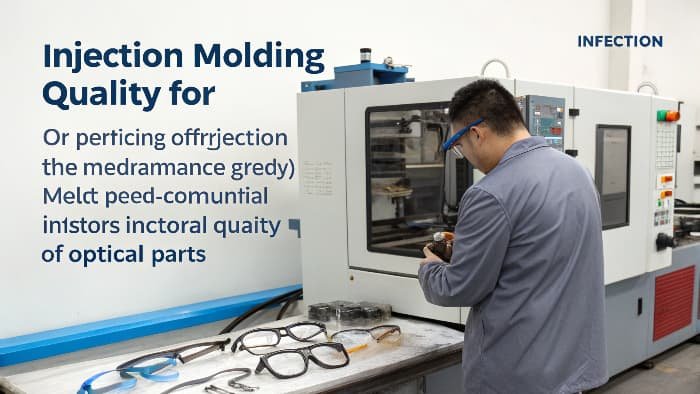
Struggling with cloudy acrylic parts? Defects ruining your optical components? We get it. Define the required optical zones and acceptance evidence before selecting a PMMA grade and tooling approach.
Optical-grade acrylic parts are difficult because the customer evaluates both function and appearance. A part can meet the drawing dimensionally but still fail because of haze, flow marks, stress, scratches or visible gate defects.
Related CKMOLD resources: injection mold services, DFM analysis, mold design, mold testing and validation, and production injection molding.
Optical PMMA work requires an agreed resin grade, optical-zone drawing, mold-surface specification and inspection method. Confirm the supplier’s relevant trial and inspection evidence for the proposed part; process descriptions are not proof of a completed optical project.
Define transmission, haze, distortion, cosmetic limits and handling requirements before a tooling quotation. The illustrations explain design considerations; project acceptance needs identified samples and measured results.
The PMMA Injection Molding for Clear Plastic Parts is the broad molding reference for clear parts; the present article examines tooling, processing and handling controls for optical parts.
Can Acrylic Actually Be Used in Injection Molding?
Ever wondered if that beautifully clear acrylic can even handle the pressures of injection molding? It’s a common question, especially when optical clarity is non-negotiable. Many worry about degradation or defects appearing.
Yes, acrylic (PMMA) is absolutely suitable for injection molding and is widely used for applications requiring high optical clarity, weather resistance, and good mechanical properties. Proper drying and precise machine settings are key to success.
How Can You Improve the Quality of Injection Molding for Optical Parts?
Are you battling with imperfections like flow lines, sink marks, or haze in your molded parts? These issues can be incredibly frustrating and costly, especially for optical components. You need consistent, consistent results.
Improving injection molding quality involves optimizing mold design (e.g., gate location, venting), precise control of processing parameters (melt/mold temperature, injection speed/pressure, cooling time), and using high-quality, properly dried material. Regular machine maintenance is also crucial.
Develop a controlled trial that separates material condition, filling, packing, mold temperature and handling effects. Record changes and optical observations against the same inspection conditions.
- Mold Surface Finish: Specify the optical surface requirement and polishing method for the actual geometry. A general SPI finish designation does not by itself establish optical performance. Separate surface replication defects from moisture, contamination and residual stress before requesting re-polishing.
- Gate Design and Location: Review candidate gates against filling, stress, vestige and optical-zone restrictions. Tab or fan gates may be options, but select and validate the design for the actual component.
- Venting: Trapped air is the enemy of clarity. Proper venting in the mold allows air to escape as the plastic fills the cavity. If it can’t escape, you get bubbles or burn marks.
Then there are the processing parameters. This is where the operator’s skill and the machine’s capability really shine. - Melt Temperature: Too low, and the acrylic won’t flow properly, leading to short shots or weld lines. Too high, and you risk degrading the material, causing discoloration or reduced strength. Use the resin producer’s current processing window for the nominated grade and verify actual melt temperature and residence time; a generic PMMA temperature range is not a production setting.
- Mold Temperature: This is super important for acrylic. Mold temperature affects replication, flow, residual stress and cycle time. Select the starting window from the exact grade’s processing guide and qualify it against the optical and dimensional requirements.
- Injection Speed and Pressure: These need to be carefully balanced. Too fast can cause shear heating and degradation. Too slow can lead to premature cooling and flow marks. We often use a profiled injection speed – starting slower, then speeding up, then slowing again for packing.
- Holding Pressure and Time: After the cavity is filled, holding pressure is applied to pack out the part and compensate for shrinkage. Getting this right minimizes sink marks and voids.
Record grade, lot, drying, process window, cavity and inspection conditions so the optical result can be traced and repeated.
What Other Factors Can Be Expected to Contribute to the Part Quality During Injection Molding?
Beyond the obvious like material and machine settings, what else could be messing with your part quality? Sometimes, the hidden culprits cause the biggest headaches, leading to unexpected defects and delays.
Other critical factors include the quality of the injection molding machine itself (consistency, control), environmental conditions (dust, humidity in the molding area), post-molding handling, and even part design complexity influencing flow and stress.
You’re right, it’s not just about the plastic and the big machine settings. There are a bunch of other things that can make or break the quality of your injection molded parts, especially when we’re aiming for optical perfection with acrylic. I’ve learned over the years – sometimes the hard way! – that you have to look at the whole picture. One big one is the environment . For optical parts, we’re practically talking cleanroom conditions, or at least a very well-controlled environment. Dust is a killer. A tiny speck of dust landing in the mold or on the molten plastic can embed itself in the part, creating an inclusion that’s unacceptable for optical applications. For black specks, trace contamination through storage, conveying, the barrel/nozzle, hot runner where used, and handling. Do not attribute a defect to an air-filtration system without evidence. Humidity in the air can also affect how some plastics process, though with proper material drying, this is less of an issue for the material itself, but high humidity can sometimes contribute to condensation issues on cooler molds if not managed. Then there’s the part design . Sometimes, designers, with all good intentions, create features that are really challenging to mold reliably.
| Design Feature | Potential Issue for Optics | CKMOLD Approach |
|---|---|---|
| Sharp internal corners | Stress concentrations, cracks | Recommend generous radii, discuss DFM early |
| Abrupt wall thickness changes | Sink marks, voids, flow issues | Advise gradual transitions, coring out thick sections |
| Very thin sections | Fill problems, fragility | Analyze flow, suggest material or gate adjustments |
| Complex geometries | Trapped air, difficult ejection | Advanced mold design, strategic venting & ejection |
This is why at CKMOLD, we love to get involved early, during the Design for Manufacturability (DFM) stage. We can spot potential issues and suggest tweaks that make a world of difference downstream. It’s all part of helping product teams avoid costly redesigns and production headaches. And let’s not forget post-molding handling. Freshly molded acrylic parts can still be a bit sensitive. How they’re ejected, cooled, and packed matters. Rough handling can cause scratches or stress. Choose controlled part removal and protective packaging for the specific optical component, and agree those process requirements with the supplier. It’s that last mile of care that ensures what comes out of the mold stays suitable.
What Is the Best Plastic for Injection Molding for Optical Clarity?
You need parts that are as clear as glass, but strong and easy to shape. With so many plastics out there, which one truly offers the best optical clarity for your injection molded components?
PMMA is a useful optical candidate, but transmission, haze, impact resistance, weathering and stress performance are grade- and thickness-dependent. Compare the actual grades for the application rather than selecting a universally “best” clear plastic.
- Polycarbonate (PC): Compare grade-specific impact, transmission, haze, scratch resistance and aging data with PMMA under the same test conditions. Neither family name qualifies a finished optical or safety component.
- Cyclic Olefin Copolymer (COC) / Cyclic Olefin Polymer (COP): These are more specialty materials, but for certain high-end optical applications, especially in medical and diagnostics, they are amazing. They offer excellent clarity, low birefringence (important for polarized light), and great moisture barrier properties. They can be a bit pricier and require specialized processing knowledge, but the results can be stunning.
- Polystyrene (PS): General-purpose polystyrene can be very clear and is inexpensive, but it’s brittle and not very durable. You might see it in things like disposable petri dishes or light-duty display cases. For demanding optical applications, it usually doesn’t make the cut.
Choose the resin from the required optical function and mechanical environment. A light guide and a protective cover may need different evidence; request the proposed grade’s limitations and a representative trial before approval.
DFM Should Define the Optical Zone
Before mold design, CKMOLD asks which surfaces are user-facing, which areas transmit light, and where defects can be tolerated. This prevents unnecessary polishing cost on hidden surfaces while protecting the areas that truly control customer perception.
Mold Polishing Needs a Manufacturing Plan
Optical finish depends on steel quality, machining marks, EDM control, polishing access and maintenance. Deep corners or narrow ribs may be difficult to polish consistently. Good mold design makes the required finish physically achievable.
Gate and Vent Strategy Protects Clarity
A poor gate can create jetting, weld lines or stress in the viewing area. Poor venting can create burns or trapped gas. For acrylic parts, gate location should support smooth filling and hide the gate vestige where it has the least visual impact.
Inspection Should Match the End Use
Optical parts should be inspected under agreed lighting, viewing distance and angle. Depending on the application, distortion or stress patterns may matter more than simple gloss. CKMOLD can align inspection expectations with the customer’s actual application.
Optical-Grade Acrylic Injection Molded Parts by CKMOLD: Buyer Review Checklist
- Mark optical zones and acceptable defect limits on the drawing.
- Choose mold steel and polishing sequence for the required finish.
- Place gates and ejectors outside critical viewing areas where possible.
- Control drying, temperature and cleanliness during molding.
- Use visual inspection conditions that reflect the final application.
FAQ
What makes acrylic parts optical grade?
Optical-grade parts require controlled clarity, low haze, clean surfaces, limited distortion and consistent inspection standards.
Can CKMOLD help improve an existing acrylic part design?
Yes. CKMOLD can review the drawing, optical zones, gate options, wall thickness and mold surface requirements during DFM.
Which Optical Requirements Belong on the Drawing?
- Identify transmission/viewing surfaces, optical path length, gates/ejector restrictions and allowable gate vestige.
- Specify the relevant wavelength and optical function; transmission alone may miss haze, distortion, birefringence or imaging errors.
- Define cosmetic inspection with lighting, viewing distance, angle, sample standard and defect limits.
- Agree conditioning, handling, protective packaging and any coating before approval.
Do not assume every optical PMMA grade is suitable outdoors. For example, Röhm places specific use restrictions on some ACRYLITE Optical grades. Read the selected grade’s current documentation. The producer’s acrylic processing guide is a starting reference; it does not qualify a finished lens.
What Should You Ask an Optical-Part Supplier to Demonstrate?
Ask for the proposed resin grade, optical-zone DFM, polishing access, contamination controls, trial samples and the agreed inspection method. Request a project-specific review with the drawing and optical function, and email CAD to jerry@ckmold.com. For processing defects rather than optical acceptance, see our PMMA clarity and stability guide.
Conclusion
Achieving suitable clarity in optical acrylic parts is a detailed process. It demands material expertise, precise mold design, and meticulous process control. Agree the grade, optical zones, manufacturing controls and acceptance method before production approval.