
Overwhelmed by ABS options? Choosing the wrong grade means project delays and cost overruns. We simplify ABS selection, ensuring your project’s success from the start.
Selecting the right ABS grade involves understanding your project’s specific requirements for impact strength, heat resistance, flow characteristics, and any special properties like flame retardancy or electroplating suitability. Matching these to available ABS grades is key.
ABS is widely used because it offers a practical balance of toughness, processability and surface quality. But there is no single universal ABS grade. The correct choice depends on impact performance, heat resistance, flow length, cosmetic finish, plating requirements, flame rating and cost.
Related CKMOLD resources: injection mold services, DFM analysis, mold design, mold testing and validation, and production injection molding.
What Makes ABS Such a Popular Choice for Injection Molding Anyway?
Ever wondered why so many products, from LEGO bricks to car dashboards, are made from ABS? It’s no accident! This material’s versatility often makes it a go-to for manufacturers.
ABS (Acrylonitrile Butadiene Styrene) is popular due to its balanced combination of toughness, impact resistance, good processability, dimensional stability, and affordability. It also offers good chemical resistance and can be easily colored or electroplated.
- Good Mechanical Properties: A nice balance of strength, stiffness, and toughness.
- Dimensional Stability: Parts hold their shape well after molding.
- Surface Finish: Can achieve a very good, glossy surface finish.
- Chemical Resistance: Holds up well against many common chemicals, oils, and acids.
- Ease of Secondary Operations: It can be easily painted, glued, machined, and, importantly for many consumer electronics, electroplated. That shiny chrome look on many plastic parts? Often, it’s plated ABS.
It’s this all-around capability that makes ABS a default choice for so many injection molding projects. It hits a sweet spot between performance and cost.How Do Different ABS Grades Actually Vary in Properties?
You know ABS is versatile, but “ABS” isn’t just one thing, right? There’s a whole family of grades, and picking the wrong one can lead to parts failing under stress or heat.
ABS grades vary significantly in impact strength (from medium to very high), heat deflection temperature, flow rate (for easy molding of thin walls or complex parts), flame retardancy (UL94 ratings), and suitability for electroplating or UV resistance.
Dive deeper Paragraph:
This is where things get interesting – and where making the right choice really matters. Saying “I need ABS” is like saying “I need a car.” Okay, but what kind of car? A sports car, an SUV, a pickup truck? ABS grades are tailored for different performance needs. At CKMOLD, we generally start by asking about the end-use application.
- General Purpose ABS: This is your standard, all-around performer. Good balance of impact strength and stiffness, easy to process. Think enclosures, housings, and everyday items.
- High Impact ABS: As the name suggests, these grades are formulated for increased toughness. The butadiene content is typically higher. Ideal for parts that might experience drops or impacts, like tool housings or certain toy components. We once helped a client making protective casings for portable electronics switch to a high-impact ABS, and it drastically reduced field failures.
- High Heat ABS (or Heat Resistant ABS): These grades can withstand higher operating temperatures without deforming. They achieve this through modifications in the acrylonitrile or styrene content, or by adding heat stabilizers. Think automotive interior parts (dashboards, vents) that sit in the sun, or housings for electronics that generate some heat.
- Flame Retardant ABS: Crucial for many electronic and electrical applications where fire safety is a concern. These grades contain additives that help them self-extinguish or resist ignition, often meeting specific UL94 flammability ratings (like V-0, V-1, V-2). This is a big one for the buyer’s industry – consumer electronics often have strict flammability requirements.
- Electroplating Grade ABS: This is a special type of ABS designed to provide excellent adhesion for metallic coatings. The surface chemistry is optimized for the plating process. You see this in decorative automotive trim, bathroom fixtures, and shiny bits on appliances.
- High Flow ABS: For parts with very thin walls or long, complex flow paths, a high-flow grade makes molding easier. It has a lower viscosity, allowing the molten plastic to fill the mold cavity more readily.
Understanding these differences is the first step. It’s not just about picking an ABS; it’s about picking the right ABS for the job. This is where our experience at CKMOLD really helps our clients nail their material selection.What Key Factors Should I Consider When Matching an ABS Grade to My Project’s Needs?
Feeling lost trying to connect your product’s demands with the right ABS grade? Prioritizing the wrong factor can mean a subpar product or unnecessary costs. You need a clear path.
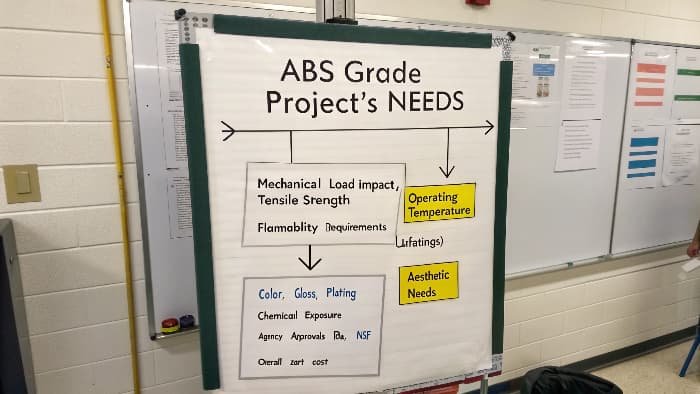
Key factors include: mechanical load (impact, tensile strength), operating temperature, flammability requirements (UL ratings), aesthetic needs (color, gloss, plating), chemical exposure, agency approvals (FDA, NSF), and overall part cost.
Dive deeper Paragraph:
Alright, so you know there are different ABS grades. Now, how do you connect the dots between what your part needs to do and the specific grade that will deliver? This is where we put on our detective hats. I generally tell the buyer, let’s list out the non-negotiables for your component.
Here’s a mental checklist I often run through with clients:
- Mechanical Performance: What kind of stresses will this part see?
- Impact: Will it be dropped? Hit? (Consider High Impact ABS)
- Tensile/Flexural Strength: Does it need to bear a load or resist bending? (Most general-purpose grades are decent, but some offer higher stiffness).
- Fatigue: Will it undergo repeated stress cycles?
- Thermal Environment: What temperatures will it experience?
- Maximum Operating Temperature: Will it be near a heat source or in a hot environment like a car dashboard? (Look at High Heat ABS grades, check their Heat Deflection Temperature or HDT).
- Minimum Temperature: Will it get very cold? (Some plastics become brittle at low temps, though ABS is generally decent).
- Regulatory & Safety Requirements: This is huge, especially for electronics.
- Flammability: Does it need to meet specific UL94 ratings (e.g., V-0, V-1, V-2, HB)? (Mandatory for Flame Retardant ABS if needed).
- Food Contact/Medical: Does it need to be FDA compliant or USP Class VI? (Specialty grades exist, though less common for general ABS).
- Aesthetics & Finishing: What does it need to look like?
- Color: ABS takes color very well. Custom colors are easy.
- Surface Finish: Glossy? Matte? (Mold finish plays a big role here, but material choice can influence).
- Electroplating/Painting: Does it need a metallic finish or a specific paint job? (Plating Grade ABS is essential for good adhesion).
- Chemical Resistance: Will it come into contact with specific chemicals, oils, or solvents? (ABS has good general resistance, but generally check against specific agents).
- Cost: While performance is key, budget generally matters. More specialized grades (e.g., high heat, flame retardant) often cost more than general-purpose ones. It’s about finding the best value, not just the cheapest option.
By systematically going through these factors, we can narrow down the choices and pinpoint the ABS grade that offers the optimal blend of performance and cost-effectiveness for your specific injection molding project. It’s a collaborative process, and that’s how we ensure success.Are There Common Mistakes to Avoid When Choosing an ABS Grade?
Worried about making a costly error in your ABS selection? A simple oversight can lead to production nightmares, failed parts, or even safety issues. Knowing the pitfalls is key to avoiding them.
Common mistakes include under-specifying (e.g., choosing a general-purpose grade for a high-heat application), over-specifying (paying for properties you don’t need), ignoring processing differences between grades, or not considering long-term environmental exposure (like UV light).
General-Purpose ABS Is Not necessarily Enough
General-purpose ABS works well for many housings and covers, but it may fall short when the part needs high impact strength, better heat resistance, improved flow or special surface treatment. Selecting only by price can create molding defects or field failures.
High-Impact, Heat-Resistant and High-Flow Grades
High-impact ABS can help parts exposed to drops or assembly stress. Heat-resistant ABS supports warmer environments but may need different molding conditions. High-flow ABS helps thin-wall or long-flow parts, but mechanical trade-offs should be checked. The grade should match the design constraint.
Plating and Flame-Retardant ABS Need Extra Discipline
Plating-grade ABS requires surface chemistry and molding stability that support metal adhesion. Flame-retardant ABS can affect flow, appearance and tooling wear. These grades should be reviewed with both the material supplier and moldmaker before final mold design.
CKMOLD’s Selection Method
CKMOLD reviews the customer’s part function, surface requirement, assembly method, tolerance and expected production volume. This helps identify whether the project needs standard ABS, modified ABS, PC/ABS, plating-grade ABS or another engineering plastic.
ABS Grades for Injection Molding: Buyer Review Checklist
- Define impact, heat and cosmetic requirements before choosing ABS.
- Confirm whether the part needs plating, painting or flame resistance.
- Check flow length and wall thickness against the chosen grade.
- Use grade-specific shrinkage data for mold design.
- Avoid changing resin grade after mold sizing without reviewing dimensions.
FAQ
What is the best ABS grade for injection molding?
There is no single best grade. The right ABS depends on impact, heat, flow, appearance, plating and regulatory needs.
Is PC/ABS better than ABS?
PC/ABS can improve heat and impact performance, but it may cost more and require different processing. It should be chosen for a specific requirement.
Conclusion
Selecting the right ABS grade is crucial for your injection molding project’s success. By understanding your needs and the available grades, you can ensure optimal performance, quality, and cost-effectiveness. CKMOLD is here to guide you.