
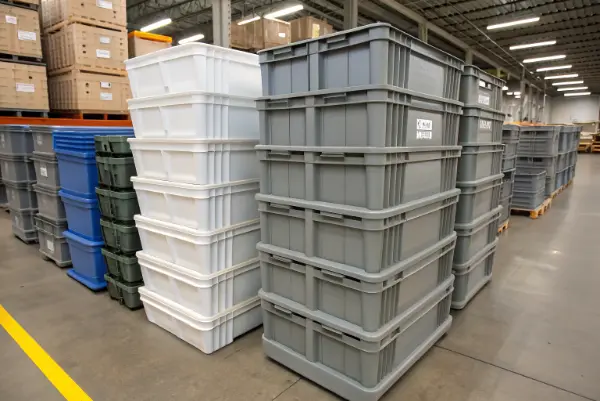
What Design Features Matter Most for Stackable Containers?
Match the container footprint, stacking interface and load path to the intended pallet, shelf or floor support. Rectangular footprints can improve packing efficiency on compatible rectangular spaces, but dimensions, handles, clearances and access still leave limits. Matching shape alone does not distribute every load evenly.
Review how the loaded container above bears on the lid, rim, corners, walls and base below. Reinforcement should follow that load path. Thick sections or ribs can also introduce sink, distortion or difficult filling, so demonstrate their benefit using the proposed resin, geometry and support conditions.
| Feature | Potential value | What must be checked |
|---|---|---|
| Common footprint | Fit within the storage or transport module | Overhang, usable internal volume, handles and retrieval clearance |
| Lid/base engagement | Improve lateral registration | Actual engagement, tolerances, loaded stability and compatible mating parts |
| Corners and rim | Carry defined stack loads | Local stress, deformation and long-term creep at service temperature |
| Base and ribs | Manage support and bending | Actual rack/pallet support span, load distribution and molding constraints |
Interlocking features do not make a stack safe against arbitrary impact, vibration or uneven support. Define the handling conditions, inspection criteria and service environment; durability and outdoor performance require suitable material and evidence rather than a general “many years” promise.
How Can You Maximize Space Using Vertical Stacking?
Use container families with a verified common stacking interface; equal height is not always necessary. Check footprint, base/lid engagement, payload and stack-load limits. Keep the handling and facility clearances required for the rack and site. Place heavy loads low where appropriate, and mix container sizes only within an approved compatible system.
Calculate capacity from actual stack pitch and required clearances. A nested or interlocking interface can make stack pitch different from overall container height. Leave room for lifting and retrieval, and follow the facility’s storage and fire-protection requirements rather than filling every available millimetre.
Separate the payload rating of one container from the supported load on the bottom container of a stack. Include the gross mass of the containers above it, the load duration, temperature, support and handling conditions. A product carrying a “high load” label is not a defined stacked system.
| Decision | Required input |
|---|---|
| Combine container sizes | Documented compatible interface and approved loaded configuration |
| Set stack height | Released stack pitch, available height, required clearances and load limits |
| Allocate contents | Gross mass, center of gravity, retrieval method and approved placement |
| Use a rack or pallet | Support locations, rated system and handling restrictions |
Heavy loads are often placed lower to manage the center of gravity, but this does not replace a validated configuration. The geometric calculation below only screens fit; the permitted count may be lower because of load, creep or site requirements.
What Are the Best Use Patterns for Quick Access?
Select the access method as well as the stacking method. An open-front bin can allow picking while supported in its intended system, but the opening changes the structure and may limit payload, item retention or dust protection. A drawer or closed tote may be more appropriate for other duties.
| Use | Candidate arrangement | Check before choosing |
|---|---|---|
| Frequent small-part picking | Open-front bins or supported drawers | Reach, item retention, bin/support rating and replenishment route |
| Traceable closed storage | Labeled totes; transparent walls where suitable | Part number, revision, lot identification and required protection |
| Mixed item sizes | Compatible modular family | Approved supports and interfaces rather than a mixture of unrelated bins |
| Individual transport | Handles and closure suited to the loaded container | Gross mass, grip, handling method and opening security |
Clear walls may help identify contents but do not replace stock or traceability labels. Choose transparency only where the material and required protection are suitable. Labels should remain legible and attached under the actual handling and cleaning conditions.
Ergonomic handles also matter here. Good handles enhance portability. They support handling of an individual container within its rated load; do not carry a stack unless the system is specifically designed and approved for that operation. Your workers will thank you for buying boxes with comfortable handles.
How Do You Select the Right Stackable Plastic Container?
Illustrative purchasing error, not a documented customer case: buying by outer dimensions alone can miss stack-interface compatibility, payload, bottom-box load and retrieval requirements. Check the actual loaded configuration before committing to tooling or a large order.
Define the required protection: dust, splash, humidity, vapour transmission or another exposure. A gasket does not automatically establish airtightness or prevent corrosion; seal geometry, closure force, contents, residual moisture and the test method matter. Agree an application-specific acceptance test.
| Selection check | Evidence to request |
|---|---|
| Footprint and support | Container and storage-interface drawings, including overhang and clearance limits |
| Payload and stacked load | Separate ratings with configuration, temperature, duration and support conditions |
| Engagement and stability | Compatibility and test results for the proposed loaded arrangement |
| Protection | Agreed dust, splash, leak or other application-specific acceptance test |
| Material and condition | Exact grade, relevant environmental resistance, inspection and retirement criteria |
| Handling | Loaded mass, handles, retrieval and equipment requirements |
A rough base is not automatically an effective anti-slip system, and a gasket alone does not prove airtightness. Ask for evidence covering the supplied configuration. Retain the approved drawing and test conditions so later material or geometry changes can be assessed.
How Do You Calculate Usable Stack Capacity?
Use the released stack drawing. For a first container of height H and additional stack pitch P, n containers occupy H + (n − 1)P. The permitted number must satisfy both available height after required clearances and the rated loaded-stack condition.
Hypothetical example: an available envelope of 1,500 mm, a project-specific handling allowance of 150 mm, a first-box height of 300 mm and a stack pitch of 290 mm allow four boxes geometrically: 300 + 3 × 290 = 1,170 mm. Five boxes occupy 1,460 mm and exceed the 1,350 mm net envelope. The 150 mm allowance is illustrative, not a general safety minimum. Load, temperature, creep, rack support and site rules can reduce the permitted count further.
What Should a Container Tooling RFQ Include?
- Pallet/rack footprint and interface drawings, useful internal volume and retrieval method.
- Payload, gross mass, number of loaded boxes above the bottom container, duration and service temperature.
- Drop, long-term creep, loaded-stack stability and lid-engagement acceptance criteria.
- Resin grade, any approved recycled content and compatibility with the current container system.
Use a container DFM review to compare ribs, corners, draft, wall transitions and stack interfaces before tooling. Send the complete storage and handling requirements and email drawings to jerry@ckmold.com so the proposed mold can be evaluated against an actual duty, rather than an unspecified “heavy-duty” claim.
Reference: OSHA materials-storage stability guidance addresses stable, secured and height-limited storage; the dimensions in the example are not taken from that regulation.
Conclusion
Storage efficiency comes from a compatible footprint, a defined load path and an accessible, qualified stacking arrangement. Use the stack-pitch calculation to check space, then apply the lower limit imposed by load, temperature, duration, support and site conditions. Specify those requirements in the tooling RFQ rather than relying on a general “heavy-duty” or “stackable” label.