
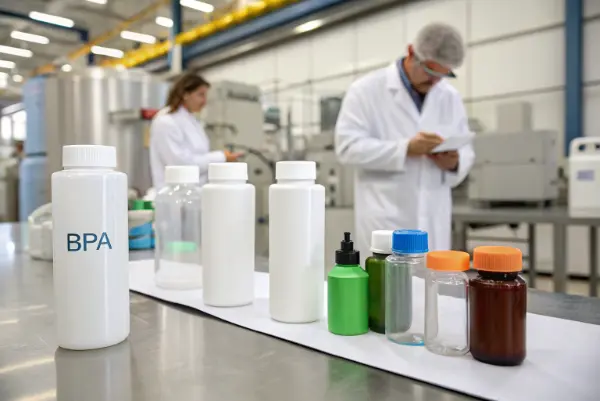
Choose a container material from its intended contents, contact time, temperature, cleaning and reuse conditions. A BPA-free claim answers one substance question; it does not establish the safety or suitability of the complete container.
BPA-free describes a specific substance claim, not the safety of the complete container. PP, PET, HDPE and selected copolyester grades can be candidates, but the exact resin, additives, colorants, closure and intended use must be assessed together. Start with food type, contact time, temperature, cleaning method and destination market before selecting a material.
Use the sections below to build a material and manufacturing specification. A BPA-free label is useful only when its scope and supporting evidence are clear; it cannot promise safe use under every possible condition.
What are BPA free materials?
Finding materials without BPA can feel like a big puzzle. If you pick the wrong plastic, your containers might fail or leak bad chemicals. This mistake costs lots of money. The good news is that you have many clear and strong choices right now.
PP, PE, PET and some copolyesters are commonly considered when a design excludes BPA-based polymers. Confirm the supplier’s declaration for the exact grade and formulation, including coatings, liners and recycled content. Glass, stainless steel and silicone are alternative material systems with their own processing, breakage, corrosion or food-contact considerations.
Common Plastic Choices
PP is often considered for lightweight containers and closures; microwave use requires a suitable grade and validation of the finished article and its instructions. PET can provide clarity, while hot-fill and repeated washing need grade-specific assessment. Tritan is a brand of copolyesters, not a universal performance rating. Compare the nominated grades and manufacturing routes before committing to a mold.
Glass and Metal Alternatives
Glass and stainless steel can be useful alternatives to molded plastics. Glass needs impact and thermal-shock assessment; steel grade, coatings and corrosion resistance need to suit the contents and cleaning chemicals. Heat retention depends on the complete container design, including insulation and closure, rather than the material name alone.
Comparing the Choices
| Material option | Useful screening question | Limit to verify |
|---|---|---|
| PP | Lightweight body, hinge or closure? | Grade-specific heat, creep and final-use testing |
| PET | Is clarity the main requirement? | Manufacturing route, drying and any hot-fill/reuse claim |
| Copolyester, including Tritan grades | Which clarity and impact requirements matter? | Exact grade, heat exposure, chemistry and cleaning cycles |
| Glass | Can the application tolerate weight and breakage? | Thermal shock, decoration and closure compatibility |
| Stainless steel | Is a metal container appropriate? | Alloy, corrosion, coatings and insulation design |
Define the required performance before choosing the resin or tooling route. A low resin price may be offset by drying, cycle time, scrap, closure leakage or failed washing tests. A material review should compare total accepted-part cost and the evidence needed for the intended application.
What Evidence Is Needed Beyond a BPA-Free Claim?
A substance claim should be evaluated alongside the full formulation and exposure conditions. The next section explains what to ask a supplier instead of relying on a blanket “non-toxic” description.
There is no universally safest material for every food, temperature and reuse condition. “BPA-free,” “natural” and “food grade” do not establish overall safety. For plant-filled plastics, identify the complete formulation: bamboo mixed into a plastic food-contact article must not be assumed equivalent to an untreated bamboo item.
Evaluate Plastic Grades and Complete Formulations
HDPE and LDPE are useful candidates for many containers and closures, but the specific grade, additives and intended use determine suitability. Mechanical toughness and low BPA content do not prove that no substance can migrate. Request documentation for the actual formulation and the finished article’s service conditions.
The Power of Natural Materials
Glass, metal and silicone also require a defined material specification and appropriate finished-product assessment. The European Commission has specifically addressed unauthorized bamboo and other plant additives in plastic food-contact materials. Check the exact composition before making an environmental or safety claim.
Compare Materials by Intended Use and Required Evidence
| Material/system | Potential application | Evidence to request |
|---|---|---|
| HDPE | Rigid containers or closures | Exact grade, additives and intended-use declaration |
| LDPE | Flexible closures or squeeze applications | Formulation, contents compatibility and temperature limits |
| Plant-filled plastic | Only after formulation review | Identity and authorization of each component for the target use |
| Silicone | Flexible seals or components | Compound identity, cure/post-cure controls and applicable migration assessment |
Request the technical data sheet, SDS, grade and batch identity, and a food-contact declaration addressing the intended market and use. An SDS supports workplace handling; it is not a certificate that the final container is non-toxic. Agree who reviews composition and who supplies any required finished-article test evidence.
Are BPA free containers safe?
It is scary to think your products might hurt someone. Just because a label says BPA-free does not mean it is fully safe for all uses. We must look at how we use and test these containers to be sure they protect the buyer.
A BPA-free container can be suitable for a specified application when formulation, manufacturing and finished-article evidence support that use. Assess repeated use, food type, contact time and temperature; a passing result for one test condition does not authorize every use.
The Hidden Dangers in Making Containers
Manufacturing controls matter alongside material selection. Manage actual melt temperature, residence time, contamination, drying where required, and approved regrind use. Excessive thermal history can degrade resin; mold temperature also affects cooling and residual stress. Validate the actual process rather than treating a warm mold alone as proof that a container is unsafe.
Real Testing for Real Safety
A qualified laboratory or compliance specialist should define a test plan for the destination market, formulation and intended use. Migration assessments can use specified simulants, contact conditions and analytical limits. Their conclusions apply to the tested scope; they do not mean “zero chemicals” or replace composition and traceability evidence.
Safety Checklist for Manufacturing
| Control | What to document | What it establishes |
|---|---|---|
| Material identity | Resin/additive/colour grade and batch | Traceability to the reviewed formulation |
| Processing | Validated settings and change control | A reproducible manufacturing process |
| Finished article | Applicable tests and use conditions | Evidence within the stated assessment scope |
Illustrative troubleshooting example, not a documented CKMOLD customer case: if a clear container cracks, review resin identity, drying, residual stress, wall transitions and cooling before changing materials. Any resin change also requires renewed mechanical and food-contact assessment; improving breakage performance does not by itself establish chemical safety.
Is BPA free and FDA approved?
Do you get confused by all the strict government rules? Missing an FDA rule can cost your business a huge amount of money and lost time. Let us make FDA approval very easy to understand so you can sell your goods with confidence.
BPA-free does not mean FDA approval of a finished container. FDA explains that the regulatory status of a food-contact article depends on its individual components and applicable authorizations and use limitations. Ask for the basis covering the specified material, supplier and conditions of use.
Understanding FDA Rules
For a US project, identify the applicable food-contact basis with the supplier and qualified reviewer. BPA status is only one part of that review. Avoid treating a general supplier certificate, a laboratory logo or a resin family name as a blanket approval of every finished container.
How to Document the Food-Contact Basis
The purchase specification should identify resin, colorants, additives and intended-use restrictions. Obtain the corresponding supplier declarations and maintain batch records. Document cleanliness and change control, and define the finished-article evidence required for the target market. These records have different roles; no single “safety certificate” replaces the complete review.
FDA Steps to Follow
| Action | Responsible party to agree | Required output |
|---|---|---|
| Select formulation | Buyer, resin supplier and manufacturer | Named grades and permitted-use conditions |
| Review documentation | Supplier and qualified reviewer | Applicable declarations with scope and limitations |
| Control production | Manufacturer | Traceability and documented process/change control |
| Assess the finished article | Buyer and qualified laboratory/reviewer | Applicable evidence for the defined use |
Keep the material and manufacturing records consistent with the product sold. Reassess changes to resin, colorant, recycled content, design or use instructions. The final compliance route and any corrective action depend on the product and market; avoid assuming the same approval process applies to every container.
What Should You Send a Container Manufacturer Before Requesting a Quote?
- Container and closure CAD, capacity, wall target and annual volume.
- Food or other contents, contact duration, filling temperature and any microwave, freezer or dishwasher claim.
- Destination market, nominated resin/additive/color grades and approved recycled-content policy.
- Leak, drop, closure-cycle and appearance acceptance criteria; identify who supplies regulatory review and testing.
For material-specific food-contact questions, also read our TPE food-contact selection guide. For a container tooling project, send the project requirements through our RFQ form and email CAD and drawings to jerry@ckmold.com. The first review can identify missing inputs and tooling risks; it is not a blanket product-safety approval.
Does a BPA-free label establish food-contact suitability?
No. It addresses BPA within its stated scope. Suitability also depends on the full formulation, intended use and applicable finished-article evidence.
Primary references: FDA component-by-component food-contact guidance; European Commission guidance on bamboo additives in plastic food-contact materials.
Conclusion
Choose a container material from a defined use specification, then verify the exact formulation, process and finished-article evidence. BPA-free can be one requirement in that specification; it should not replace assessment of heat, mechanical performance, chemical migration or cleaning and reuse.