
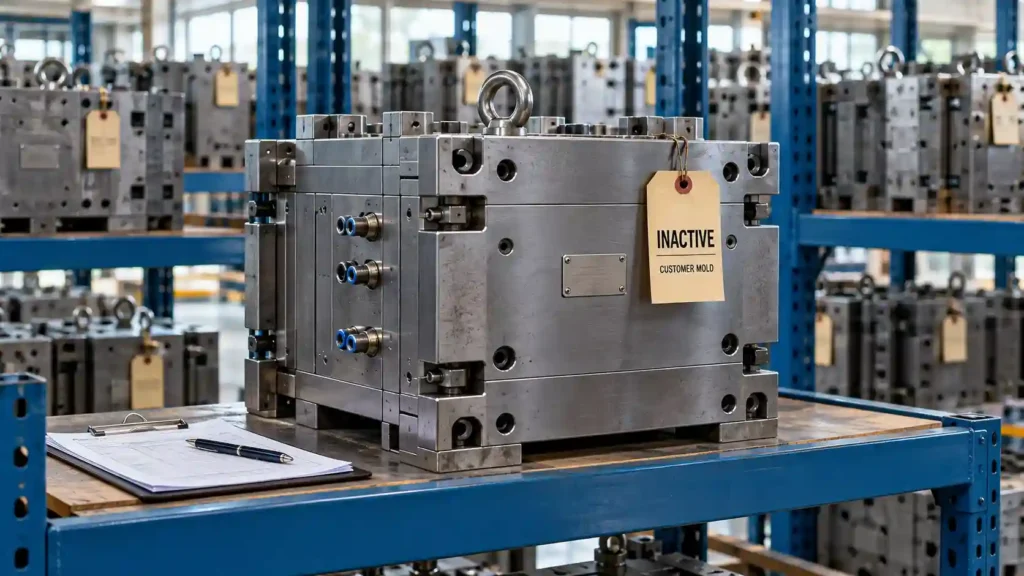
The mold was an investment. The parts shipped. When sales waned, or a product line was discontinued, or a new design succeeded the old one, sales orders ended. Months go by. Your part number is imprinted on a steel tool on a rack in a factory in Guangdong.
What does it do then?
This depends on three factors: ownership of the mold, the agreement regarding the inactive mold, and how the factory manages the inactive mold. Buyers are unaware of any of these until they reorder in two years. This guide explains each one, with reference to the way CKMold handles customer molds, with commercial coordination in Shenzhen and manufacturing resources in Dongguan. This way, you have some idea of what you’re in for and what to ask for in writing before the final order ships.
Who Owns the Mold Once Production Stops?
When the orders cease, it’s not because the ownership changes. Whether it is used weekly or stored for 3 years, if you paid for the tool and your contract stipulates that the mold belongs to you, it will belong to you.
The issue is that many buyers assume they own the mold without having it documented. An "invoice line" item for a "mold fee" or "tooling charge" doesn’t help you as much as you believe. Ownership can transfer to you even while the factory continues to hold the mold, but the agreement needs to say so clearly. Without a written clause covering ownership, a factory may argue that the fee paid for the use of the tool rather than the tool itself.
This is the reason it’s important to use ownership language in the contract right from the start. A solid clause identifies the mold by number. It specifies when ownership transfers to the buyer. Transfer on final tooling payment is one possible arrangement, but it is a contract term the parties agree on, not a universal rule. The clause should also define custody, meaning how the factory holds and looks after the mold, and the conditions under which it will be released. If you are preparing one, our guide to injection molding agreements will go over the clauses that are important. It’s also why the payment structure for a new injection mold project is worth more consideration than it typically receives. In many agreements, the final tooling payment is the point where ownership changes hands.
Separate the physical mold and its design data, also, in your mind. Question whether the 3D mold design files, steel certificates, and process sheet are included with the tool. If you own a mold but can’t properly care for it or rebuild it, it’s valued at a lot less.
How Long Will a Factory Store an Inactive Mold?
There is a breaking point for every molder; written or unwritten. The cost of the floor space is an expense. The weight of the molds varies from a few hundred kilos to a few tons. If a factory has hundreds of customer tools, you just can’t store them all forever.
Storage periods vary by supplier and by agreement. Some suppliers set a fixed inactivity window, some keep molds as long as orders continue at a regular interval, and others never define it at all. There is no industry-wide standard, so the period that matters is the one written into your own agreement.
What counts as "inactive" should be defined in the agreement. If the period is measured from the last production order, occasional emails or calls to the factory may not reset it.
Many factories don’t even have a number, and that’s where problems begin in China. The policy is kept in someone’s head or in a line in the quotation terms. That is why storage and inactivity terms are best confirmed in writing at the RFQ and agreement stage rather than assumed. If you don’t know your current supplier’s number, ask for it in an email you can keep a record of.
Will I Be Charged a Mold Storage Fee?
After a mold breaks through its free storage window, storage fees are typical. These are typically charged per mold, monthly or yearly, depending on the mold’s size or weight. Some factories don’t charge a fee, or they may charge nothing at all if you order regularly and only start charging when the tool goes dormant.
Two related costs are worth watching. The first is a setup fee on the next run, which covers mounting the mold, bringing it to temperature, and setting up the process again. The second is unpaid charges. Depending on the contract and applicable law, outstanding invoices for parts, mold work, or storage may affect when and how the mold is released. That does not mean any unpaid invoice automatically gives the factory the right to keep a customer’s mold, but it is a good reason to settle open balances and agree on release conditions in writing.
Prior to the production stop, ask three questions. What is the free storage time? What will be the charge after that? And will a small order per year maintain it on active status?
How Does the Mold Physically Change When Idle?
A steel mold doesn’t stay the same just because nobody is using it. In a humid environment, it degrades. This is a very real problem in the humid summer conditions found in southern China: surface rust will form on cavity steel in a few days if it is not protected.
A good factory prepares and protects the mold before placing it in storage. The usual steps:
- Wipe out the cavity, core, and parting line of resin residue and gas deposits.
- Dry out cooling channels with compressed air to prevent corrosion from standing water.
- Apply rust preventative to the moulding surfaces and moving parts like slides, lifters, and ejector pins.
- Close the mold, strap the mold, and tag with the mold number, customer’s name, and the date of the last run.
- Keep last-shot samples from the final run as a reference for the next run.
- The location of the mold is also important. It should be stored off the ground, within racks or pallets, and sheltered from coolant splashes and forklift traffic.
Ask any supplier who does this work and whether it is logged. Restart time is much faster for a mold with a maintenance record and last-shot samples than for a mold pulled from the press and parked.
Will a Factory Scrap/Dispose of My Mold?
It can happen, but it should only happen under agreed conditions. Whether a factory may dispose of a customer’s mold depends on what the agreement says: how long the mold must be inactive, how and to whom notice is sent, how long the owner has to respond, and who must authorize disposal in writing. Stopping orders does not, by itself, give a factory permission to scrap your mold.
Disputes usually start with poor communication rather than bad faith. The buyer’s contact leaves the company, the factory’s notices go to an inbox nobody checks, and questions about the mold go unanswered. A missed email should not authorize disposal on its own, but unclear terms and outdated contacts make misunderstandings far more likely.
This can be avoided by:
- Maintaining up-to-date information on all the molds in the factory, including a current contact.
- Inquiring for an annual status report on the location and condition of the mold.
- A clause requiring written notice by email and courier, a response period before any disposal (for example, 60 to 90 days, which can be negotiated), and the owner’s written authorization.
- Documenting mold numbers, photos, and nameplate information when the tool is completed.
If you are sure you will never use the part again, it’s a fair assumption to make that the mold should be scrapped. Just be sure it’s your choice.
How Do I Get My Mold Back or Move It to Another Supplier?
If you are the owner of the mold, and your account is up to date, you can request the release of the mold. It may be sent to you, to a third-party warehouse, or directly to another molder.
It’s not just putting a crate on a truck. Ask for:
- Prior to the mold shipment, an inspection and condition report is issued.
- Open maintenance items are indicated and priced.
- The mold design files, steel specifications, and the last approved process parameters.
- Provide last-shot samples and customer-approved reference samples, clearly identified.
- Drain and dry the cooling circuits, apply suitable corrosion protection, and secure the mold in appropriate transport packaging.
There is also export documentation to handle, and it will take time to get the mold out of China.
Molds also travel the other way. CKMold receives tools from other factories via the mold transfer service. The same inspection is done first: steel, cooling, ejection, and wear; then a trial before going into production. Transferred molds sometimes need repairs the previous supplier never mentioned, which is another reason a documented maintenance history is worth asking for.
What Does It Take to Restart Production After a Long Break?
It takes more than just hanging a dormant mold back in the press to bring it back to life. You may need to wait for a brief period for the qualification to be repeated, particularly if the mold has been stored for over a year.
Here’s how a typical restart would look. The toolroom takes off the rust preventative, cleans and examines the cavity, verifies that slides, lifters, and ejector pins are free to move, and pressure tests the cooling circuits. Then the mold is installed, with the last approved process sheet used as a reference. Those settings must be checked against current production conditions, such as the press, auxiliary equipment, and material, and adjusted where needed. First parts are inspected against the current approved drawings and specifications. Last-shot samples show how the mold was running when it was stored, while customer-approved reference samples show what the customer accepted, so the two serve different purposes. If the resin grade, material supplier, or press has changed, the change should follow the customer’s change-control and approval requirements; a first article inspection alone may not be enough.
Allow some time. A clean, well-stored mold can be up and running again in a few days. If it is not stored properly, it can require polishing, a replacement part, or weld repair before it can make a good part. When an old program returns, CKMold’s engineering team is responsible for this type of review.
The cost of pricing can also vary. A part price quoted two years ago may no longer apply. Resin prices fluctuate, and setup costs on a small restart run can increase the unit price. Before restarting an old order, reconfirm pricing and lead time rather than relying on a previously issued PO.
What Should I Settle Before I Stop Ordering?
It is best to deal with all this before the final run ships. A short checklist:
- Document ownership and transfer of title to the mold.
- Request the period of storage, definition of "inactive," and fees in writing.
- Ask for the mold to be cleaned, rust-protected, and stored, with photos.
- Keep your own last-shot samples and customer-approved reference samples.
- Ask for the design of the mold and the process parameters.
- Provide a long-term contact, not only the current project buyer.
- Decide whether to store the mold at the factory, move it to a third-party warehouse, or arrange its return or transfer.
Don’t be afraid to pay attention to the points a supplier resists. In our article on how to know if an injection molding manufacturer is trustworthy, we listed other warning signs to look for.
Planning with CKMold
If it’s a good steel mold, it will last for years and can be used for many breaks if proper care is taken between runs, and paperwork is kept up to date.
Since 2002, CKMold has been manufacturing injection molds, with commercial coordination in Shenzhen and manufacturing resources in Dongguan. The company is certified for ISO 9001, ISO 14001, ISO 13485, and IATF 16949.
Mold ownership, storage terms, and transfer conditions are best confirmed during the RFQ, not sorted out later. For those who have an inactive mold at your current supplier or for those who are considering a new project and want to get the terms of the inactive mold right from the get-go, please reach out to CKMold.