
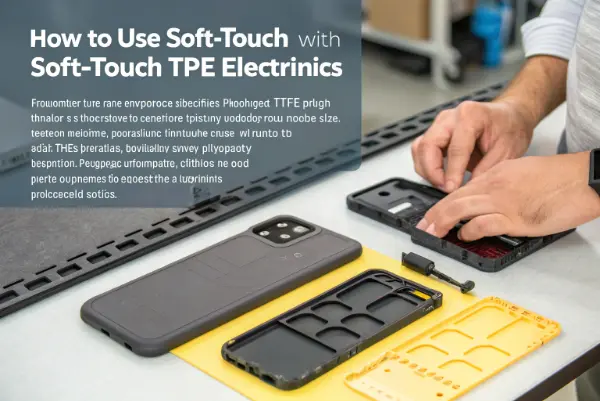
A premium soft-touch surface comes from a controlled material–geometry–tool–process system, not from choosing a low Shore hardness alone. Start with the user’s grip, wear and cleaning conditions; then match a TPE grade to the rigid substrate and validate the appearance and bond on production-representative parts.
Translate “premium feel” into measurable requirements
Words such as soft, silky, dry, grippy and rubber-like are subjective. A useful design brief converts them into samples and testable limits:
- approved color, gloss and texture plaque under defined lighting;
- target Shore scale and hardness, with test method and conditioning;
- overmold thickness and the allowed variation in apparent feel;
- coefficient-of-friction or grip comparison where it affects use;
- skin-oil, sunscreen, hand-sanitizer and household-cleaner exposure;
- scratch, abrasion, staining and color-transfer acceptance; and
- peel or functional bond acceptance after aging.
A thin overmold can feel significantly harder than a thick plaque made from the same TPE. Avient’s guidance on apparent hardness versus thickness illustrates why the drawing should control geometry as well as nominal durometer.
Choose the rigid substrate before the overmold grade
The substrate is the first material decision because TPE adhesion is chemistry-specific. A grade formulated to bond to PC/ABS may not bond to PA, POM or PP. The full substrate grade also matters: glass reinforcement, flame-retardant packages, recycled content and mold-release additives can change the interface.
| Design question | What to define | Why it matters |
|---|---|---|
| Substrate identity | Manufacturer, grade, color and additives | Controls chemical compatibility and processing window |
| Overmold function | Grip, cushion, seal, impact feature or cosmetic band | Determines thickness, hardness and load path |
| Bond strategy | Chemical adhesion, mechanical interlock or both | Reduces dependence on a single interface mechanism |
| Exposure | UV, sweat, skin oil, cleaners, heat and drop cycles | Sets conditioning and aging tests |
| Appearance | Texture, gloss, witness-line and gate limits | Drives tool finish, gate position and process control |
Design the interface to resist peeling
Place the overmold boundary away from an edge that the user can repeatedly lift. Use radiused transitions, adequate section thickness and mechanical retention such as through-holes, undercuts or wrap-around geometry where the assembly permits it. Avoid feather edges: they are difficult to fill consistently and create a peel starter.
Gate location should keep the advancing flow front hot enough to wet the interface without trapping air. Vents are especially important at the end of fill. Texture can increase contact area, but it cannot rescue an incompatible or contaminated material pair.
Protect the interface during molding
Teknor Apex’s overmolding adhesion guidance identifies chemical compatibility, heat and process conditions as major influences. The exact resin data sheets remain the starting point. In production, control:
- substrate cleanliness and absence of unapproved mold release;
- drying of hygroscopic materials as specified by the supplier;
- substrate temperature and time between first and second shots;
- TPE melt temperature and residence time;
- injection speed sufficient to fill without moving or distorting the insert;
- hold until gate freeze without overpacking the soft feature; and
- cavity-to-cavity and lot-to-lot bond verification.
Validate feel, appearance and durability together
- Approve molded plaques for color, texture and initial haptics.
- Mold representative geometry using the selected substrate and overmold grades.
- Measure bond with a defined peel, pull or functional test rather than hand-pulling alone.
- Condition parts with the expected cleaners, skin oils, UV/heat and wear cycles.
- Repeat appearance, tack, bond and functional checks after conditioning.
- Freeze the approved material pair, texture standard and process window.
What to include in an RFQ
Send the 3D model, rigid-resin grade, desired TPE hardness, approved feel/texture sample, cosmetic zones, exposure list, bond test, annual quantity and assembly requirements. CKMOLD can review shutoffs, retention, gates and manufacturability through DFM analysis and overmolding services. For a project review, request a quote with these inputs.