
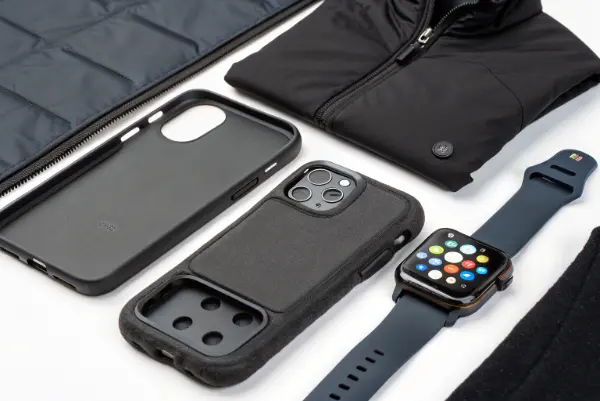
TPE is used in consumer electronics where a flexible feature adds grip, sealing, strain relief, impact control or vibration isolation. It should not be specified as a generic “soft plastic.” The component function, substrate, chemical exposure, flame/electrical requirements and service environment determine the TPE family and grade.
Match the TPE to the component function
| Component | Primary function | Key selection questions |
|---|---|---|
| Protective case or corner bumper | Grip and impact-energy management | Drop temperature, wall thickness, substrate retention, abrasion and skin-oil resistance |
| Overmolded grip or button | Haptics and user control | Apparent hardness, texture, bond, actuation force and cosmetic boundary |
| Seal or gasket | Limit dust or liquid ingress | Compression set, sealing load, joint tolerance, chemical exposure and aging |
| Cable strain relief | Control bend radius and flex fatigue | Jacket adhesion, repeated-flex test, temperature, UV and flame requirements |
| Internal vibration pad | Isolate vibration or prevent rattle | Compression behavior, creep, temperature and assembly preload |
| Wearable skin-contact feature | Comfort and retention | Sweat, skin oil, cleaning, sensitization assessment and long-term tack |
Do not use hardness as a shortcut for performance
Shore hardness measures resistance to indentation under specified conditions. It does not directly specify stiffness, friction, compression set, tear strength or damping. The molded thickness and rigid support beneath an overmold also change perceived softness. Select several candidate grades using the full property profile, then compare molded samples with the intended geometry.
Substrate and bond design
Standard styrenic TPE or TPV grades may bond well to some polyolefins but poorly to engineering plastics. Specialty grades are formulated for PC, ABS, PC/ABS, PA, PBT, POM or other substrates. Confirm the exact material pair in a supplier compatibility guide and prototype it. Add mechanical retention where failure would expose an edge or compromise sealing.
Keep the interface free from mold release, oil, dust and moisture. Place the boundary away from repeated peel loads. A texture can help mechanical keying, but it does not replace chemical compatibility or adequate flow temperature.
Electronic-product exposures that are easy to miss
- Skin oils and cosmetics: can change gloss, color, friction or tack.
- Cleaning agents: alcohol-rich wipes and household cleaners can affect the TPE or induce substrate stress cracking.
- Heat: charging, battery operation and a closed vehicle can elevate service temperature.
- Outdoor light: UV and weathering resistance are grade-specific; color can influence results.
- Flame/electrical rules: a flame-retardant claim must be tied to the exact grade, thickness, color and applicable listing or test.
- Migration: oils or additives can mark neighboring plastics, coatings or packaging.
Design and tool checks before release
- Define the flexible feature’s load, deflection and environmental exposure.
- Freeze the rigid substrate and identify compatible TPE candidates.
- Review overmold thickness, feather edges, shutoffs and mechanical interlocks.
- Position gates and vents to fill cosmetic surfaces without air traps or hesitation.
- Specify texture and gloss using a physical standard, not a vague adjective.
- Plan bond, drop, sealing, flex and conditioned-aging tests.
- Approve production-representative samples before cosmetic and material limits are frozen.
When TPE is not the best option
Silicone, thermoset rubber, foam, a separate gasket or a rigid living hinge may be better when the application requires a temperature range, compression behavior, chemical resistance or geometry that the screened TPE grades cannot meet. A two-material design also adds tooling and recycling complexity. The choice should be made at the product-system level rather than by appearance alone.
Build a useful manufacturing brief
Provide the CAD model, component function, rigid grade, candidate TPE, hardness and thickness, texture sample, environmental exposures, acceptance tests and forecast quantity. CKMOLD can assess the hard-soft interface through product design support, DFM analysis and overmolding. Use the RFQ page for project-specific tooling feedback.