
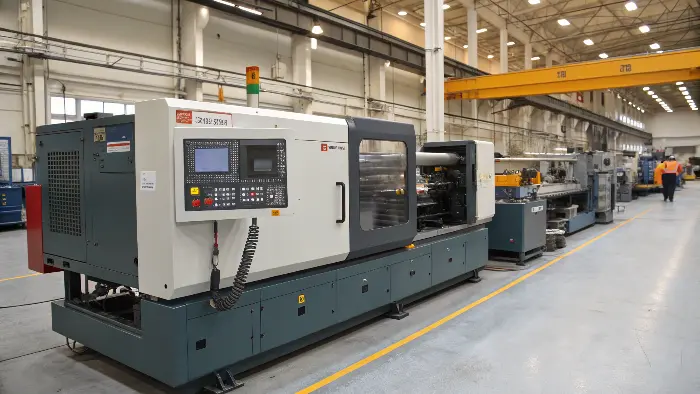
The phrase “180-ton PET preform injection molding machine” identifies a nominal clamp-force class and application, not a guaranteed preform output. Selection still depends on shot, screw/plasticizing, rate/pressure, mold, resin preparation, cooling and controls.
Approval requires the exact machine model, screw/injection unit, mold/cavity/shot, PET grade and handling, cooling/auxiliaries, cycle basis and preform acceptance plan. Nominal tonnage alone is insufficient evidence.
Related CKMOLD resources: production injection molding, multi-cavity molds, mold testing and validation.
An industrial equipment is a 180 ton PET preform injection molding machine. It employs the injection molding technique in production of PET preforms. These are the initial forms which the bottles we use on a daily basis, are blown into. The 180 ton section can be referred to as its clamping force that is important in ensuring that the mold remains firmly clamped together throughout the production process.

Evaluate the complete PET preform cell rather than the clamp-force label alone. The mold, shot and screw, PET preparation, plasticizing and injection performance, hot runner, cooling, controls, auxiliaries and acceptance tests must work as one specified system.
What is a PET preform?
Have you ever thought why plastic bottles originate? It is no magic but a certain production work. As a person engaged in the manufacture of products or packaging them in containers, you need to familiarize yourself with the PET preforms so that you know the cycle of construction of containers using these raw materials.
A preform of PET is an intermediate of occurring of bottles manufactured by a PET material. It is a hollow vessel which resembles a thick-walled test tube with the neck threads already made on the bottle. These preforms are manufactured in the form of Polyethylene Terephthalate (PET) resin which is subsequently heated into stretched-blown molds to give them the final bottle design. Their quality has a direct bearing on integrity and appearance of the final bottle.

Now we will take a closer look at PET preforms. Such small things are not as simple as it seems. They are especially designed to evolve into something bigger and useful.
The body (Polyethylene Terephthalate, or PET) used in it is selected because of its strength, translucency, and barrier effect. It is a kind of polyester.
But why go about using a two step process of preforms? To begin with, it is economical. Preforms are easily and cheaply transported and stored because they are small and compact in contrast with fully formed bottles. Consider that it would cost millions of bottles instead of millions of microscopic preforms to ship. The saving is huge in space. Second, there are two steps that can be optimized (injection molding of the preform followed by blow molding the bottle). Preforms can be produced at one facility and transported to other bottling centers across the globe.
Here are some key characteristics of a good preform:
| Feature | Importance |
|---|---|
| Neck Finish | Ensures a proper and secure seal with the cap. |
| Weight | Determines the final bottle’s volume and wall strength. |
| Wall Thickness | Affects even material distribution during blowing. |
| Clarity | Important for aesthetic appeal and detecting impurities. |
| Material Grade | Must be suitable for the intended contents (e.g., carbonated drinks, hot-fill). |
| Gate Vestige | Should be minimal to avoid issues in blowing or aesthetics. |
Understanding these aspects of a PET preform helps you appreciate why the machines that make them, like the 180-ton PET preform injection molding machine, need to be so precise.
PET Preform Injection Molding Is Grade- and System-Specific
PET preform molding plasticizes a specified PET grade, distributes it through a runner/hot-runner system and cools the preforms sufficiently for stable ejection. Moisture control, residence history, melt and mold conditions affect degradation, IV/colour, acetaldehyde and appearance. The material supplier’s current grade sheet and the dryer/machine instructions—not one universal drying temperature or moisture number—must define the process.
A production assessment therefore records resin supplier and grade, regrind policy, dryer dew point and residence, throughput, shot mass, screw/recovery performance, hot-runner design, cooling-water conditions and required preform tests. Purpose-built suppliers such as Husky describe PET systems as an integrated machine, mold and auxiliary solution, which is why clamp tonnage alone cannot establish capability.

What are the challenges in PET injection?
Although PET injection moulding sounds simple and straightforward, the process involves a host of parameters. Material dryness, melt temperature, mould temperature, pressures, ventilation and injection speed must all be configured with the right values, set at the right times, to achieve suitable results. PET is very sensitive to water and must be meticulously dried before production.
It is also sensitive to high temperatures, so it is critical to adhere to the established pressures, times and temperatures, , PET was mainly used in blow moulding to produce thin-walled products. Thick-walled products require injection moulding, however, and the process is more complex. The material properties have to be in suitable sync with the mould shape and design, as well as the injection moulding machine.
What Determines PET Preform Manufacturing-Cell Cost?
Published machine-price bands and country stereotypes are not a reliable budget. Compare the complete, quoted cell: machine and controls, mold/hot runner, dryer and material delivery, chiller/cooling, compressor if required, robot/conveyor, inspection, installation, commissioning, spares, training, utilities, freight and support.
For economics, calculate accepted preforms per hour and energy/material use at the approved process—not theoretical shots alone. Ask bidders to state cavity count, shot mass, demonstrated cycle basis, uptime and reject assumptions separately so the comparison can be audited.

What Happens When Machine Fit Is Wrong?
Too little available clamp force can allow parting-line opening or flash, while excess machine size can reduce operating efficiency or place the shot outside a suitable screw-utilisation range. Short shots, haze, degradation, gate defects and poor dimensions can also arise from plasticizing, injection rate/pressure, drying, hot-runner balance, cooling or material—not simply tonnage.
Autodesk’s clamp-force description derives force from the cavity-pressure distribution over projected area. Use that basis with mold layout, machine limits and a validated process; do not diagnose surface quality by changing clamp force alone.
Should You Step Up From 180 to 200 Tons?
Do not select the next nominal tonnage from a generic price table. Compare the candidate machines’ usable shot capacity and screw, maximum injection pressure/rate, plasticizing and recovery, tie-bar/platen and mold opening, ejection, controls, utilities and supplier support. Manufacturer portfolios such as ENGEL’s injection-molding machine range show why machines within a clamp class still differ materially.
Request the exact machine model and an approved mold-machine interface sheet. The machine-selection checklist explains the broader fit calculation.

What the 180-Ton Rating Means
The tonnage describes the machine’s approximate ability to hold the mold closed against cavity pressure over the projected area. It does not directly specify the number of preforms per cycle, shot weight, cycle time or product quality. A smaller or larger preform can require a different machine even if the clamp class appears suitable.
PET Preform Injection Has Special Thermal Requirements
PET is moisture-sensitive and needs controlled drying to protect intrinsic viscosity and appearance. The injection unit, residence time, melt temperature, screw, nozzle and purging method should suit PET. Excessive heat or moisture can cause haze, brittleness, yellowing or performance loss.
Mold and Hot Runner Drive Output
Preform molds often use multiple cavities and hot-runner nozzles with precise temperature and gate control. Neck finish, gate quality, cavity balance, cooling and robot handling affect output and weight consistency. The mold must be balanced for the selected machine and preform design.
Cooling and Cycle Determine Economics
The machine may fill the mold quickly while cooling controls the usable cycle. Chiller capacity, mold circuit flow, preform temperature, ejection and post-mold handling must be checked. Theoretical cycles should be compared with stable weight, appearance, IV, dimensions and downstream blow performance.
Evaluate the Complete Production Cell
Include dryer, loader, mold-temperature control, chiller, robot, inspection, material handling, scrap policy and maintenance. A 180-ton press is appropriate only when the whole cell can produce the required preform consistently.
a 180-Ton PET Preform Injection Molding Machine: Buyer Review Checklist
- Use clamp force as one input and verify shot, injection rate, pressure, mold size and reserve.
- Confirm PET drying, residence time, melt control, screw and purging requirements.
- Check cavity count, hot runner, gate, neck finish, balance, cooling and handling.
- Calculate stable cycle from weight, appearance, dimensions, IV and downstream blow performance.
- Evaluate dryer, chiller, robot, inspection, material handling and maintenance as one cell.
FAQ
How many PET preform cavities can a 180-ton machine run?
There is no universal number; cavity count depends on preform weight, projected area, shot capacity, mold dimensions, injection performance and cycle.
Why is PET drying important?
Moisture can reduce material performance during melt processing and cause haze, brittleness, yellowing or inconsistent preform quality.
Conclusion
A 180-ton rating identifies nominal clamp-force class; it does not determine cavity count, preform weight, cycle or quality by itself. Approve the exact resin, mold, machine, auxiliaries, cooling, utilities and acceptance method as one production cell.