
Struggling to find a material for your construction components that withstands the test of time? You worry about parts failing under harsh weather, leading to costly recalls and a damaged reputation. This constant search for a durable yet affordable solution can be frustrating. PVC, or Polyvinyl Chloride, when combined with injection molding, offers a reliable, versatile, and cost-effective answer that ensures the long-term performance and integrity of your building projects.
PVC can be a strong candidate for construction components when the grade and design match the environment. Its value may include chemical resistance, tunable rigidity, insulation, weathering options, cost and compatibility with existing systems. It is not a universal construction material: temperature, impact, UV, fire requirements, plasticizer behavior, connections and local standards must be verified for the actual product.
Related engineering resources: production injection molding | mold design | mold testing and validation
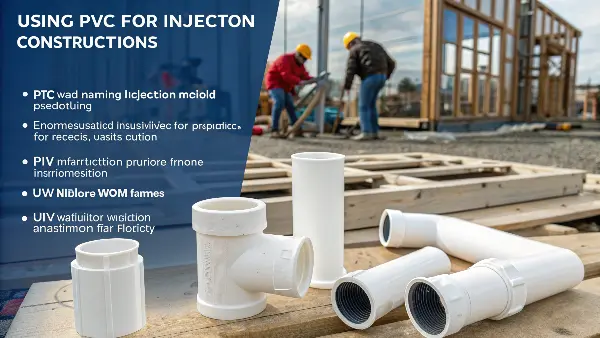
Polyvinyl Chloride (PVC) is a top choice for injection molded construction components because of its exceptional durability, cost-effectiveness, and resistance to environmental factors. It stands up to moisture, chemicals, and UV radiation, preventing rot and corrosion. The injection molding process allows for the creation of complex, precise, and consistent parts like pipe fittings, window frames, and electrical enclosures. This combination provides a low-maintenance, long-lasting solution, making it a smart and reliable investment for the building industry.
We see that PVC is a reliable material for construction. But what exactly gives it this incredible resilience? And how does the manufacturing process of injection molding unlock its full potential for creating the specific parts your projects demand? It’s one thing to know it works, but understanding the details is what gives you a real competitive edge.
What Makes PVC So Durable for Outdoor Construction Use?
Choosing materials for outdoor applications feels like a gamble. You select a material that looks good, but within a few years, it’s cracking, fading, and failing under the constant assault of sun and rain. This leads to unhappy clients and expensive replacement jobs. The solution lies in a material with inherent toughness. PVC is scientifically built to resist these exact environmental challenges, providing peace of mind and lasting quality for decades.
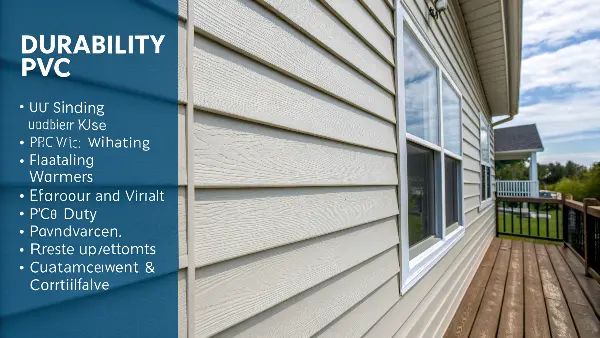
PVC’s durability for outdoor construction comes from its inherent chemical structure. It is naturally resistant to UV radiation, moisture, and a wide array of chemicals, which prevents it from rotting, corroding, or degrading over time. To boost this natural strength, manufacturers include additives like UV stabilizers and impact modifiers. This means PVC components like siding, decking, and window profiles can face harsh weather for years without losing their structural integrity or appearance, making them a truly low-maintenance, long-term solution.
To really understand why PVC lasts so long, we need to look closer at its specific resistances. It’s not just one thing, but a combination of factors that make it an ideal choice for the demanding world of construction. From the molecular level to practical applications, these properties work together to deliver performance you can count on. It’s about more than just being plastic; it’s about being the right plastic for the job.
Why UV Rays Can’t Beat It
One of the biggest enemies of any outdoor material is the sun. Ultraviolet (UV) radiation breaks down the chemical bonds in many materials, making them brittle and discolored. PVC, however, has a natural advantage. The chlorine atoms in its polymer chain help to stabilize it against UV attack. But we don’t stop there. To make it even tougher, we add stabilizers like titanium dioxide (TiO2). This compound is brilliant white and is fantastic at reflecting and scattering UV radiation, acting like a permanent, built-in sunblock for the component. This is why white PVC window frames and fences can stay bright and strong for over 20 years without painting.
Unbeatable Moisture and Chemical Resistance
Water is another major threat. Materials like wood absorb moisture, causing them to swell, warp, and eventually rot. Untreated metal will inevitably rust and corrode when exposed to rain and humidity. PVC is different. It’s hydrophobic, meaning it doesn’t absorb water. Rain simply runs off its surface. This makes it suitable for applications like pipes, gutters, and siding. It’s also highly resistant to a wide range of chemicals, including the salts used on roads in winter and common acids and alkalis found in the soil. This chemical stability ensures that the material won’t break down even in challenging coastal or industrial environments.
| Feature | PVC | Wood | Untreated Steel |
|---|---|---|---|
| Moisture Resistance | Excellent (Does Not Rot) | Poor (Rots, Warps) | Poor (Corrodes, Rusts) |
| UV Resistance | Very Good (with additives) | Poor (Fades, Degrades) | Excellent (No effect) |
| Chemical Resistance | Excellent | Fair | Poor |
| Maintenance | Very Low | High (Needs Sealing/Painting) | High (Needs Painting) |
| Insect Resistance | Excellent (Cannot be eaten) | Poor (Termites, etc.) | Excellent |
How Does Injection Molding Optimize PVC for Complex Building Parts?
Manually fabricating complex construction parts is time-consuming and prone to error. When you need thousands of identical brackets or fittings, traditional methods can lead to inconsistencies and high labor costs, slowing down your entire project. You need a process that is precise, fast, and repeatable. Injection molding is the suitable partner for PVC, transforming the raw material into consistent, intricate components at a speed and scale that other methods simply can’t match.
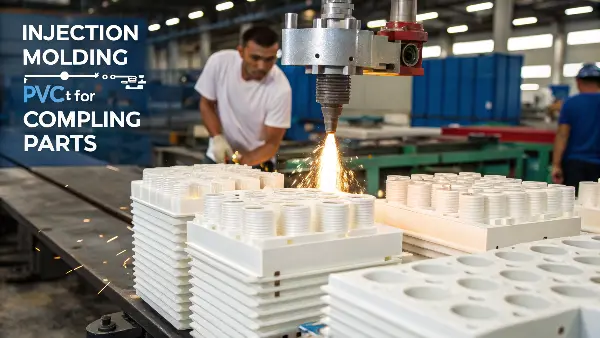
Injection molding optimizes PVC for complex building parts by enabling the mass production of intricate designs with exceptional precision and consistency. The process forces molten PVC into a custom-made mold under high pressure, reliably capturing every detail, from screw threads to snap-fit connectors and textured surfaces. This method creates strong, solid parts with a superior finish in a single, rapid cycle. It is ideal for producing components like electrical junction boxes, complex pipe fittings, and decorative trim with features that reduce assembly time.
The synergy between PVC and injection molding is what makes so many modern construction components possible. It’s not just about making a shape; it’s about making it reliably, thousands of times over, with integrated features that simplify the entire building process. Understanding this will help you see the possibilities for your own designs.
Achieving Suitable and Complex Geometries
Geometry is useful only when the molded feature can be filled, cooled, ejected and inspected without creating weak weld lines or hidden stress. For a clip, drain fitting or enclosure, identify load paths, sealing surfaces, fastener interfaces and outdoor-exposure zones on the drawing. Then review wall transitions, radii, draft, gate position, venting and access for dimensional measurement.
Consistency and Quality Control Are Built-In
In construction, every millimeter counts. A pipe fitting that is slightly off can cause a leak. A window trim that isn’t uniform will look unprofessional. Injection molding delivers amazing part-to-part consistency. Once the mold is made and the machine parameters are set, the first part produced will be virtually identical to the hundred-thousandth. This high level of repeatability is critical for large-scale projects. The process also creates parts with a high-quality surface finish. We can design the mold surface to be smooth, glossy, or even have a specific texture, like a wood grain for decorative elements. This removes the need for secondary finishing processes like sanding or painting, further saving time and money while ensuring every part meets the required standard.
Are There Different Types of PVC for Specific Construction Needs?
You know PVC is a great material, but you’re now faced with a specific design challenge. Maybe you need a rigid pipe that can withstand high pressure, or perhaps a flexible seal for a window frame. Using a one-size-fits-all approach could lead to product failure. It’s frustrating when a material is almost suitable but lacks one key property. Thankfully, PVC is not a single material. It is a highly versatile polymer family that can be tailored to meet a huge variety of performance requirements.
Yes, there are different types of PVC designed for specific construction needs, primarily categorized as rigid and flexible. Rigid PVC (uPVC) is strong, stiff, and impact-resistant, making it ideal for structural applications like pipes, window frames, and siding. Flexible PVC, on the other hand, contains plasticizers that make it soft and pliable. This version is used for applications like electrical cable insulation, waterproof membranes, and seals or gaskets. By choosing the right formulation, you can match the material’s properties exactly to the job’s demands.
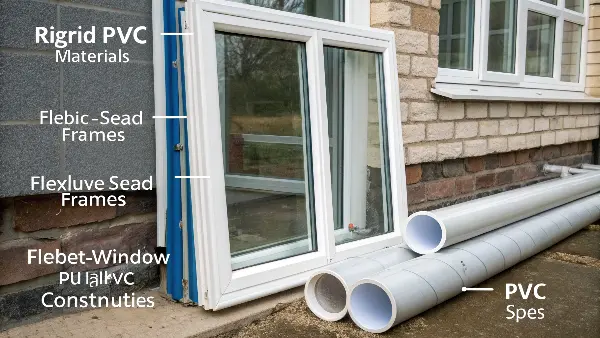
Understanding the distinction between these PVC types is crucial for any engineer or product designer. The choice you make will directly impact the performance, longevity, and safety of your final product. It’s more than just choosing “PVC”; it’s about selecting the right grade of PVC for the application.
Rigid PVC (uPVC): The Backbone of Building
When people in construction talk about PVC, they are often referring to uPVC, where the ‘u’ stands for unplasticized. This means it has no added plasticizers, making it hard and rigid. This is the material that gives PVC its reputation for strength and durability. Its primary advantage is its high tensile strength and stiffness, which allows it to be used in structural applications. Think of high-pressure water pipes that have to contain water without bursting, or window frames that need to support heavy glass panes without warping. I’ve designed many molds for uPVC fittings, and the key is generally managing its high viscosity and ensuring the part is strong enough to handle real-world stress. uPVC is also highly resistant to chemicals and weathering, which is why it’s the standard for so many long-lasting, low-maintenance building products.
Flexible PVC: For When You Need to Bend
To create flexible PVC, plasticizers are added to the formulation. These additives get between the long PVC polymer chains, spreading them apart and allowing them to move more freely. The result is a material that is soft, pliable, and rubber-like. This opens up a whole new set of applications. In construction, flexible PVC is essential for things like wire and cable insulation, where it needs to protect the copper conductor while being easy to bend and route through walls. It’s also used for roofing membranes, waterproof liners, and expansion joints. The level of flexibility can be precisely controlled by the amount of plasticizer added, allowing us to create everything from a semi-rigid hose to a soft, squishy gasket.
| Property | Rigid PVC (uPVC) | Flexible PVC | Common Construction Applications |
|---|---|---|---|
| Stiffness | High | Low | uPVC: Pipes, Window Frames, Siding |
| Flexibility | Low | High | Flex PVC: Gaskets, Cable Insulation, Membranes |
| Impact Strength | Good (can be high with modifiers) | Excellent | uPVC: Gutters, Electrical Conduits |
| Hardness (Shore) | High (Shore D) | Low (Shore A) | Flex PVC: Weatherstripping, Flooring |
| Primary Additive | Impact Modifiers, Stabilizers | Plasticizers | Varies based on need |
What Are the Key Design Considerations for Injection Molded PVC Parts?
You have a great idea for a new construction component and you’ve chosen PVC as your material. However, if the part isn’t designed correctly for the injection molding process, you’ll face major headaches. Problems like weak spots, warping, and parts getting stuck in the mold can derail your project, causing delays and driving up costs. The frustration of a failed production run is something every product owner wants to avoid. Success depends on designing the part with the manufacturing process in mind from the very beginning.
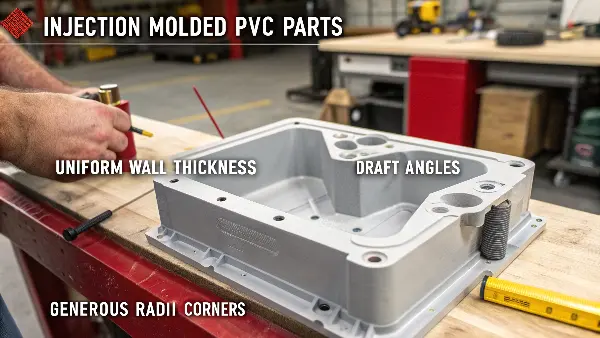
Key design considerations for injection molded PVC parts include maintaining uniform wall thickness to prevent warping and sink marks, and incorporating draft angles to ensure the part can be easily ejected from the mold. Adding generous radii to corners instead of sharp edges reduces stress concentration and improves material flow. Furthermore, a proper gate location is crucial for ensuring the mold fills completely and for controlling the cosmetic appearance of the final part. Following these design-for-manufacturability principles is essential for a successful product.
Getting the design right from the start saves an incredible amount of time and money. A part that is optimized for injection molding will be stronger, look better, and be cheaper to produce. It’s a critical step that bridges the gap between a great idea and a successful, profitable product. These are the details that separate a smooth production run from a costly failure.
The Golden Rule: Uniform Wall Thickness
This is the most important rule in designing for injection molding. When molten plastic cools, it shrinks. If one part of your component is much thicker than another, the thick section will cool and shrink much more slowly. This differential shrinkage creates internal stress, which can cause the part to warp or leave unsightly indentations called sink marks on the surface. The goal is to keep wall thickness as consistent as possible throughout the part. If you do need to create a thicker section for strength, use supporting ribs instead. Ribs can add significant stiffness and strength without using a lot of material, and they can be designed to maintain a more uniform thickness. As a rule of thumb, the thickness of a rib should be about 50-60% of the wall it is attached to.
Draft Angles and Radii: Getting Your Part Out
A mold is typically made of two halves. After the plastic is injected and cures, these halves separate, and the part needs to be pushed out. If the walls of your part are reliably vertical (90 degrees to the mold opening), friction can make it very difficult to eject. This can damage the part or the mold itself. To prevent this, we add a slight taper to the vertical walls, known as a draft angle. Even an angle as small as 1 to 2 degrees makes a huge difference. Another critical element is adding radii, or rounded edges, to both inside and outside corners. Sharp inside corners are stress concentrators, creating a weak point where the part is more likely to crack under load. They also make it harder for the molten plastic to flow smoothly. Rounding these corners improves strength and moldability.
Start With the Installation Environment
List indoor or outdoor exposure, water, soil, cleaners, salts, UV, temperature, impact, load and expected life. A protected indoor fitting and an exposed outdoor enclosure have different requirements even if both are called construction components.
Choose the Compound for the Function
Rigid, impact-modified and flexible formulations deliver different stiffness, flexibility, sealing and low-temperature performance. Stabilizers, pigments and modifiers can affect weathering and processing. Select the compound against the failure mode and obtain the required technical or compliance documentation.
Design Connections and Load Transfer
Threads, sockets, clips, seals, solvent-bonding surfaces and fastener bosses need stable geometry. Avoid sharp stress concentrations and unsupported thin walls. Consider installation torque, thermal expansion, creep and field variation rather than testing only an ideal assembly.
Protect the Molded Surface and Process
Gate and weld-line locations can matter for appearance and pressure integrity. Draft, venting, ejection, texture and cooling should be reviewed with the compound’s thermal sensitivity. A robust mold reduces variation and makes maintenance safer over a long construction-product life.
Validate Durability and Required Standards
Test impact, pressure, leakage, weathering, chemicals, dimensional retention, connection strength and aging as applicable. Identify the standard or customer requirement before tooling. Keep lot, compound, process and test evidence so product changes can be assessed without guessing.
Construction-Component Evidence Package
- Define indoor/outdoor exposure, UV dose, temperature range, chemicals, load duration and expected service environment.
- Specify the exact PVC compound and color; “PVC” alone does not define impact retention, weathering or fire performance.
- Identify the product-specific code or test method and the required acceptance value rather than claiming universal construction compliance.
- Approve critical connections, seals and loaded features after conditioning representative molded parts.
For outdoor products, the stabilizer package and accelerated-weathering evidence must match the exact compound. The ECVM stabilizer overview explains the role of heat and light stabilization but does not certify any individual construction component. Share the service conditions during plastic product design review.
PVC Is Used in Injection-Molded Construction Components: Buyer Review Checklist
- Define indoor/outdoor environment, UV, chemicals, temperature, impact and life.
- Select rigid, flexible, impact-modified or stabilized compound by failure mode.
- Design threads, seals, sockets, fasteners, load paths and installation tolerance.
- Review gate, weld lines, draft, venting, ejection, cooling and thermal history.
- Validate durability, pressure, leakage, weathering and applicable requirements.
Frequently Asked Questions
Is PVC suitable for all outdoor construction products?
No. UV, temperature, impact, chemicals, fire or regulatory requirements may require a specific stabilized formulation or another material.
Why are connection features critical in molded PVC components?
Threads, seals and sockets transfer installation and service loads. Small dimensional or stress issues can become leaks, cracks or assembly failures in the field.
Conclusion
In the end, choosing the right material and manufacturing process is fundamental to the success of any construction project. PVC, with its unmatched durability and resistance to the elements, provides a solid foundation. When shaped by the precision of injection molding, it transforms into complex, reliable, and cost-effective components that are built to last. This powerful combination is not just a choice; it’s a strategic advantage in a competitive industry.