
You are developing a new medical device, and the pressure to choose the right material is crushing. Pick the wrong plastic, and you risk biocompatibility failures, regulatory rejection, or product recalls that could destroy your reputation. It’s a terrifying thought.
ABS can be suitable for selected medical-device housings, fixtures and non-implant components, but there is no blanket category of medically safe ABS. Material acceptability depends on the exact formulation, patient-contact nature and duration, manufacturing residues, cleaning, sterilization and finished-device risk assessment. A supplier’s medical-grade label is useful evidence, not a substitute for device-specific evaluation.
Related engineering resources: mold testing and validation | production injection molding | mold design
Yes, ABS (Acrylonitrile Butadiene Styrene) is generally safe for many medical devices, particularly housing and non-implantable components. While standard ABS isn’t automatically medical-grade, specific formulations are ISO 10993 compliant and meet USP Class VI standards1. It is widely chosen for its impact resistance, chemical stability, and ability to be sterilized using gamma radiation or EtO gas2, making it a reliable choice for handheld instruments and equipment casings.
However, just knowing that ABS canbe used isn’t enough. You need to understand the nuances of compliance, the specific limitations, and where it truly shines compared to other polymers. If you misunderstand the regulatory landscape or the material’s weaknesses, your project could stall before it even starts.
Is ABS used in medical devices?
You see plastic components in hospitals everywhere, but you might wonder if that tough, shiny material is actually ABS. It’s easy to assume medical devices require exotic, expensive super-polymers, and you might worry that a common material like ABS isn’t “advanced” enough for critical applications.
ABS is extensively used in the medical industry, primarily for structural components and housings rather than fluid-path or implantable parts. Its excellent impact resistance and aesthetic finish make it suitable for protective casings on MRI machines, nebulizers, drug delivery systems, and handheld diagnostic tools. Manufacturers favor it because it bonds well with other materials, allows for easy molding of complex ergonomic shapes, and withstands the daily abuse typical in a clinical environment.
The application usually falls into two categories: protection and user interface. Think about a blood pressure monitor. The casing needs to survive being dropped on a hard hospital floor. That is where ABS shines. It is tough. It absorbs shock.
Also, medical staff need equipment that is easy to hold and clean. ABS can be polished to a high gloss, which resists dirt accumulation.
Here is a breakdown of common applications where ABS is the standard choice:
| Application Category | Specific Examples | Why ABS is Chosen |
|---|---|---|
| Diagnostic Equipment | Ultrasound machine housing, MRI covers | High impact strength, good surface finish for painting/branding. |
| Drug Delivery | Inhaler bodies, auto-injector shells | Dimensional stability ensures precise dosing mechanisms work correctly. |
| Surgical Tools | Handles for non-invasive instruments | Ergonomic grip, can be color-coded for easy identification. |
| Lab Equipment | Centrifuge casings, blood analyzer covers | Chemical resistance to mild cleaning agents and durability. |
However, we need to be clear. We do not use ABS for permanent implants. It is not designed to stay inside the human body. It is a structural material, not a biological scaffold. When you are designing the shell of a device, ABS is often the most cost-effective and reliable option.
Is ABS FDA approved?
Navigating FDA regulations feels like walking through a minefield blindfolded. You might think that buying “FDA Approved” pellets solves all your problems, only to find out later that the material certification doesn’t cover your specific use case, leading to costly delays.
Strictly speaking, raw ABS pellets are not “FDA approved” because the FDA approves the final medical device, not the material itself. However, raw material suppliers provide ABS resins that are “FDA compliant” or meet specific Food Contact Notification (FCN) standards. For medical use, you must look for resins that have passed USP Class VI testing and ISO 10993 biocompatibility standards to ensure they are safe for skin contact or limited mucosal contact.
There is a big difference between food-safe and medical-grade. Here is what you need to look for when selecting a resin for a medical project.
First, USP Class VI. This is a series of biological reactivity tests. If a material passes Class VI, it means it has low toxicity. This is the gold standard for medical plastics in the US.
Second, ISO 10993. This is the international standard for biological evaluation of medical devices. It covers everything from cytotoxicity (does it kill cells?) to irritation and sensitization.
When you source material, you are looking for a “Master File” (MAF) number. Major resin suppliers lodge this file with the FDA. It contains the proprietary formulation details. When you submit your device for approval, you reference this file. This allows the FDA to review the material ingredients without the supplier revealing their trade secrets to you.
Here is a simple checklist for material selection:
- Does the datasheet explicitly state USP Class VI compliance?
- Is there a Drug Master File (DMF) or Device Master File (MAF) on record?
- Has the material passed ISO 10993-5 (Cytotoxicity) and ISO 10993-10 (Irritation)?
- Is the resin produced in a GMP (Good Manufacturing Practice) facility?
If the answer to these is no, do not use it for a medical device. It is not worth the risk.
Is ABS RoHS compliant?
You want to sell your medical device globally, especially in Europe, but environmental regulations are strict. If your product contains restricted hazardous substances like lead or cadmium, your shipment could be seized at the border, costing you a fortune.
Yes, standard ABS plastic is RoHS (Restriction of Hazardous Substances) compliant. The base polymer consists of carbon, hydrogen, and nitrogen, none of which are restricted substances. However, compliance issues can arise from additives, colorants, or flame retardants added to the ABS during processing. You must generally request a specific RoHS Certificate of Compliance from your material supplier to support that no banned heavy metals or flame retardants were introduced during compounding.
RoHS is huge in the European Union, but its influence is global. It restricts specific hazardous materials found in electrical and electronic products. Since many medical devices have electronic components, the plastic housing falls under this scope.
The base chemistry of ABS is clean. Acrylonitrile, Butadiene, and Styrene are not on the banned list. The danger lies in the extras.
When we mold parts at CKMOLD, we have to be very careful with color masterbatches. Some bright reds or yellows used to use lead or cadmium-based pigments. Those are strictly forbidden now under RoHS.
Another trap is Flame Retardants. Medical devices often need to be fire-resistant (UL94 V-0 rating). To achieve this, some suppliers add brominated flame retardants. Some of these specific brominated compounds (like PBBs and PBDEs) are restricted by RoHS.
So, how do we handle this?
- Verification: We do not assume. We ask for the updated RoHS 3 (Directive 2015/863) declaration for the specific lot of resin.
- Additives Check: We verify that the flame retardant package is non-halogenated or uses compliant chemistry.
- Supply Chain Control: We ensure that no contamination happens during the mixing stage.
If you are a business owner like the buyer, you need to make this a line item in your quality control. Ask your molder: “Is the colorant you are using also RoHS compliant?” If the base resin is fine but the dye is toxic, the part fails. It is a simple check that saves major headaches later.
What are the disadvantages of ABS?
ABS seems suitable—it’s strong, cheap, and looks good—but relying on it for the wrong application can lead to catastrophic failure. If you use it in an environment it can’t handle, like high heat or harsh sterilization, the device might crack, warp, or discolor, ruining your product’s reliability.
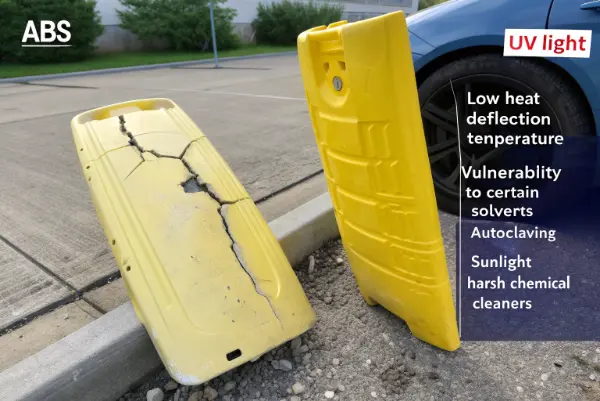
The main disadvantages of ABS are its poor resistance to UV light, low heat deflection temperature compared to high-performance engineering plastics, and vulnerability to certain solvents. It cannot withstand autoclaving (steam sterilization) because the high heat will warp the part. Additionally, ABS can degrade and turn yellow if exposed to prolonged sunlight, and it has poor resistance to harsh chemical cleaners like ketones or esters, which can cause stress cracking.
It is useful to state clearly what a material cannot do. ABS is great, but it is not a super-material. Understanding its weaknesses is actually more important than knowing its strengths.
Sterilization Issues:
This is the biggest hurdle in medical. Hospitals love autoclaves. They use high-pressure steam at 121°C (250°F). ABS softens around 100°C (212°F). If you put an ABS tray in an autoclave, it will come out looking like a melted Dali painting.
- Solution: Use ABS only for single-use devices or devices sterilized by Gamma radiation or Ethylene Oxide (EtO) gas.
Chemical Resistance:
In a hospital, everything gets wiped down constantly. Isopropyl alcohol is usually fine on ABS. But stronger solvents are a problem. If a nurse uses a cleaner containing acetone or certain ethers, the ABS will suffer from “environmental stress cracking.” The part might not break immediately, but tiny micro-cracks will form, and eventually, the housing will shatter.
Fatigue Resistance:
ABS is tough, but it doesn’t like being bent back and forth a million times. It doesn’t have the fatigue resistance of Polypropylene (PP). If your device has a living hinge (a thin plastic flap that bends), do not use ABS. It will snap off.
Here is a comparison table to help you decide if ABS is the wrong choice:
| Weakness | Consequence | Better Alternative |
|---|---|---|
| Low Heat Resistance | Warps in autoclave steam sterilization. | PEEK or PSU (Polysulfone) |
| Poor Chemical Resistance | Cracks when exposed to ketones/esters. | Polypropylene (PP) or PC (Polycarbonate) |
| UV Sensitivity | Yellows and becomes brittle in sunlight. | ASA (Acrylonitrile Styrene Acrylate) |
| Transparency | ABS is naturally opaque (milky/ivory). | Polycarbonate or Acrylic |
During project review, Reviewers should ask: “How will this be cleaned?” and “Where will this be stored?” If the answer involves high heat or outdoor use, we switch materials immediately.
Start With the Finished Device and Contact Path
Describe whether the ABS is external, indirectly contacting, fluid-path adjacent or patient contacting, and define contact duration and tissue type. Identify seams, vents, wear surfaces and plausible misuse that could expose material. The biological evaluation plan follows the nature of contact and total evidence for the finished device, rather than the polymer name alone.
Lock the Exact Grade and Formulation
ABS grades vary in rubber content, additives, pigments, mold-release agents and regulatory support. Obtain supplier composition and change-notification information appropriate to the risk. Color concentrate, labels, coatings, adhesives and regrind require separate review because they can alter chemistry and extraction profiles.
Evaluate Cleaning and Sterilization Compatibility
Alcohols, disinfectants, stress, heat, radiation and repeated cleaning can cause discoloration, crazing, loss of impact or dimensional drift. Validate the intended method, dose or cycle count on molded and assembled devices. A grade that survives one exposure may not retain performance over the specified service life.
Assess Biocompatibility With a Risk-Based Plan
Use existing material and supplier data where scientifically relevant, then identify remaining endpoints under the device’s biological evaluation framework. Chemical characterization and toxicological assessment may reduce or refine biological testing, but the evaluation should represent manufacturing, finishing, cleaning and the final sterilized state when applicable.
Control Molding and Device Traceability
Drying, melt history, residence time, contamination, mold-release use and regrind policy can affect appearance and extractables. Define validated process limits, cleaning status, material lot, cavity identification and nonconformance controls. Changes to grade, color, sterilization, mold, process aids or supplier should enter formal device change assessment.
ABS for Medical Devices: Design and Validation Checklist
- Define device function, patient contact type, duration and failure consequence.
- Approve the exact ABS grade, color, additives, suppliers and change notification.
- Test repeated cleaning, disinfectant and sterilization effects on molded assemblies.
- Build biological evaluation from finished-device risk and relevant existing evidence.
- Validate molding, contamination control, traceability and post-launch changes.
Authoritative Reference Points
Frequently Asked Questions
Is all medical-grade ABS biocompatible?
No. Supplier support may help, but biological acceptability is assessed for the final device, its contact and its manufacturing and sterilization state.
Can ABS be repeatedly sterilized?
It depends on the exact grade, method, dose, geometry and required cycle count. Heat, radiation and chemicals can change properties and must be validated.
Can regrind be used in a medical ABS part?
Only under an approved risk, regulatory and quality strategy. Source, contamination, property drift and traceability make uncontrolled regrind inappropriate.
Conclusion
ABS is a safe, versatile, and cost-effective choice for medical device housings and structural components, provided you select medical-grade resins that meet ISO 10993 and USP Class VI standards. While it excels in impact resistance and appearance, it is not suitable for autoclaving or implants. By verifying regulatory compliance like RoHS and understanding its chemical limitations, you can confidently use ABS to build reliable, high-quality medical products.