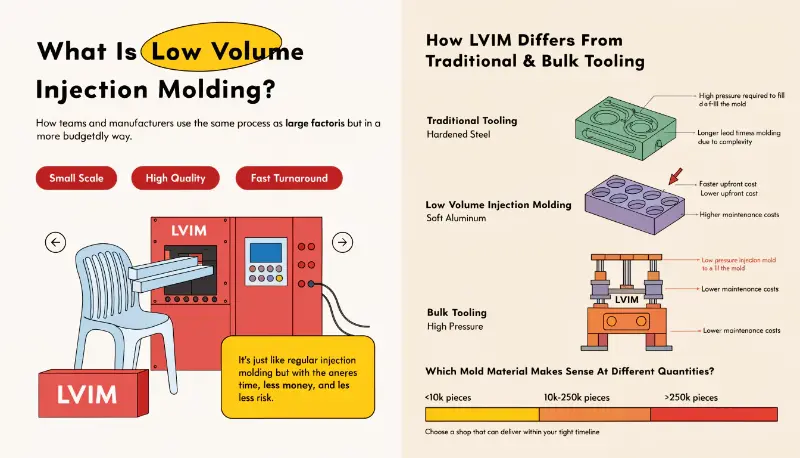
Low-volume injection molding is economical when production-grade geometry and material behavior justify a mold, but the expected quantity does not justify a full high-output tooling system. There is no universal quantity threshold. Part complexity, resin, tolerance, expected repeats, tool life, cycle, inspection and the alternatives determine the break-even point.
Start with a quoteable demand profile
Define prototype quantity, first release, annual demand, peak order, reorder pattern and expected program life. Add the exact resin, color, cosmetic zones, critical dimensions, assembly, testing and delivery cadence. A “500-part project” with monthly repeats is a different tool decision from a one-time 500-part validation run.
Compare tooling routes against the same part requirements
| Route | When to screen it | Questions before selection |
|---|---|---|
| Machined aluminum mold | Geometry and resin permit it; speed and lower initial investment matter | Wear, texture/polish, inserts, repair method, dimensional stability and expected repeats |
| Prehardened steel mold | More wear, pressure, surface or repeat-order margin is needed | Steel grade, replaceable wear areas, maintenance, cavity count and future changes |
| Production-intent steel tool with simplified automation | The part may scale and preserving future capacity matters | Which features are deferred, machine interface, automation plan and upgrade cost |
| Temporary or printed insert | Very limited shots can answer a focused molding question | Pressure/heat limits, surface, dimensional drift, material compatibility and failure containment |
Tool material alone does not define “prototype” or “production” quality. The complete design, components, process controls and acceptance evidence matter.
Compare total cost, not only tool price
For each route, calculate:
Total program cost = tooling and engineering + trials/corrections + quantity × acceptable-part variable cost + inspection/packaging/logistics + expected maintenance/change cost.
Use the same material, quality level and delivery basis. A lower-cost tool can be the more expensive option if cycle, scrap, manual handling, inspection or early replacement is not included. Conversely, an elaborate multi-cavity tool may not recover its extra fixed cost in a short or uncertain program.
Use bridge tooling deliberately
A bridge tool can provide molded parts while a production tool is validated, support a launch ramp or reduce demand uncertainty. Define whether it must be transferable, how long it will be stored, how reorders are handled and which learnings will be carried into the next tool. Do not assume the first tool can be upgraded economically without a design review.
Preserve production intent where it affects learning
- Use the intended resin and color when material behavior is part of the test.
- Keep critical gates, parting lines and ejection effects representative where possible.
- Measure parts after defined conditioning, not immediately after molding only.
- Identify cavity and sample revision in dimensional and functional results.
- Freeze approved changes before each build; do not mix prototype revisions in one lot.
Low-volume supplier checklist
- What quantity and reorder assumptions drive the proposed tool?
- Which steel/aluminum, components, cavities and runner system are included?
- What trials, samples, measurements and corrections are included?
- What limitations apply to resin, filler, texture, tolerance and tool life?
- Who owns, stores, maintains and may transfer the mold?
- What changes if volume grows or the production location changes?
Move from a budget estimate to an engineering quote
Use the injection mold cost estimator for a preliminary tooling budget. Then send the CAD, drawing, material, quantities, quality requirements and reorder plan through the RFQ page for an engineering review of tool concept, cycle assumptions, yield risks and production cost. CKMOLD’s low-volume injection molding service page describes the service scope.