
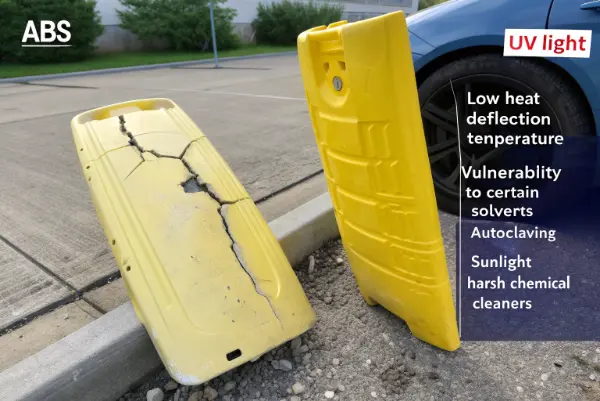
ABS can be used in some medical-device housings and nonpatient-contact components, but no generic ‘medical-grade ABS’ label proves that a finished device is biocompatible, sterilization-compatible or cleared by a regulator. The decision starts with device function, contact type and duration, chemicals, cleaning and sterilization.
Material supplier evidence can support a risk assessment, but biological evaluation belongs to the finished device or a representative test article under its actual manufacturing conditions. Regulatory strategy remains the device manufacturer’s responsibility.
Start With the Finished Device and Contact Path
Describe whether the ABS is external, indirectly contacting, fluid-path adjacent or patient contacting, and define contact duration and tissue type. Identify seams, vents, wear surfaces and plausible misuse that could expose material. The biological evaluation plan follows the nature of contact and total evidence for the finished device, rather than the polymer name alone.
Lock the Exact Grade and Formulation
ABS grades vary in rubber content, additives, pigments, mold-release agents and regulatory support. Obtain supplier composition and change-notification information appropriate to the risk. Color concentrate, labels, coatings, adhesives and regrind require separate review because they can alter chemistry and extraction profiles.
Evaluate Cleaning and Sterilization Compatibility
Alcohols, disinfectants, stress, heat, radiation and repeated cleaning can cause discoloration, crazing, loss of impact or dimensional drift. Validate the intended method, dose or cycle count on molded and assembled devices. A grade that survives one exposure may not retain performance over the specified service life.
Assess Biocompatibility With a Risk-Based Plan
Use existing material and supplier data where scientifically relevant, then identify remaining endpoints under the device’s biological evaluation framework. Chemical characterization and toxicological assessment may reduce or refine biological testing, but the evaluation should represent manufacturing, finishing, cleaning and the final sterilized state when applicable.
Control Molding and Device Traceability
Drying, melt history, residence time, contamination, mold-release use and regrind policy can affect appearance and extractables. Define validated process limits, cleaning status, material lot, cavity identification and nonconformance controls. Changes to grade, color, sterilization, mold, process aids or supplier should enter formal device change assessment.
ABS for Medical Devices: Design and Validation Checklist
- Define device function, patient contact type, duration and failure consequence.
- Approve the exact ABS grade, color, additives, suppliers and change notification.
- Test repeated cleaning, disinfectant and sterilization effects on molded assemblies.
- Build biological evaluation from finished-device risk and relevant existing evidence.
- Validate molding, contamination control, traceability and post-launch changes.
Authoritative Reference Points
Frequently Asked Questions
Is all medical-grade ABS biocompatible?
No. Supplier support may help, but biological acceptability is assessed for the final device, its contact and its manufacturing and sterilization state.
Can ABS be repeatedly sterilized?
It depends on the exact grade, method, dose, geometry and required cycle count. Heat, radiation and chemicals can change properties and must be validated.
Can regrind be used in a medical ABS part?
Only under an approved risk, regulatory and quality strategy. Source, contamination, property drift and traceability make uncontrolled regrind inappropriate.
Next step
Send the CAD, component function, body-contact path, exact grade/color, cleaning or sterilization method, target markets, traceability needs and required tests for a moldability review. Freeze approved inputs and change notification before production.