
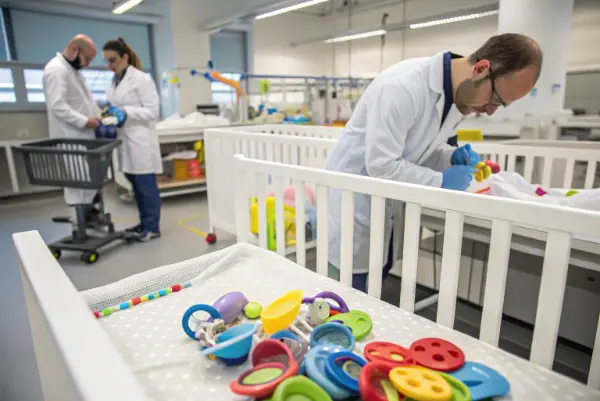
Ensuring the safety of products designed for children keeps many business owners awake at night. You worry about recalls, lawsuits, and the devastating impact a harmful product could have on a family. The landscape of regulations for Polyethylene (PE) Ensuring the safety of products designed for children keeps many business owners awake at night. You worry about recalls, lawsuits, and the devastating impact a harmful product could have on a family. The landscape of regulations for Polyethylene (PE) materials is complex and constantly changing. If you miss just one requirement, your entire shipment could be seized at customs, or worse, harm a child.
To ensure PE materials are child-safe, manufacturers must adhere to strict regulatory frameworks like the CPSIA in the US and EN 71 in Europe1. This involves rigorous testing for restricted substances like lead and phthalates, alongside mechanical testing for small parts and sharp edges. Specifically, Child-Resistant Packaging (CRP) must meet the Poison Prevention Packaging Act (PPPA) standards, requiring protocols where packages are tested with panels of children and seniors2 to verify safety and accessibility.
Navigating these regulations is not just about checking boxes; it is about building trust with your customers. I have seen companies try to cut corners on testing, only to pay ten times the cost later in legal fees and brand damage. Understanding the specifics of these tests and standards is the first step in protecting your business and the end-user. Let’s break down exactly what you need to know to stay compliant and safe.
What are the CPSC guidelines for toys?
We all know the fear of a toy breaking and becoming a choking hazard. The Consumer Product Safety Commission (CPSC) sets the rules to prevent this, but the sheer volume of guidelines can feel overwhelming for a manufacturer. If you don’t understand the specific mechanical and chemical mandates for your PE-based toys, you are risking huge fines and product recalls.
The CPSC mandates that all toys intended for children under 12 years of age must undergo third-party testing at a CPSC-accepted laboratory. Key guidelines include ASTM F963, which covers mechanical hazards like sharp points and edges, and chemical restrictions limiting lead content to 100 ppm and banning specific phthalates. Manufacturers must issue a Children’s Product Certificate (CPC) certifying compliance based on these test results before the product can enter the US market.
When I first started in the mold industry, I had a client who wanted to make a simple PE rattle. He thought because the design was simple, the regulations would be simple too. He was wrong. We had to go deep into the ASTM F963 standard. This is the "gold standard" for toy safety in the US, and it is mandatory.
The CPSC guidelines for Polyethylene toys break down into three main categories that you need to watch during the design and molding phase:
1. Physical and Mechanical Properties
This is where good mold design matters. The CPSC requires tests to ensure the toy doesn’t break into small pieces (small parts regulation).
- Impact Test: The toy is dropped to see if it shatters.
- Torque and Tension Test: Parts are pulled and twisted to see if they detach.
- Compression Test: We check if the toy collapses under pressure.
If your PE part has a snap-fit joint, for example, we need to make sure that joint is permanent. If a child can pry it open and swallow a small internal component, the product fails.
2. Chemical Requirements
Polyethylene itself is generally safe, but the additives are the problem. You must control your masterbatch (colorants) and any plasticizers.
- Lead Limits: Total lead content in the substrate cannot exceed 100 parts per million (ppm). Lead in surface coatings (paint) is limited to 90 ppm.
- Phthalates: There is a permanent ban on certain phthalates (like DEHP, DBP, BBP) in concentrations greater than 0.1%.
3. Labeling and Tracking
Every product needs a tracking label. This must be permanently molded or printed on the product and packaging. It allows the CPSC to trace the product back to the specific batch and factory if a problem occurs. As a mold maker, I often have to EDM (electrical discharge machining) these tracking codes directly into the mold cavity to ensure they never wear off.
| Requirement Area | Specific CPSC Mandate | Impact on Molding Process |
|---|---|---|
| Mechanical | No small parts for children <3 | Design robust wall thickness and permanent snaps. |
| Chemical | Lead < 100 ppm | Source certified, virgin PE resin; vet colorant suppliers. |
| Traceability | Permanent Tracking Label | Engrave date codes and batch info directly into the mold. |
What are the standards of child-resistant packaging from a regulatory view?
Packaging protects the product, but sometimes it also needs to protect the child from the product. If you manufacture household chemicals, pharmaceuticals, or certain cosmetics using PE bottles or caps, failing to meet child-resistant standards is a direct violation of federal law. The regulatory view is strict because the consequences of failure are often fatal poisoning incidents.
From a regulatory perspective, Child-Resistant Packaging (CRP) is governed principally by the Poison Prevention Packaging Act (PPPA), enforced by the CPSC in the US and ISO 8317 internationally. The standard defines CRP as packaging that is significantly difficult for children under five to open within a reasonable time, yet not difficult for normal adults to use properly. Compliance is not theoretical; it requires verified human testing data.
The regulatory view is not just about "making it hard to open." It is about a specific balance. I often discuss this with clients who want to make their PE caps "safer." They tighten the tolerance on the threads so much that even an adult cannot open it. That is a failure too.
The regulatory landscape divides into two main geographical heavyweights that often set the tone for the rest of the world:
The United States (16 CFR 1700)
Under the PPPA, the Code of Federal Regulations (16 CFR 1700) lists exactly what substances need this packaging. This includes things like:
- Aspirin and acetaminophen.
- Furniture polish.
- Products containing more than 10% hydrocarbons (like some cleaning solvents).
If your PE container holds these, the closure (cap) and the container (bottle) must work together as a system. You cannot just buy a "child-resistant cap" and put it on any bottle. The neck finish of the bottle must match the cap perfectly to pass regulatory scrutiny.
International Standards (ISO 8317 & EN 14375)
If you export to Europe, you look at ISO 8317 (for re-closable packages) and EN 14375 (for non-re-closable packages like pharmaceutical blisters).
- Harmonization: While similar to US standards, ISO testing protocols can be slightly different regarding the testing groups.
- Documentation: European regulators often require more extensive technical files documenting the design process of the mold and the validation of the safety features.
The Role of the Manufacturer
From my side at CKMOLD, the regulatory view changes how we cut steel.
- Precision: Child-resistant mechanisms usually rely on "push-and-turn" or "squeeze-and-turn" actions. These require complex undercuts in the mold.
- Material Selection: We must use High-Density Polyethylene (HDPE) or Polypropylene (PP) that is rigid enough to maintain the "spring" action of the safety tab. If the material is too soft, the safety lock disengages too easily, failing the regulatory standard.
What are the requirements for child-resistant packaging testing?
Knowing the standards is one thing, but proving your packaging meets them is a completely different challenge. Many manufacturers assume a 3D simulation is enough. It is not. The requirements for testing are physical, expensive, and involve real people, which creates a significant bottleneck in your time-to-market if you don’t plan for it.
The testing requirements for child-resistant packaging involve a strict "protocol test" with two distinct human panels. First, a panel of 50 to 200 children (aged 42-51 months) attempts to open the package; at least 85% must fail to open it within 5 minutes. Second, a panel of senior adults (aged 50-70) tests the package; at least 90% must be able to open and properly reclose it within a specific timeframe.
This is the most critical part of the process. I remember a project where we designed a beautiful dual-injection molded cap. It looked great. But when it went to the testing lab, the "senior adult" panel failed it. They couldn’t get enough grip on the smooth PE surface to push and turn it. We had to scrap the mold cavity and add ribs for better friction.
Here is a deeper look at how these tests actually work and what you need to prepare for:
The Child Test Panel (The "F" Value)
The goal is to prove children cannot get in.
- Duration: Children get 5 minutes initially. If they don’t open it, they get a visual demonstration (without words) on how to open it, and then another 5 minutes.
- Success Rate: For the first 5 minutes, 85% of children must be unable to open it. After the demonstration, 80% must still be unable to open it.
- Using Teeth: Yes, the test monitors allow children to use their teeth. This is vital for PE materials. If the plastic is soft, a child might bite through the cap rather than unscrewing it. We design wall thickness specifically to resist biting.
The Senior Adult Test Panel (The "SA" Value)
The goal is to prove adults can use it.
- Demographic: 100 adults between 50 and 70 years old. 70% of them are women.
- Screening: They are screened to ensure they don’t have obvious disabilities, but they represent the average strength of that age group.
- Time Limit: They usually have 5 minutes to open and, crucially, re-close the package properly. If they open it but don’t engage the safety lock when closing it, it counts as a failure.
Sequential Testing
You don’t always test 200 kids at once.
- Pilot Test: We usually recommend a small pilot test (20-30 participants) to catch obvious design flaws before paying for the full protocol.
- Full Test: If the pilot passes, you move to the full panel mandated by the CPSC or ISO.
| Testing Phase | Target Group | Objective | Success Criteria |
|---|---|---|---|
| Child Test | 42-51 months | Restrict Access | >80% cannot open after demo. |
| Senior Test | 50-70 years | Ensure Usability | >90% can open and reclose. |
| Re-securing | Seniors | Safety Verification | Package must return to "child-safe" state. |
What is the safety testing for baby products?
Baby products are in a league of their own because the end-users are the most vulnerable population. Babies chew, suck, and sleep on these products. The testing goes far beyond just mechanical strength; it dives into chemical leaching and flammability. Ignoring these specific safety tests is not an option for any ethical or legal business operation.
Safety testing for baby products (pacifiers, rattles, cribs) focuses heavily on chemical migration and suffocation hazards. In addition to standard physical tests, regulations require migration testing to ensure no harmful chemicals leach from the PE material into saliva. Flammability testing is also mandatory for textiles and certain plastics, alongside strict geometric testing to prevent choking or airway obstruction.
When we mold products for infants, the mindset is "zero defect." A burr on a plastic part for a car engine might be annoying; a burr on a pacifier shield cuts a baby’s mouth. That is unacceptable.
Here is a breakdown of the specific testing layers for baby products made of PE:
1. Geometric and Template Testing
Babies explore the world with their mouths. We have to make sure the product physically cannot block their airway.
- Small Parts Cylinder: If the product (or a piece that breaks off) fits entirely inside a standardized test cylinder (roughly the size of a throat), it is banned for children under 3.
- Rattle Test Fixtures: Rattles and teethers must not be able to enter the full depth of a baby’s mouth and impact the throat. We use specific templates to measure this. If the handle of a rattle is too long and thin, it fails.
2. Chemical Migration (Saliva Simulation)
Since PE is often used for teethers, we must ensure nothing comes out of the plastic.
- EN 71-3: This European standard is widely used globally. It involves soaking the material in a solution that simulates gastric acid and saliva for a set time at body temperature.
- Heavy Metal Analysis: The lab analyzes the solution to see if elements like Antimony, Arsenic, Barium, Cadmium, Chromium, Lead, Mercury, or Selenium have leached out.
- BPA Free: While most PE is naturally BPA-free, testing verifies that no cross-contamination occurred during manufacturing.
3. Flammability Testing
This is crucial for items that might be near a sleeping baby.
- Burn Rate: The test measures how fast a flame spreads across the material. The material must either be non-flammable or have a very slow burn rate to allow parents time to react.
4. Structural Integrity for Soothing Products
For pacifiers (often involving a PE shield and a silicone nipple):
- Pull Test: A machine pulls the nipple and the shield apart with significant force (often 90 Newtons). They must not separate. This ensures the baby cannot pull the nipple off and choke on it.
In my factory, when we run these parts, we increase our Quality Control frequency. We check for flash (excess plastic) every hour instead of every shift. We use medical-grade PE resins that come with their own purity certificates to ensure we pass the chemical migration tests every single time.
Conclusion
Navigating the regulations for Child-Safe PE materials is a rigorous process, but it is necessary. From the mechanical stress tests required by the CPSC for toys to the human panel testing for child-resistant packaging, every step is designed to protect vulnerable users. As a manufacturer, you must view these regulations not as obstacles, but as essential blueprints for quality. By understanding and adhering to these standards, you protect your business, your reputation, and most importantly, the children who use your products.
-
"The Consumer Product Safety Improvement Act (CPSIA) | CPSC.gov", https://www.cpsc.gov/Regulations-Laws–Standards/Statutes/The-Consumer-Product-Safety-Improvement-Act. The Consumer Product Safety Improvement Act (CPSIA) establishes federal safety standards for children’s products in the United States, while EN 71 provides the European standard for toy safety, both of which govern materials including polyethylene used in products intended for children. Evidence role: general_support; source type: government. Supports: CPSIA and EN 71 serve as primary regulatory frameworks for children’s product safety in their respective jurisdictions. Scope note: These sources confirm the frameworks exist and apply to children’s products generally, though specific PE material requirements may be detailed in subsidiary technical standards. ↩
-
"16 CFR Part 1700 — Poison Prevention Packaging", https://www.ecfr.gov/current/title-16/chapter-II/subchapter-E/part-1700. The Poison Prevention Packaging Act regulations (16 CFR § 1700.20) specify testing protocols that require child-resistant packages to be evaluated by panels of children aged 42-51 months to demonstrate resistance to opening, as well as by adult panels to ensure the package remains accessible to intended users including seniors. Evidence role: mechanism; source type: government. Supports: PPPA testing protocols require evaluation with both child and adult test panels. ↩