
Are you struggling to pick the right TPE hardness for your new product? Pick the wrong hardness, and your part might fail, feel cheap, or break during use. This can cost you a lot of time and money. Do not worry. In this guide, I will show you exactly how to choose the perfect TPE hardness every single time.
TPE hardness measures how much the material resists pressure and bending. You can choose the right hardness by matching the Shore scale to your product needs. Use Shore A for soft, rubbery grips and Shore D for tough, rigid parts. To choose correctly, you must know your product’s use, check the Shore scale, and test sample parts.
Finding the right material can feel like a big puzzle. But once you understand the basic rules of TPE, it becomes very easy. Let us break down everything you need to know so you can make the best choice for your next injection molding project.
What is the hardness range of TPE?
You have a great design, but you do not know if TPE can match the feel you want. If you guess the material limits, you might design a part that cannot be made. Let me explain exactly how soft or hard TPE can be.
The hardness range of TPE is very wide. It goes from extremely soft to very hard. It starts at 0 Shore A, which feels like a soft gel cushion. It goes all the way up to 80 Shore D, which feels like a tough hard hat. Because of this huge range, you can use TPE for many different things.
Understanding the Soft End
When we talk about the soft end of TPE, we mean the materials that feel like jelly or human skin. In my early days at the mold factory, we made a soft grip for a medical tool. We used a very low Shore A TPE. It was so soft that it felt like an eraser. Materials in the 0 to 30 Shore A range are highly flexible. They stretch easily. They are perfect for things that touch the human body. Think about earplugs or soft watch bands. They need to be gentle.
Understanding the Hard End
On the other side, TPE can be very tough. When you go past the Shore A scale, you enter the Shore D scale. A TPE at 60 or 70 Shore D is almost like standard plastic. It does not stretch much. It can take a heavy hit without breaking. We use this hard TPE for skateboard wheels or heavy duty power tool handles. It gives you the toughness of plastic but still has a little bit of bounce.
Breaking Down the Ranges
To help you see this clearly, I made a simple table. This table shows the different ranges and what they feel like.
| Hardness Range | Feel | Common Product Example |
|---|---|---|
| 0 – 30 Shore A | Very Soft, Gel-like | Gel insoles, soft medical grips |
| 40 – 60 Shore A | Medium Soft, Rubbery | Pencil erasers, door seals |
| 70 – 90 Shore A | Firm, Flexible | Shoe soles, tire treads |
| 40 – 60 Shore D | Hard, Slightly Flexible | Skateboard wheels, tough covers |
| 60 – 80 Shore D | Very Hard, Rigid | Hard hats, heavy tool handles |
By looking at this table, you can see that TPE covers almost every need. You just have to pick the right spot on the scale.
Which hardness scale should I use?
It is confusing when material data sheets show different letters and numbers. If you pick the wrong scale, you might order a material that is way too hard. Let me clear up this confusion for you right now.
You should use the Shore OO scale for very soft gels, the Shore A scale for flexible rubber-like parts, and the Shore D scale for hard, rigid parts. Most of the time, product designers use the Shore A scale because it covers the most common rubbery items we use every day.
The Three Main Scales
There are three main scales you will see when you look at TPE materials. They are Shore OO, Shore A, and Shore D. Think of them as three different rulers. You use a small ruler for small things and a big ruler for big things. The Shore OO scale is for things that are as soft as a gummy bear. The Shore A scale is the most popular. It is for things that feel like a car tire or a rubber band. The Shore D scale is for hard things like a bowling ball.
Why the Scales Overlap
Sometimes, the scales overlap. This can trick people. For example, a hardness of 95 Shore A is almost the same as 45 Shore D. I remember a client who ordered 50 Shore D material, thinking it would be very soft because the number 50 is low. But Shore D is the hard scale! His parts came out like solid rocks. Always check the letter, not just the number.
How to Choose the Right Scale
To make this simple, ask yourself one question: How do I want this part to bend? Use the table below to match your part to the right scale.
| If your part needs to… | Use this scale | Example |
|---|---|---|
| Squish easily like a gel | Shore OO | Bicycle seat gel pad |
| Bend and stretch like rubber | Shore A | Phone case, toothbrush grip |
| Resist bending, stay hard | Shore D | Protective bumper guard |
If you are ever in doubt, start by looking at Shore A. It is the middle ground. Most everyday consumer products live on the Shore A scale.
What are the different grades of TPE?
You might think all TPE materials are exactly the same. But if you choose the wrong type of TPE, it might melt in the heat or crack in the cold. Let us look at the different types so you get the right match.
There are several grades of TPE, including TPS, TPO, TPV, TPU, and TPEE. Each grade is mixed differently to handle heat, oil, or wear. TPS is the most common for soft grips. TPU is the best for high wear and tear. TPV is the top choice if your part will touch oils or high heat.
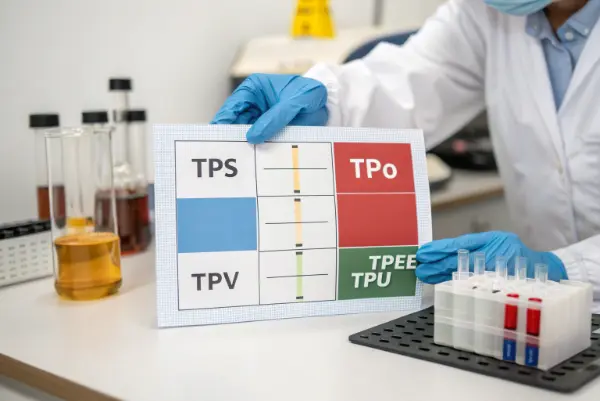
TPS: The Everyday Choice
TPS stands for Styrenic Block Copolymers. This is the most common grade. It is very easy to mold. We use it all the time for soft touch grips on pens or toothbrushes. It is cheap and does the job well for simple things. But, it does not like high heat. If you leave a TPS part in a hot car, it might get sticky.
TPU: The Tough Guy
TPU stands for Thermoplastic Polyurethane. This grade is very strong. It fights off scratches and cuts. When I built molds for heavy duty phone cases, we always used TPU. It is harder than TPS. It also costs a bit more. But if your product will fall on the ground a lot, TPU is your best friend.
TPV: The Heat Resistor
TPV stands for Thermoplastic Vulcanizates. This material is special. It acts very close to real rubber. It can handle hot temperatures and oil. Car makers use TPV a lot. They use it for parts under the hood where it gets very hot and greasy.
Comparing the Grades
Here is a simple table to show you when to use which grade of TPE.
| TPE Grade | Main Strength | Common Use Case |
|---|---|---|
| TPS | Soft feel, low cost | Tool handles, toys, grips |
| TPU | Toughness, scratch proof | Phone cases, shoe soles |
| TPV | Heat and oil resistance | Car parts, weather seals |
| TPO | Weather resistance | Car bumpers, outdoor gear |
| TPEE | High flex memory | Hoses, industrial belts |
When you know the environment your product will live in, choosing the grade is easy. Match the grade to the weather and wear your product will face.
Can you make TPE softer?
Sometimes you get a TPE material, but it feels too hard for your project. You might think you have to buy a whole new batch of plastic. I will show you how we can change the softness.
Yes, you can make TPE softer. You can do this by adding plasticizers or oils into the raw material mix before molding. You can also make a part feel softer by changing the design. If you make the part thinner or hollow inside, it will feel much softer when you press it.
Changing the Material Recipe
In the factory, TPE is just a mix of plastics and rubbers. If we want it softer, we add oil. We call this a plasticizer. Think of it like adding water to dry mud. The more oil we add, the softer the TPE gets. But there is a limit. If we add too much oil, the TPE becomes weak. It might even "bleed" oil later. This means the surface feels greasy. We must be very careful with the mix.
Changing the Product Design
You do not always have to change the material to get a soft feel. You can change the shape of the part. I once helped a client design a handle. The material was 60 Shore A. It felt too hard. Instead of changing the TPE, we changed the CAD file. We added small empty pockets inside the handle. We also made the outer wall thinner. When the user squeezed it, the handle crushed inward easily. It felt like a 40 Shore A material!
Methods to Soften the Feel
Here is a table showing the two main ways to make your TPE product feel softer.
| Method | How it works | Pros and Cons |
|---|---|---|
| Add Oil (Plasticizer) | Changes the raw chemistry | Pro: Really makes material soft. Con: Can make part weak or greasy. |
| Thinner Walls | Part bends easier | Pro: Saves material cost. Con: Can break if too thin. |
| Add Hollow Pockets | Leaves empty space to crush | Pro: Feels soft, keeps outer shape. Con: Makes the mold design harder. |
| Surface Texture | Small bumps bend easily | Pro: Good grip feel. Con: Hard to clean the part later. |
So, if your part is too hard, look at your mold design first. A clever design can make a hard material feel nice and soft.
Conclusion
Choosing the right TPE hardness is all about matching the Shore scale to your product needs. You must understand the wide hardness range, pick between Shore A and D, and select the right TPE grade. Remember, you can also use design tricks to make parts feel softer. Always test your materials first to get the perfect result.