
Designing food containers can be very stressful. If you pick the wrong flexible material, you risk health hazards and product recalls. This hurts your brand and your customers. But finding a rubber-like material that follows strict food safety rules does not have to be a nightmare. By understanding TPE options, you can make safe, legal, and great products.
Thermoplastic Elastomer (TPE) is a safe, flexible plastic used for food-contact items like jar seals, baby spoons, and water bottle bites. To ensure safety, food-grade TPE must pass strict global standards like the FDA in the USA or LFGB in Europe. Choosing the right material means picking a grade that will not melt in hot food or leak bad chemicals, while keeping the flexibility your product needs.
Let me walk you through what I have learned during my years in the mold industry, so you can pick the best food-safe TPE without guessing.
What Makes TPE a Great Choice for Food-Contact Products?
Many designers struggle to find a soft material that does not ruin the taste of food. Traditional rubber can leave a bad smell, and some soft plastics have toxic chemicals. This makes finding a good seal really tough. TPE solves this problem. It gives you the soft feel of rubber but processes as easily as normal plastic.
TPE is highly preferred for food-contact items because it is free from harmful chemicals like BPA, phthalates, and heavy metals. It does not alter the taste or smell of the food it touches. Plus, it can be easily molded over other hard plastics, creating a strong, watertight seal for food storage containers and drinking bottles.
Why We Love TPE in the Mold Factory
When I started working in a mold factory, we used a lot of silicone for food parts. Silicone is great, but it takes a long time to cure in the mold. Then we found TPE. TPE changed everything for us. TPE melts and cools quickly, just like regular plastic. This means we can make parts much faster. For a designer, this means your product gets to the store sooner and costs less to make.
Key Benefits of TPE for Food Items
TPE brings many good things to the table. Let us look at why it beats other soft materials. First, it is very clean. It does not leach chemicals into food. Second, you can color it easily. You can make bright baby cups or clear water bottle seals. Third, it grabs onto hard plastics like PP (Polypropylene) or PC (Polycarbonate) very well. We call this overmolding. It saves time because you do not need glue.
Comparing TPE to Other Soft Materials
| Feature | TPE (Food Grade) | Silicone | PVC (Flexible) |
|---|---|---|---|
| Safety for Food | Very High | Very High | Low (often has phthalates) |
| Smell / Taste | None | None | Can have a plastic smell |
| Recyclable | Yes | No | Yes, but hard to sort |
| Cycle Time | Fast (Seconds) | Slow (Minutes) | Fast |
| Cost | Medium | High | Low |
Looking at this table, you can see why TPE wins so often. It gives you the safety of silicone but at a lower cost and a faster speed. It also beats PVC because it is much safer for human health. When you are designing a new food box, TPE helps you balance safety, cost, and speed perfectly.
Which Global Safety Standards Must Food-Grade TPE Meet?
Trying to sell a food product worldwide can give you a huge headache. Every country has its own safety laws. If your TPE part fails a test at the border, your whole shipment gets sent back. This costs a lot of money. But if you know the big rules early on, you can test your material and sell your product anywhere with peace of mind.
Food-grade TPE must pass specific safety tests to prove it will not leak harmful things into food. In the United States, it must meet FDA 21 CFR standards. In Europe, it must follow EU Directive 10/2011 and the very strict German LFGB test. These tests check what happens when the TPE touches oily, sour, or hot foods.
Understanding the Big Three Standards
I remember a time when a client of mine wanted to sell a new baby feeding bowl in Germany. They bought "FDA approved" TPE. But when they tried to sell it in Germany, it failed the tests. Why? Because the German rules are different from the US rules. You must know where your product will go before you buy your plastic.
The FDA Standard (USA)
In America, the FDA (Food and Drug Administration) has rules for plastics. The rule for TPE is usually 21 CFR 177.1810 or 177.2600. The FDA tests the material with water and with a fatty substance. They want to see if the plastic loses any weight. If it loses weight, it means chemicals went into the food. The TPE must stay stable to pass.
The EU and LFGB Standards (Europe)
Europe is much tougher. The main rule is EU 10/2011. It tests how materials react to different foods over time. But Germany goes even further with the LFGB standard. LFGB tests check for smell and taste changes. If your TPE makes the water taste like plastic, it fails.
Quick Guide to TPE Food Testing
| Standard Name | Region | What It Tests Mostly | Difficulty to Pass |
|---|---|---|---|
| FDA 21 CFR | USA | Chemical leaching in water and fats | Medium |
| EU 10/2011 | Europe | Overall migration of chemicals into food | High |
| LFGB | Germany | Smell, taste, and heavy metal testing | Very High |
| GB 4806 | China | Residues and migration specific to Chinese diets | High |
If your design passes LFGB, it is usually safe everywhere else. Always ask your raw material supplier for the exact test papers. Do not just take their word for it. Read the paper to see exactly which test it passed.
How Do You Select the Right TPE Grade for Your Food Packaging?
Picking a TPE from a catalog is confusing. There are hundreds of grades. If you pick a grade that is too soft, it might tear. If you pick one that cannot take heat, it will melt in the dishwasher. By checking a few key details, you can narrow down the list and find the perfect TPE for your exact product.
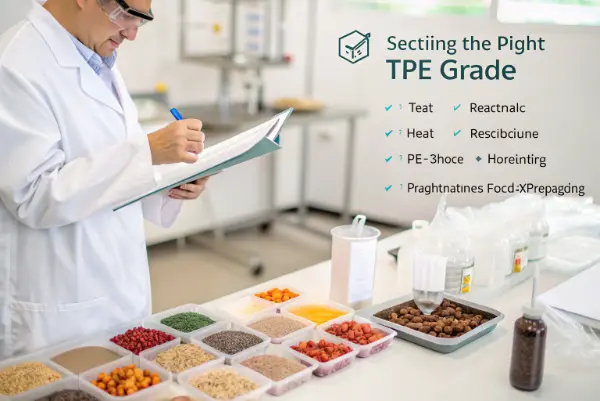
To choose the right food-grade TPE, you must check three main things. First, check its heat resistance so it survives hot food and dishwashers. Second, check its hardness (Shore A) to make sure it feels right and seals well. Third, check its bonding ability if you plan to mold it over a hard plastic part.
Heat and Cold Resistance
When I design a food container seal, I always think about where it will go. Will the user put it in the microwave? Will it go in the freezer? Standard TPE might get sticky in the microwave. If your product needs to handle high heat, you must choose a special high-temperature TPE grade. Some grades can handle boiling water easily. Others get hard and crack when placed in a cold freezer. You must match the material to the user’s kitchen habits.
Choosing the Right Hardness
TPE comes in many softness levels. We measure this with a scale called "Shore A". A Shore A of 10 is very soft, like human skin. A Shore A of 80 is hard, like a shoe sole. For food container seals, a Shore A of 40 to 60 is usually best. If it is too hard, it will not press down enough to stop water from leaking. If it is too soft, it might roll out of its groove when the user opens the lid.
Bonding to Other Plastics
Most TPE parts are not used alone. They are often molded onto a hard plastic lid. This is called overmolding. Not every TPE sticks to every hard plastic. You have to match them perfectly.
TPE Bonding Compatibility Guide
| Hard Plastic (Base Part) | TPE Type Needed | Bond Strength | Common Use |
|---|---|---|---|
| PP (Polypropylene) | Standard TPE-S | Excellent | Food storage lids |
| PC (Polycarbonate) | Special Alloy TPE | Good | Clear water bottles |
| ABS | Special Alloy TPE | Good | Kitchen tool handles |
| Nylon (PA) | High-Performance TPE | Medium | Spatulas and cooking tools |
Always tell your material supplier what hard plastic you are using. If you use standard TPE on a PC water bottle, the TPE seal will peel right off. This will ruin the part. Asking the right questions early saves you from making bad molds.
What Are the Common Mold Design Challenges When Processing Food-Grade TPE?
Even if you buy the best TPE, a bad mold design will ruin your part. TPE is sticky and soft when it is hot. It can get stuck in the mold or shrink too much. This causes ugly marks or bad seals. By using the right mold design rules, you can make perfect, clean TPE parts every single time.
When molding food-grade TPE, the main challenges are controlling shrinkage, venting trapped air, and preventing parts from sticking. TPE shrinks differently than hard plastic, so the mold must be sized perfectly. You also need good air vents so the material fills nicely, and a good ejection system to push the soft part out without tearing it.
Dealing with TPE Shrinkage
TPE shrinks a lot when it cools down. If you do not calculate this right, your food seal will be too small. It will leak. The tricky part is that TPE shrinks more in the direction the plastic flows, and less in the other direction. When I design a mold, I always ask the material maker for the exact shrink rate. Usually, it is between 1.5% and 2.5%. You have to make the steel mold a little bit bigger so the final part cools down to the perfect size.
Venting the Mold
TPE fills the mold very fast. As it rushes in, it pushes the air out. If the air cannot escape, it gets very hot and burns the TPE. This leaves ugly black marks on your clean food product. We call this burn marks. To fix this, we cut tiny lines at the edge of the mold. These lines let air out but keep the plastic in. Because TPE is so thin when hot, these vents must be very small, usually only 0.01 mm deep.
Getting the Part Out
Because TPE is soft, you cannot just push it out of the mold with thin metal pins. Thin pins will poke a hole right through the soft rubber.
Mold Design Rules for TPE
| Design Issue | What Happens if Ignored | How to Fix It in the Mold |
|---|---|---|
| Ejection (Pushing out) | Ejector pins poke holes in the soft part | Use large ejector plates or air blasts |
| Draft Angles | The soft part sticks and tears on the walls | Add a 2 to 3 degree angle on side walls |
| Gate Size (Entry point) | Leaves a big ugly bump on the part | Use small pinpoint gates or sub-gates |
| Cooling | Part warps or takes too long to make | Add lots of water cooling channels near the TPE |
When you handle these design details, the TPE parts come out of the machine looking perfect. They will be safe, clean, and exact in size. This makes the assembly process smooth and keeps your final food product safe from leaks.
Conclusion
Choosing TPE for food-contact products is smart because it is safe, flexible, and fast to mold. By understanding global rules like FDA and LFGB, you protect your customers and your business. Match your material’s heat and bonding limits to your product, and always design your mold to handle soft plastic. With these simple steps, your next food container design will be a huge success.