
Choosing the right material for baby products is a huge headache. If you pick the wrong plastic, it can harm a baby and ruin your brand forever. You want to make safe toys and spoons, but you also need to control costs. Let us look at the best materials to solve this problem.
When designing baby products, the safest materials are 100% food-grade silicone, natural rubber, and medical-grade TPE. These materials are completely free from BPA, phthalates, and other bad chemicals. Silicone gives you the best heat resistance and lasts the longest. Natural rubber is a great green choice, but it might cause latex allergies. TPE is a cheap, easy-to-mold plastic alternative. Your final choice depends on if your product needs boiling water cleaning, green marketing, or low factory costs.
Let us look closely at each of these materials. I will share stories from my time running my mold factory. This will help you make the best choice for your next big design project, so you do not waste time or money.
Is 100% silicone safe for babies?
Parents worry a lot about toxic plastics these days. If a baby chews on a cheap, toxic toy, they can get very sick. This makes parents scared to buy new things. Using 100% food-grade silicone solves this worry completely.
Yes, 100% food-grade or medical-grade silicone is extremely safe for babies. It does not contain BPA, lead, PVC, or phthalates at all. It will never leak bad chemicals into a baby’s milk or food. Silicone can also handle very high heat. This means parents can boil silicone pacifiers or bottles in water to clean them safely. Because it is so stable and pure, it is always the top choice for baby feeding items and teething toys.
Why Silicone Wins in Mold Design
When I first started CKMOLD, many clients came to me asking for cheap plastics to make baby spoons. I always told them to use silicone instead. It costs a little bit more money, but it is 100% worth it. Silicone is a wonder material for baby products. It is made from sand and carbon. This means it is very close to a natural element.
As a product designer, you must think about how the end user cleans the product. Babies drop things on the dirty floor all the time. Parents need to kill the germs. If you use normal plastic, boiling water will melt it. If you use silicone, boiling water does nothing to it. The silicone stays soft and strong. This peace of mind is what parents pay for.
Let us break down the core properties of silicone. You need to know this when you set up your mold designs. Silicone flows differently than hard plastics. We use Liquid Silicone Rubber (LSR) molding for baby parts. It requires very precise molds because LSR flashes very easily. You must have tight tolerances in your steel molds.
| Feature | Details for Silicone | Why it Matters for Babies |
|---|---|---|
| Heat Resistance | Can survive up to 200°C | Parents can boil it to kill germs. |
| Chemical Safety | Zero BPA, zero PVC | Babies can chew it safely all day. |
| Durability | Does not crack or dry out | The toy lasts for many years. |
| Feel | Very soft and skin-like | It does not hurt a baby’s gums. |
If you want to design a premium baby product, silicone is your best friend. You just need to work with a mold maker who knows how to control the LSR process perfectly.
Is TPE material non-toxic?
You want to lower your mold costs to make more profit. But using cheap rubber can add bad smells and chemicals to baby toys. TPE is a great way to save money, but you might worry if it is safe.
Yes, medical-grade and food-grade TPE (Thermoplastic Elastomer) are non-toxic and very safe for babies. Good TPE does not have BPA, PVC, lead, or phthalates. It is safe for babies to touch and put in their mouths. TPE is a mix of plastic and rubber. It melts easily like plastic but feels soft like rubber. It is very easy to mold and recycle. Just make sure you always buy certified food-grade TPE from a trusted supplier.
The Hidden Truth About TPE Molding
I have seen many designers make big mistakes with TPE. TPE is a category, not just one single material. There are cheap TPEs used for shoe soles, and there are high-end TPEs used for medical tubes. When you design a baby product, you must specify the exact grade. If you just write "TPE" on your drawing, a bad factory might use industrial TPE. That is very dangerous for a baby.
TPE is wonderful because it is a thermoplastic. This means we can inject it into a standard plastic injection mold. We do not need special LSR machines. This saves you a lot of money on tooling. Jacky, I know you work in a mid-sized company. If your boss wants to cut tooling costs by 30%, TPE is your best answer. We can even over-mold TPE onto hard plastics like PP (Polypropylene). This is how we make baby toothbrushes with soft grip handles.
However, TPE cannot handle high heat. If a parent puts a TPE toy in boiling water for ten minutes, it might lose its shape. It can get sticky. You must put a clear warning on your packaging. Tell parents to wash TPE toys with warm soapy water only.
| TPE Grade Type | Best Use Case | Safety Level for Babies |
|---|---|---|
| Industrial TPE | Tool handles, shoe soles | Very bad. Do not use for babies. |
| Food-Grade TPE | Baby spoons, bath toys | Very safe. No bad chemicals. |
| Medical-Grade TPE | Teethers, medical parts | The safest. Highly pure. |
Always ask your material supplier for SGS or FDA test reports. As long as you use the right grade, TPE is a fantastic, safe, and cheap material for baby items.
Which is safer, silicone or TPE?
You have a new design ready to go to the factory. You must pick between silicone and TPE right now. Making the wrong choice could cause product recalls and angry customers. Let us look at which one is truly safer.
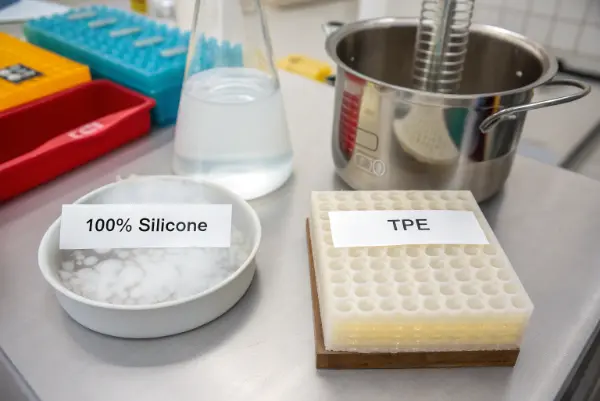
Both materials are very safe, but 100% food-grade silicone is generally safer than TPE for baby products. Silicone has much better heat resistance. Parents can boil silicone in water to kill all germs safely. TPE might melt or get sticky in boiling water. Silicone is also more chemically stable and lasts a lot longer without breaking down. TPE is safe, but its quality depends heavily on the factory. If you want the absolute safest material, choose silicone.
Making the Right Design Choice
When I talk to designers like you, Jacky, I always hear the same question. "Jerry, should I use TPE or Silicone?" The answer comes down to safety and budget. I always tell my clients that silicone wins the safety contest every single time. It is not just about the chemicals inside the material. It is about how the material survives in the real world.
Silicone is almost impossible to destroy with normal household use. You can leave it in the hot sun. You can put it in the dishwasher. You can boil it. It will not change. It will not release any micro-plastics. TPE is a plastic. Over a long time, TPE can degrade. If it gets too hot, the chemical bonds can break down. This means TPE has a shorter life.
However, TPE is still very safe if used correctly. I helped a client make a line of baby bath toys using TPE. Bath toys do not need to be boiled. They just sit in warm bath water. TPE was the perfect choice there. It saved them thousands of dollars in mold costs. But for baby bottle nipples, we only use silicone. You can never compromise on feeding parts.
| Comparison Point | Silicone | TPE |
|---|---|---|
| Overall Safety | Extremely High | High |
| Boiling Water Safe? | Yes, very safe | No, it will melt or deform |
| Mold Cost | High (Needs LSR molds) | Low (Standard injection molds) |
| Material Cost | Higher | Lower |
If the product goes inside the baby’s mouth for feeding, spend the money on silicone. If it is a toy the baby holds in their hand, TPE is a smart and safe choice.
Is natural rubber better than silicone for babies?
Green marketing is huge right now for baby brands. If your product uses normal plastic, many green moms will simply not buy it. Natural rubber sounds like the perfect green solution, but is it really better than silicone?
Natural rubber is not always better than silicone, but it is a great eco-friendly choice. Natural rubber comes directly from tree sap. It is 100% natural and breaks down in the earth when thrown away. It is very soft and babies love the natural feel. However, some babies are highly allergic to the latex inside natural rubber. Also, rubber breaks down much faster than silicone and cannot handle boiling water well. Silicone lasts longer and has zero allergy risks.
The Eco-Friendly Dilemma
Many new brands want to use natural rubber. I totally understand this. When a mother sees "100% Natural Tree Rubber" on the box, she feels good. She feels like she is protecting the earth. Natural rubber is biodegradable. Silicone is not biodegradable. Silicone will sit in the earth for a very long time. In terms of saving the planet, natural rubber is clearly the winner.
But as a product designer, you must look at the dark side of natural rubber. The biggest problem is latex allergies. A small number of babies can get red skin or breathing problems if they touch latex. You must write "Contains Latex" on your packaging. This can scare some buyers away.
Also, natural rubber is very hard to keep clean. You cannot boil it. If you boil natural rubber, it gets very sticky and breaks apart. It also has a strong natural smell. Some babies hate this smell and will not put the rubber toy in their mouths. Silicone has absolutely no smell at all.
From a manufacturing side, natural rubber is slow to mold. It needs vulcanization. The cycle times are long. The unit cost is usually higher than TPE.
| Feature | Natural Rubber | Silicone |
|---|---|---|
| Eco-Friendly | Yes, it breaks down | No, it does not break down |
| Allergy Risk | Yes (Latex) | No (Hypoallergenic) |
| Smell and Taste | Has a distinct rubber smell | No smell, no taste |
| Cleaning | Wash with warm water only | Safe to boil and put in dishwasher |
If your brand’s main selling point is being 100% natural and green, use natural rubber. If your main selling point is ease of use and long life, stick with silicone.
Conclusion
Choosing between silicone, TPE, and natural rubber is a big decision for any baby product designer. Silicone is the safest and handles high heat perfectly. TPE is very safe, easy to mold, and saves you money. Natural rubber is the best for the earth but has allergy risks. Think about your customer’s needs, and you will pick the right material.