
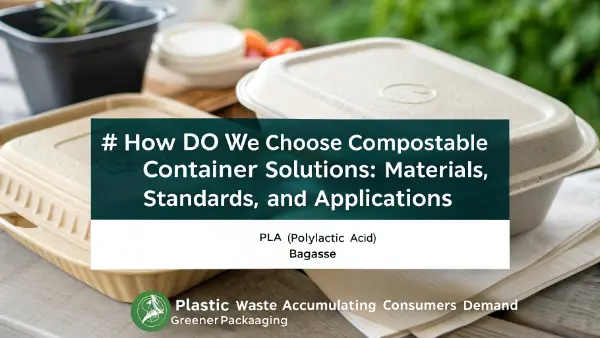
Plastic waste is piling up, and your buyers are demanding greener packaging. But switching to eco-friendly containers is incredibly confusing. You might buy something labeled "biodegradable" only to find out it just sits in a landfill forever. I will show you how to choose real compostable materials that actually break down, keeping your business compliant and your customers happy.
Compostable container solutions are packaging systems made from materials like PLA (polylactic acid) and bagasse that break down entirely into non-toxic organic matter. To be truly compostable, these containers must meet strict global standards like ASTM D6400 or EN 13432. They typically decompose in industrial composting facilities within 90 to 180 days. They are widely used in foodservice and events to reduce plastic pollution and help businesses achieve zero-waste goals.
Moving away from traditional plastics is a big step for any manufacturing business. In my years working around plastic manufacturing, injection molds, and CNC machining, I have seen a massive shift toward biopolymers. But you cannot just mold a plant-based resin and assume it is green. You need to understand the rules. Let us look at the specific standards you need to follow.
What is the ASTM D6400 standard?
Finding the right compostable material is frustrating. You might buy a batch of PLA containers thinking they are perfect, but local waste facilities might reject them. Why? Because not all bioplastics decompose the same way under the same conditions. The ASTM D6400 standard solves this problem by providing a strict test to prove your packaging will actually turn into dirt.
The ASTM D6400 standard is the North American guideline for labeling plastics as compostable in municipal or industrial facilities. It requires the material to undergo rapid disintegration and complete biodegradation within 180 days. Additionally, the material must leave no toxic residue behind, ensuring the resulting compost is safe for plants and soil life. It applies mainly to solid plastics like PLA clamshells and cups.
How Materials Pass the Test
To meet ASTM D6400, a material has to pass three main tests. First, it must disintegrate. This means the container has to physically break down into tiny pieces so that you cannot easily see it in the compost pile.
Second, it must biodegrade. Microbes in the compost facility actually eat the plastic. The standard requires the material to convert into carbon dioxide, water, and biomass within 180 days.
Third, it has to pass an ecotoxicity test. The dirt left behind must be safe enough to grow plants. If the plastic leaves heavy metals in the soil, it fails.
Common Materials Used
Most containers that pass this test are made of PLA (polylactic acid). PLA is a bioplastic made from fermented plant starch, usually corn. I see a lot of clear cups and clamshells made from this because it looks and feels just like traditional plastic.
Another great option is bagasse. Bagasse is the leftover fiber from sugarcane. It is molded into plates and takeout boxes. It is strong, microwave-safe, and usually breaks down in 45 to 90 days in a commercial facility.
Manufacturing Considerations
If you run a manufacturing business, switching to these materials changes your floor operations. In my experience with CKMOLD, we see that getting the injection molds right for bioplastics is very different than running standard ABS or polypropylene.
PLA has a different melting point and cooling time. If you do not adjust your mold design and cycle times, your part quality will suffer, and your lead times will go up. When our goal is to master molding right, we have to treat biopolymers with the exact same precision we use for traditional plastics.
What is the ISO standard for composting?
Selling your containers globally can cause major headaches. A package approved in the US might get flagged in Asia or Europe. Dealing with different regional rules slows down your supply chain and costs you real money. Thankfully, an international framework exists to help standardize compostable plastics across borders.
The ISO standard for composting is ISO 17088. This international framework specifies the procedures and requirements for identifying and labeling compostable plastics globally. It closely mirrors regional standards like ASTM D6400 by demanding strict biodegradation, disintegration, and low ecotoxicity. Packaging that meets ISO 17088 will safely break down in commercial composting facilities without leaving harmful heavy metals behind.
Why Global Standards Matter
When you build a supply chain, consistency is everything. If you source products overseas or sell to international buyers, having one standard makes life easier. ISO 17088 provides that common ground.
It uses tests like the OECD 310 to verify that the leftover compost will not harm plants or earthworms. This gives buyers peace of mind, knowing your product is safe no matter what country it ends up in.
Best Applications for These Materials
Compostable containers shine best in the foodservice industry. Think about takeout meals, cafeterias, and catered events.
Normally, if a traditional plastic bowl is covered in cheese or grease, it cannot be recycled. The food ruins the recycling batch. So, it goes to the landfill.
But with compostable containers, you do not have to wash them. The user simply throws the soiled bowl, the fork, and the leftover food into one single bin. It all goes to the compost facility together. This drastically reduces methane emissions from landfills.
The Role of Plant Fibers
Beyond PLA, we see a lot of bamboo fiber and other plant fibers used here. Bamboo offers a very rigid, natural-looking alternative to plastic. It is great for dry food and hot items.
However, you have to be careful with thickness. A thick bamboo tray might take months or even years to fully decompose, depending on the heat of the compost pile. So, balancing the structural strength of the container with its ability to break down fast is a constant challenge for product designers.
What is the difference between EN 13432 and ASTM D6400?
If you plan to export your products to Europe, you will quickly hit a wall. European buyers usually will not accept your US-certified packaging. They demand their own local certifications, and failing to provide them means losing big contracts. Understanding the difference between the European and American standards is the key to expanding your market.
The main difference between EN 13432 and ASTM D6400 is their regional focus and specific testing timelines. EN 13432 is the European standard, requiring packaging to disintegrate into pieces smaller than 2mm within 12 weeks, and biodegrade within six months. ASTM D6400 is the North American standard with a similar 180-day timeline but slightly different testing protocols. Both ensure products break down safely in industrial compost.
Comparing the Rules
Both standards want the same outcome: zero toxic waste and good, healthy dirt. But they go about it slightly differently. Here is a simple breakdown:
| Feature | EN 13432 | ASTM D6400 |
|---|---|---|
| Region | Europe | North America |
| Disintegration Time | 12 weeks (under 2mm pieces) | 12 weeks |
| Biodegradation Time | 6 months (90% breakdown) | 180 days (90% breakdown) |
| Common Label | OK Compost Industrial | BPI Certified |
If your product passes EN 13432, you can carry labels like "OK Compost Industrial." This is heavily recognized across the EU.
Tooling and Material Choices
When developing products for both markets, you have to watch your material blends. Some companies blend cornstarch with other biopolymers like PBAT to make flexible pouches or coated paper cups.
If you use a coating on a paper cup, the entire cup, including the coating, must compost fully. This is actually covered under a related standard called ASTM D6868 for fiber-based items.
From a manufacturing view, blending materials means you have to be precise with your equipment. If you use CNC machining to cut prototype molds, you need to account for how these new biopolymer blends shrink as they cool. The shrinkage rates can differ slightly to meet specific regional ecotoxicity limits, so getting the engineering right early saves a lot of money later.
What is the difference between ASTM and BPI?
Buyers often ask for proof that your containers are actually compostable. You might tell them you meet ASTM rules, but they still refuse to buy. Why? Because simply claiming you meet a scientific standard is not enough. Buyers want third-party proof to avoid greenwashing, which is where certification agencies come into play.
The difference between ASTM and BPI is that ASTM creates the testing standards, while BPI provides the actual certification. ASTM (American Society for Testing and Materials) writes the scientific rules, such as ASTM D6400, detailing exactly how a material should break down. BPI (Biodegradable Products Institute) is an independent organization that tests your product against ASTM rules. If you pass, BPI allows you to use their official logo.
The Lab vs. The Label
Think of ASTM as the rulebook and BPI as the referee. Anybody can read the rulebook, but you need the referee to officially say you played by the rules.
If you want to supply a major restaurant chain in the US, they will demand a BPI certificate. That little logo on the bottom of a cup builds massive trust. It tells the buyer, the consumer, and the waste facility that this container is safe to process.
The Main Challenges Ahead
Even with perfect materials and BPI certifications, we face a few massive hurdles in this industry.
The biggest challenge is facility availability. Compostables work terribly if commercial composting is not available in your city. A BPI-certified PLA cup will not break down in a backyard compost pile. It needs the sustained high heat and forced aeration that only an industrial plant can provide. If a consumer throws it in the trash, it goes to a landfill and acts just like regular plastic.
Consumer Education is Crucial
The other big issue is consumer confusion. A compostable PLA cup looks exactly like a recyclable PET plastic cup.
If a consumer puts the PLA cup into a standard plastic recycling bin, it melts at a different temperature and ruins the entire batch of recycled plastic. Conversely, if they put a regular plastic cup into the compost bin, it shreds up and leaves microplastics in the soil.
Education is key. We have to clearly label these products. We also have to use them in the right places. Festivals, stadiums, and closed-loop cafeterias are perfect. You give people one bin for everything. That eliminates the guesswork and makes the system work flawlessly.
Switching to compostable container solutions is a smart move for reducing environmental impact and hitting zero-waste goals. By understanding materials like PLA and bagasse, and following standards like ASTM D6400, EN 13432, and BPI, you can offer products that truly work. Ensure your manufacturing processes and molds are optimized for bioplastics, and focus on educating your end-users to keep our waste streams clean and efficient.