
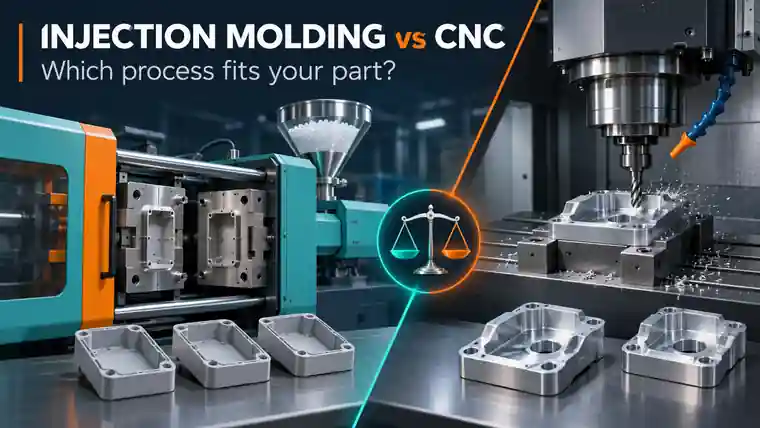
CNC machining and injection molding can both produce a plastic part, but in different ways. The CNC machine will cut the part from a solid block – often parts in days, with no tooling. The first step in injection molding is the creation of the mold which costs money, typically takes weeks to make and once made each piece is often produced in seconds at a fraction of the cost of the same part being machine-made.
So it is easy to keep in mind: machine for low volumes, mold for high volumes. So far that’s a good rule. It does not explain where your break-even point is, nor why a machined prototype might pass every test and the molded one fail, or how to take advantage of the combination of both processes for a project. This guide answers those questions as well.
Quick Answer: Which Process Should You Choose?
- Use CNC machining when: prototypes and small batches, metal parts, designs still in progress, or very tight tolerances.
- Use injection molding for plastic parts when the expected lifetime volume justifies the mold investment, the design is fixed, and you want the lowest cost per part and consistent repeat production. The break-even quantity depends on the part and comparable supplier quotes.
- Use both when appropriate. Many products are machined first then molded and some molded products are then machined on one or two critical features.
How Does CNC Machining Work?
CNC (computer numerical control) machining is a subtractive process. A program created from your CAD model controls cutting tools on the mill/lathe or multi axis machine and the machine cuts the material out of a block, bar or plate such that the part remains.
No part specific tooling. You will need a program and standard cutters and you will need some means of holding the part in place, and a changed design will typically require a changed program, not new hardware. CNC machining can be used for materials like aluminum, steel, stainless steel, brass, titanium, and for plastics that are sold as stock shapes like POM (acetal), nylon, PC, ABS, PEEK and UHMW-PE.
The compromise is time per part. All parts are cut individually and therefore the price per part stays fairly flat as quantity grows, and a considerable amount of the original block ends up as chips.
How Does Injection Molding Work?
Injection molding process heats plastic pellets in a barrel and forces the molten plastic into a closed mold under high pressure. The plastic cools against the mold walls, the mold opens and the part is ejected. Then it repeats; cycle time depends on the part, material and mold, and is often under a minute.
The large initial expense is the mold. It is a precision tool made of steel or aluminum to which cavities, cooling channels, ejector pins and sometimes slides or lifters for undercuts have been precision machined. A mold can be single cavity or multiple cavities and the number of mold cavities can have a significant impact on tooling costs and part cost.
After the mold is approved, injection molding can yield many copies of the part, requires very little labor, and generates relatively little material waste. Hot runners can reduce or eliminate solidified cold-runner waste, but gate or trimming waste may remain, and regrind use depends on the resin and product requirements.
Injection Molding vs CNC Machining: Side-by-Side Comparison
| Factor | CNC machining | Injection molding |
|---|---|---|
| Process | Subtractive: cuts the part from solid stock | Formative: molten plastic fills a mold |
| Upfront tooling | None (program and fixturing only) | Mold required; the main upfront cost |
| Time to first parts | Often days; depends on part, material and supplier | Typically weeks, for mold design, building and trials; depends on part, tooling and supplier |
| Cost per part | Fairly flat as quantity rises | Drops sharply as quantity rises |
| Best-fit volume | One-offs, prototypes, small batches | Volumes that justify the mold investment; break-even depends on the part and comparable quotes |
| Materials | Metals and machinable plastics | Thermoplastics, TPEs and some thermosets |
| Design changes | Update the program | Modify or replace the mold |
| Geometry limits | Tool access, internal corner radii, deep narrow pockets | Draft, wall thickness, undercuts, parting line |
| Precision | Often tight on accessible features; depends on geometry, material, fixturing and supplier capability | Good and repeatable; depends on resin shrinkage, part geometry, mold design, cooling and process control |
| Material waste | Chips from the original stock, often a large share | Cold runners and sprues, reduced or eliminated with hot runners; gate or trim waste may remain, and regrind depends on resin and product requirements |
| Part-to-part consistency | Good, but each part is cut separately | Very high once the process is set |
How Do the Costs Compare?
The difference in cost comes from where the money goes.
In CNC machining, nearly all the expenses are in each part, such as machine running, programming, setup, material and finishing. Ten parts will cost about ten times one part, except for some setup cost savings. The money with injection molding goes towards the mold up front and the cost of each part is the material plus a short machine cycle.
That provides you with a quick method to determine your break-even point:
Break-even quantity = mold cost / (CNC price per part − molded price per part). This assumes CNC programming and fixture costs are already included in the CNC price per part; if they are not, compare the upfront costs of both processes.
A Worked Break-Even Example
The numbers below listed are for illustration purposes only to demonstrate the arithmetic. Substitute in objective, comparable quotes from your suppliers.
| Item | CNC machining | Injection molding |
|---|---|---|
| Tooling | $0 | $12,000 |
| Price per part | $25.00 | $1.50 |
| Total cost at 200 parts | $5,000 | $12,300 |
| Total cost at 1,000 parts | $25,000 | $13,500 |
| Total cost at 5,000 parts | $125,000 | $19,500 |
Here the break-even point is $12,000 ÷ ($25.00 − $1.50) ≈ 510.64, or about 511 parts. Using these illustrative numbers, CNC machining is cheaper through 510 parts, and molding is cheaper from 511 parts. The higher above that, the less expensive the molding will be, and the larger the difference will be with each additional part, if the quotes include the same requirements for material, finish and inspection.
Your own number could be much lower or higher. A small, simple part may justify a mold at a few hundred pieces, while a large, complex part with slides may need far more. Consider lifetime volume, not just the initial order. For the molding side of the comparison, you can use the CKMold injection mold cost calculator for a preliminary mold size and tooling estimate. It does not include the molded-part price, so you will need a separate production quote.
Which Process Gives Better Precision?
CNC machining can often hold tight tolerances on accessible features, but achievable limits depend on part geometry, material, fixturing, and supplier capability. It is typically used for accurate bores and sealing faces and mating parts, particularly in metal.
Injection molding is accurate in another sense. When the mold and process are set up, it will repeat very closely from shot to shot, however the tolerance that can be achieved is dependent on resin shrinkage, part geometry, wall thickness, mold design, cooling and process control. When the plastic cools down, it shrinks; and some shrink differently along and across the flow direction, so tight tolerances on large molded features require careful mold design and process control. Issues like sink and warp can be associated with wall thickness, rather than the mold itself.
Apply tight tolerances only when they are necessary for the function. Where one or two features require machining to a very close tolerance, it may be cost effective to mold the part with a post-machining step rather than machine the entire part.
Machined Prototypes vs Molded Parts: Why They Behave Differently
Many comparison guides skip this, but it catches a lot of product teams. Even within the same family of plastics, a prototype made in a machine will not be a perfect preview of the molded product.
A prototype machined from stock may not represent how the production part behaves after molding, because the flow and cooling of the melt in the mold affect the molded part. This translates to a molded component may contain weld lines at points of intersection of two flow fronts, flow-related fiber orientation in glass-filled grades, sink in thick areas, and shrinkage or warpage. None of these are present in a prototype that has been machined. The same applies to CKMold’s 3D printing vs CNC vs injection molding guide: machined parts do not necessarily represent molded stress, weld lines or finishes.
For checking fit, assembly and general function, "Machined" prototypes are good alternatives. Validate critical fit, strength, sealing, snap-fit and cosmetic requirements with samples molded from the intended production resin. Prototype injection molding with a prototype or bridge mold allows you to get parts made using production resin before you commit to a full production tool.
How Do Design Rules Differ?
What works well in the machine may not mold well and vice-versa.
Their limits in CNC machining are determined by the cutting tool. Some internal features cannot be achieved without multiple setups, deep narrow pockets are difficult to reach and internal corners must have a radius at least as large as the cutter. No need to draft and walls may be of different thicknesses.
The limitations of injection molding are due to the mold as well as the flow of plastic. Molded parts require draft to release from the mold, controlled nominal wall thickness to prevent sink and warp, ribs as opposed to solid thick sections and a sensible gate location and parting line. Undercuts are possible, but generally require slides or lifters to be created and incur mold cost.
If you plan to move a machined design into a mold, some redesign will be required. The lowest cost place to make draft, core out thick sections and adjust features is during a DFM analysis prior to the mold build.
Which Materials Can Each Process Use?
| Material | CNC machining | Injection molding |
|---|---|---|
| Aluminum, steel, stainless, brass, titanium | Yes | No (metal injection molding is a separate process) |
| ABS, PC, PC/ABS | Yes | Yes |
| POM (acetal), nylon (PA) | Yes | Yes |
| PP, PE | Possible, but soft and harder to hold tight tolerances | Yes, very common |
| Glass-filled plastics | Possible, limited stock and abrasive on tools | Yes, common |
| TPE / TPU (soft elastomers) | Difficult | Yes |
| PEEK and other high-performance plastics | Yes | Yes, with suitable equipment and process control |
The big split is metal. When it comes to metal parts, CNC machining is generally the go-to solution, especially for smaller quantities, while casting or metal injection molding can be used for larger production runs. Injection molding provides more grades, colors and additives available for plastics than can be purchased as machinable stock. See CKMold’s plastic materials guide for common molding resins.
How Do Lead Times Compare?
Once the drawing and material has been approved, the CNC parts can often be delivered within days, depending on the part, material and supplier. Injection molding typically requires several weeks, depending on the part, tooling and supplier, to produce the mold for the part, time for mold design, steel machining for the mold, and trials and sample approval.
From then on the picture turns upside down. After the mold is approved, repeat orders are primarily dependent on the press time, and large batch orders come quickly. Machining a large batch takes longer as each part must be cut.
Can You Use Both Processes Together?
Yes, and this is the best road to take for many products:
- Molding after the machine. For initial prototypes & pilot production, use CNC parts; once the design is finalized, make a mold.
- Bridge production. Fill launch demand in the interim with a prototype or bridge molding, or with low volume injection molding, until production tools can be created.
- Mold, then machine. Mold the part near net shape and machine only the critical features, such as a precision bore or flat sealing face.
- Combine parts. Use insert molding to mold plastic around metal inserts or shafts.
Common Mistakes When Choosing a Process
- When comparing the cost of molds to the cost of the machined part, rather than the total cost over the product’s life.
- Building a production mold prior to a well-established design. Late changes will come at a higher cost as detailed in our guide of what happens if your design changes after tooling begins.
- Accepting a design based on machined prototypes without testing with molded samples.
- Copying machining tolerances onto a molded part drawing without checking whether they are needed.
- Sending a machined part design to a molder without allowing any draft, or correcting any thick sections.
Quick Decision Checklist
- What is the number of parts now, and over the lifespan of the product?
- Does the piece need to be made of metal or would a plastic piece work?
- Has the design been finalized, or is it still evolving?
- What is the desired accuracy of certain features and what is the accuracy of others?
- Do any parts require features to be molded in, like snap fits, living hinges or textured surfaces?
- When do you require the initial parts, and initial large batch?
CNC machining is probably a more suitable application if the majority of answers are low quantity, metal, design change, and very tight tolerances throughout. Injection molding is the more cost effective method if the focus is on high quantity, plastic, stability of design and low per unit cost.
Frequently Asked Questions
Is CNC machining cheaper than injection molding?
Typically, yes, for small amounts as there is no mold to cover. Typically, injection molding decreases in cost per part and overall as more parts are produced.
At what quantity does injection molding become cheaper?
There are no set numbers. For a given real, comparable quote use the difference in per-part quote to calculate the break-even quantity: the mold cost / (per-part quote difference) = break even quantity
Can injection molding match CNC tolerances?
Good and repeatable tolerances in plastic can be achieved in injection molding while very tight tolerances for large or thick features are more difficult to maintain. Critical features can be machined after molding.
Can I use my CNC prototype design for injection molding?
Typically, not without alterations. For molded components, draft, controlled nominal wall and molding characteristics should be planned for, as it is important to have a review prior to tooling.
Getting the Right Process for Your Part
CNC machining is the winner when it comes to speed to first parts, design freedom, metal options and low volume cost. Injection molding is cost per part competitive, consistent and has capacity when the design is ready for a mold. These are both applied at various stages of many successful products.
CKMold specializes in injection mold design and manufacturing, mold making and injection molding, and has in-house molding capability of up to 1200T. When you have a machined part that is ready to go into volume production, or you are not certain if your quantity is high enough to warrant a mold, just use the request a quote page or contact jerry@ckmold.com to share your CAD file, material, key tolerances and your expected annual volume. The team can discuss moldability, suggest design changes if necessary, and advise you whether or not a mold is appropriate.