
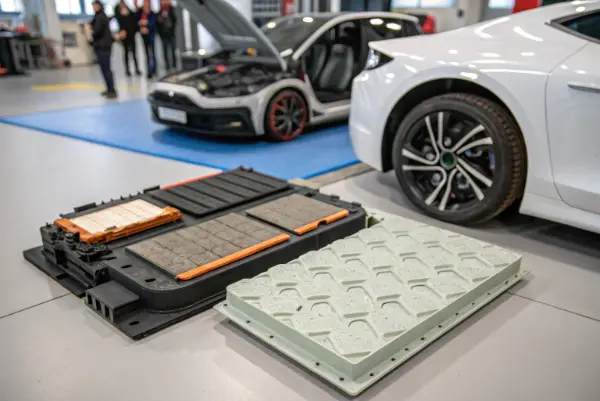
PLA and other bio-based plastics can contribute to selected electric-vehicle components, but standard PLA is not a broad substitute for automotive ABS, PC/ABS, PA, PBT or other engineering resins. The practical decision begins with the component’s temperature, load, impact, humidity, chemical, flammability, VOC, appearance and service-life requirements—not the feedstock label.
Bio-based, biodegradable and compostable mean different things
| Term | What it describes | What it does not establish |
|---|---|---|
| Bio-based | Some or all carbon is derived from biomass | Biodegradation, compostability or lower lifecycle impact |
| Biodegradable | Breakdown under stated biological and environmental conditions | Rapid breakdown in a vehicle, landfill, soil or ocean |
| Compostable | Compliance with a defined composting test and disposal condition | Home compostability or compatibility with every waste system |
The European Commission notes that bio-based plastics are not necessarily biodegradable or compostable. End-of-life claims should identify the standard, test condition, certification and available collection route. A durable EV part should not be marketed as environmentally preferable from a single material attribute alone; mass, service life, repair, recycled content, manufacturing yield and end-of-life route also matter.
Why standard PLA has a narrow automotive window
Unmodified PLA offers useful stiffness, low density and renewable feedstock potential, but common grades can have limited heat resistance, brittle impact behavior, slow crystallization and sensitivity to moisture or hydrolytic aging. NatureWorks’ injection-molding guide lists a glass-transition region around 55–58 °C for the referenced Ingeo material family; that is a material behavior input, not a universal finished-part service limit.
Automotive environments can expose a component to:
– solar heating and parked-cabin temperatures;
– low-temperature impact;
– continuous clamp load, creep and vibration;
– humidity, condensation and hydrolysis;
– cleaners, oils, fuels, coolants or skin-contact chemicals;
– UV and weathering;
– ignition and flammability requirements;
– cabin VOC, odor and fogging limits.
A standard PLA grade may fit a protected trim, cover, clip or noncritical decorative element after validation. Battery-adjacent, under-hood, structural, high-impact, long-term loaded or safety-relevant parts usually demand a different performance envelope.
Modified PLA is a different engineering proposition
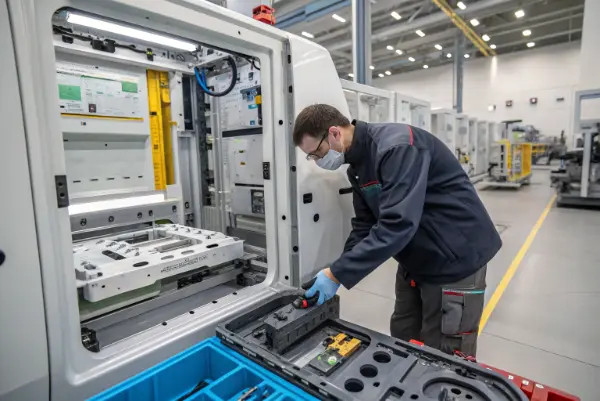
Impact modifiers, nucleating agents, mineral or fiber reinforcement, chain extenders, flame-retardant systems and polymer blends can improve selected PLA limitations. Those additions also change shrinkage, anisotropy, moisture sensitivity, density, surface quality, emissions, recyclability and processing.
Do not carry data from neat PLA into a modified compound. Review the exact supplier grade and its current technical, safety and processing documents. If a property is critical, specify the test method, specimen condition, thickness and retained value after aging rather than relying on a marketing label such as “automotive bioplastic.”
Other bio-based routes may preserve engineering performance
“Bio-based plastic” includes more than PLA. Drop-in polymers such as bio-based PE or partially bio-based engineering resins can retain chemistry similar to fossil-derived equivalents. Bio-based PA grades, bio-based polyesters and reinforced composites may offer higher heat or mechanical capability than standard PLA.
The tradeoff is application-specific. A bio-based content claim does not establish flame rating, electrical behavior, hydrolysis resistance or automotive approval. Conversely, a durable bio-based engineering resin does not need to be biodegradable to have a renewable feedstock contribution.
Use the CKMOLD plastic materials decision page to frame property questions, then confirm the shortlisted producer grade and OEM material specification.
Match the material to the EV component zone
| Component zone | Early screening questions | Typical evidence before release |
|---|---|---|
| Decorative interior trim | Surface, scratch, UV, cabin heat, odor/VOC, attachment and color stability | Conditioned appearance, heat aging, emissions and assembly tests |
| Interior functional bracket or duct | Creep, vibration, impact, fastening, humidity and dimensional retention | Load/creep, thermal cycling, vibration and fit checks |
| Exterior cover or clip | Weathering, water, road chemicals, low-temperature impact and fatigue | UV/weathering, chemical exposure, impact and attachment validation |
| Electrical or battery-adjacent component | Temperature, insulation, tracking, flammability, dimensional stability and fault conditions | OEM/electrical specification, flammability at thickness, aging and system tests |
| Under-hood or structural use | Heat, fluids, vibration, fatigue, long-term load and failure consequence | Grade-specific material data plus component and vehicle-level qualification |
This table is a screening tool. The vehicle manufacturer or tier supplier’s current specification controls the actual qualification program.
Automotive validation goes beyond a resin data sheet
The test plan may include thermal aging and cycling, humidity, creep, fatigue, impact, chemical exposure, UV/weathering, dimensional stability, color/gloss, odor, fogging and VOC emissions. U.S. interior applications may need assessment against FMVSS No. 302; other markets and OEMs apply their own requirements. ISO 12219-2 describes a bag method for screening VOCs, formaldehyde and other carbonyl emissions from vehicle interior parts and materials.
Flammability data must identify the exact grade, color, additive package and tested thickness. A UL classification or supplier result does not by itself prove compliance of the assembled vehicle component. The customer’s approved material list and component drawing remain central controls.
Injection-molding implications
PLA and many bio-based compounds are moisture- and residence-time-sensitive. Use the current supplier processing guide to establish drying, melt temperature, mold temperature, screw speed, back pressure and residence limits. Hot-runner design, dead spots and purge procedures deserve review when thermal degradation could create odor, color change, gas or molecular-weight loss.
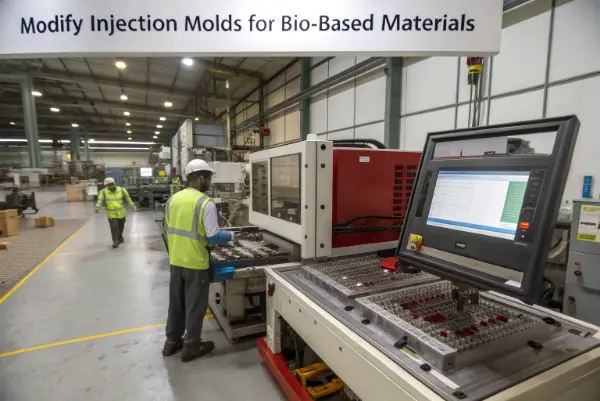
During production injection molding, validate cavity balance, weld locations, fiber orientation where applicable, shrinkage, warp and ejection across a documented process window. A lower nominal processing temperature does not by itself prove lower total energy use; cycle time, drying, scrap, rework and plant energy mix affect the result.
A buyer’s material submission package
Send the part CAD, component zone, load case, temperature profile, chemicals, humidity/UV exposure, appearance, flammability or electrical requirements, VOC/odor limits, annual volume, target markets, OEM specification and sustainability claim you intend to make. If a grade is proposed, include producer, full designation, color and current data sheet.
Use the DFM review page to connect material behavior to walls, ribs, gates, cooling and ejection. For a quotation, complete the project requirements form; CAD files can be emailed to [jerry@ckmold.com](mailto:jerry@ckmold.com).
Sources used for this evaluation
– European Commission: Bio-based, biodegradable and compostable plastics
– NatureWorks: Injection Molding Guide for Ingeo Biopolymer
– Critical review of PLA composites in the automotive sector
– NHTSA: FMVSS 302 laboratory test procedure
– ISO 12219-2: Vehicle-interior VOC screening
Practical questions
Is PLA automatically biodegradable in normal vehicle use or landfill?
No. Degradation depends on polymer, product geometry and environmental conditions. Compostability claims should name the applicable standard and disposal route.
Can modified PLA pass automotive tests?
Some compounds may meet selected requirements. Release still depends on the exact grade, thickness, component design, process, conditioning and OEM test plan.
Does bio-based mean lower carbon impact?
It describes feedstock origin, not a complete lifecycle result. Use supplier-specific and method-transparent lifecycle data for environmental claims.
Which EV parts are the best starting candidates?
Low-consequence, protected components with manageable heat, impact and aging requirements are better screening candidates than battery-adjacent, structural or safety-relevant parts.