
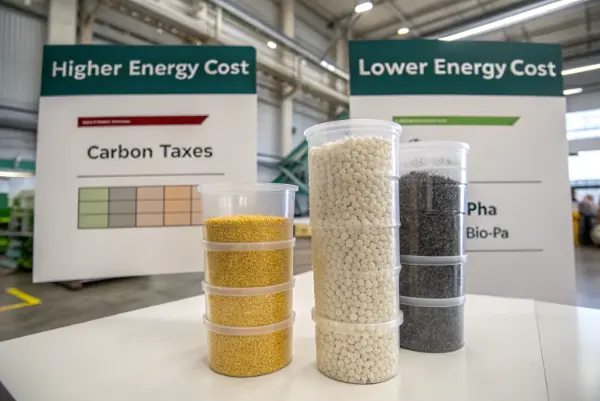
Bio-based resins can reduce reliance on fossil feedstocks, but “bio-based,” “biodegradable” and “compostable” describe different attributes. None of those labels proves that a resin is suitable for an injection-molded product. Product teams still have to qualify heat resistance, impact, dimensional stability, moisture behavior, chemicals, appearance, processing, supply and the intended end-of-life route.
The practical question is therefore not whether the industry is “moving beyond PLA.” It is whether a specific commercial grade can meet the application and whether its environmental claim is supported for the market and disposal system in which the product will be sold. PLA remains a useful candidate for some molded parts, while modified PLA, PHA-based compounds, bio-based polyamides and mass-balance or recycled-content materials may answer different requirements.

Bio-Based, Biodegradable and Compostable Are Not Synonyms
A bio-based plastic contains carbon derived wholly or partly from biomass. It may be durable and not biodegradable. A biodegradable plastic is intended to be broken down by microorganisms under defined conditions, but the rate and extent depend on temperature, moisture, oxygen, time, shape and the receiving environment. A compostable material must meet the criteria of a specified composting standard and disposal route; certification for industrial composting does not automatically mean home-compostable or degradable in soil, fresh water or the ocean.
The European Commission’s policy framework makes the same distinction and notes that biodegradable and compostable plastics should be used for applications where reduction, reuse or conventional recycling are not better options. Environmental claims should state the feedstock basis, relevant standard, certification, product form and intended collection or treatment route.
| Term | What it can describe | What it does not prove |
|---|---|---|
| Bio-based | All or part of the resin’s feedstock is renewable | Biodegradability, compostability, recyclability or lower total impact in every scenario |
| Biodegradable | Biological breakdown under specified conditions | Rapid disappearance in normal use, littering environments or every climate |
| Industrially compostable | Conformance to a stated standard in managed industrial composting conditions | Home composting, marine degradation or acceptance by a local collection system |
| Recycled content | A stated share of feedstock comes from a defined recycled source | Unlimited recyclability or unchanged performance without grade and process control |
| Mass balance | Certified allocation of renewable or recycled feedstock through a shared production system | Physical segregation of that feedstock in each individual pellet without the scheme’s chain-of-custody rules |
Candidate Resin Families and Their Practical Roles
The following groups are starting points. Product teams should request current technical data sheets, regulatory statements, certificates and processing guides for the exact supplier grade.
Standard and Modified PLA
PLA can provide good stiffness, gloss and clarity in suitable grades, but unmodified injection-molding grades may have limited impact and heat performance. For example, the NatureWorks Ingeo 3001D data sheet identifies that grade as an injection-molding resin for clear applications with a heat-deflection temperature below 49°C and provides grade-specific drying, processing and shrinkage starting points. Those values should not be applied to every PLA.
Other PLA formulations use crystallization, nucleating systems, impact modifiers or blends to target higher heat or toughness. The TotalEnergies Corbion resource library separates standard and high-heat injection-molding guidance and publishes product data by grade. This variation is why “PLA is too brittle” or “PLA handles high heat” are both incomplete statements without naming the formulation and test condition.
PHA-Based Resins and Blends
PHA describes a family of polymers, not one molding material. Commercial compounds can differ in crystallization, toughness, heat resistance, processing window and certified end-of-life conditions. Some formulations are developed for flexible or compostable applications; others target rigid parts. Do not describe a PHA part as “ocean-safe” without product-specific evidence, a relevant test method and a clear explanation of conditions. Biodegradation data for a thin laboratory specimen cannot automatically be transferred to a thick molded housing.
Bio-Based Polyamides
Bio-based PA610, PA1010 and related long-chain polyamides can be considered for durable applications where strength, chemical resistance, dimensional stability or lower moisture uptake is important. These materials are generally selected as durable engineering polymers, not because they are intended to biodegrade. Evonik’s VESTAMID Terra documentation, for example, distinguishes partially and fully bio-based polyamide types and notes that compounds can include stabilizers, flame retardants, reinforcement and colorants. Each compound therefore needs its own property and processing review.
Bio-Attributed and Recycled-Content Engineering Resins
When a product needs the behavior of an established engineering resin, a certified mass-balance grade or recycled-content grade may be more practical than changing polymer chemistry. The decision still needs traceability, supplier declarations, approved-grade control and validation of any variation in color, odor, contaminants, mechanical properties or processing. The environmental benefit should be reported using the supplier’s certification and an appropriate product-level assessment, not a generic claim that the part has “zero impact.”
Build the Material Specification From the Product Requirements
Begin with measurable requirements rather than a sustainability label:
- continuous and peak temperature, including transport and storage;
- impact, flexural, creep and fatigue loads;
- dimensional tolerance and humidity exposure;
- chemicals, cleaners, oils, skin contact and UV exposure;
- surface appearance, color, gloss and decoration;
- food-contact, electrical, medical or other regulatory requirements where applicable;
- expected service life and repair or reuse model;
- realistic collection, recycling or composting route in the target market;
- annual volume, approved suppliers, lead time and geographic availability; and
- the evidence required to support environmental claims.
Use the plastic material selection overview to organize performance inputs. A material can have renewable feedstock and still be unsuitable if it creeps under load, absorbs moisture, discolors, lacks the required recognition or cannot be sourced consistently.
How Bio-Based Resins Affect Mold and Process Planning
There is no universal extra draft angle, gate enlargement, shrinkage rate or mold temperature for biomaterials. Amorphous PLA, crystallized PLA compounds, PHA blends and bio-based polyamides have different rheology, crystallization and moisture behavior. Tooling decisions must start from the selected grade’s supplier data and a representative trial.
Drying and Material Handling
Moisture-sensitive grades can lose molecular weight or surface quality if processed wet. Confirm dryer type, temperature, time, dew point and allowable moisture with the supplier. Protect dried material during transfer and avoid assuming that settings for a conventional resin or a different bio-based grade are safe.
Residence Time and Thermal History
Some resins have a narrower processing window or require careful startup, shutdown and purging. Match shot size to the press so material does not remain unnecessarily in the barrel. Monitor melt temperature rather than relying only on barrel set points, and establish a response for production interruptions.
Gate, Runner and Venting
Gate type and size depend on viscosity, shear sensitivity, crystallization, part thickness and appearance. A larger gate is not automatically better: it may extend gate-freeze time, increase witness size or complicate removal. Runner regrind also needs project approval because repeated heat history and cross-contamination can change properties or conflict with a controlled environmental claim.
Cooling, Crystallization and Ejection
Mold temperature and cooling time can strongly influence crystallinity, shrinkage, heat performance, warpage and cycle. A high-heat PLA system, for example, may rely on formulation and mold-temperature conditions that differ from a standard clear PLA grade. Ejection design should be based on actual stiffness, shrinkage, friction and cosmetic zones rather than a blanket “add more draft” rule.
A grade-specific DFM review should connect the material to wall thickness, ribs, bosses, gates, weld lines, venting, cooling and the intended press. Simulation is useful only when the material model represents the candidate grade and the assumptions are documented.
Supply and Cost Need a Program-Level View
Bio-based resins may have different price, minimum order, color availability, regional stock and lead time from established fossil-based grades. Tooling cost can also change if the grade requires a different gate, corrosion protection, cooling approach or process window. A lower melt temperature does not prove lower total manufacturing cost; drying, cycle, scrap, energy mix and secondary processing also matter.
For a sourcing comparison, ask suppliers to identify:
- exact grade and manufacturing region;
- renewable or recycled-content calculation method and certificate;
- minimum order, normal lead time and approved equivalent policy;
- natural and colored grade availability;
- change-notification and lot-traceability practice;
- processing guide and material safety information;
- food-contact or other regulatory statements where relevant; and
- end-of-life certification for the actual product claim.
Do not assume a bio-based grade receives zero tax, avoids every plastics fee or qualifies for an incentive. Tax and packaging rules vary by jurisdiction, product category, recycled content, certification and date. Commercial planning should use current advice for the target market.
Prototype and Validate Before Production Release
A controlled trial is especially important when the selected resin changes the product’s heat, impact, moisture or aging behavior. Printed prototypes can answer fit and assembly questions, but they do not reproduce injection-molded orientation, weld lines, crystallinity, residual stress or surface finish. Prototype injection molding can provide parts in the intended production grade when that behavior matters.
A practical validation plan may include:
- supplier data and certificate review for the exact grade;
- drying and processing-window trial with recorded settings;
- dimensional inspection by cavity and after conditioning;
- appearance, odor and color review;
- assembly, torque, snap and insert-retention checks;
- temperature, impact, chemical, humidity and UV tests relevant to use;
- aging and shelf-life evaluation where required;
- review of startup scrap, cycle stability and regrind policy; and
- verification that the final environmental wording matches the evidence and disposal route.
The customer remains responsible for final product qualification and market claims. The molding supplier should retain the agreed resin specification, process basis and inspection records required by the project.
How to Make Environmental Claims That Buyers Can Defend
Use specific, bounded language. “Contains 60% bio-based carbon measured to [standard]” is more useful than “green plastic.” “Certified industrially compostable to [standard] for this product form” is more defensible than “automatically degrades.” If disposal infrastructure is not available in the target market, say so. Do not encourage littering or imply that biodegradability replaces collection and waste management.
When comparing carbon impact, identify the study boundary, geography, energy assumptions, allocation method and reference material. Supplier life-cycle information can support screening, but a finished product claim may require a product-specific life-cycle assessment and independent review.
Bio-Based Resin Questions
Is every bio-based plastic biodegradable?
No. Bio-based describes feedstock origin. Many bio-based engineering plastics are designed for long service life and are not biodegradable.
Does compostable mean a molded part will break down in home compost or the ocean?
No. Check the named certification, specimen or product form, thickness and treatment conditions. Industrial compostability does not automatically establish home, soil, freshwater or marine degradation.
Can a standard injection molding machine process bio-based resin?
Many commercial grades can run on conventional equipment, but machine sizing, drying, temperature, residence time, purging and tooling requirements must follow the exact supplier guide and be verified in trial.
Should a mold be cut using a generic biomaterial shrinkage value?
No. Use the selected grade’s data as a starting point, review geometry and process conditions, and plan steel-safe corrections where dimensional risk is high.
Selection Summary
Bio-based resin selection is an engineering and evidence problem, not a label substitution. Define the product requirements and real end-of-life route, compare exact grades, review molding implications, confirm supply and cost, then validate molded parts. PLA may remain suitable; a modified PLA, PHA compound, bio-based polyamide, recycled-content or mass-balance version of an established resin may be better in another application.
To review a specific molded part, share the project requirements through the RFQ form and email the CAD package to jerry@ckmold.com.