
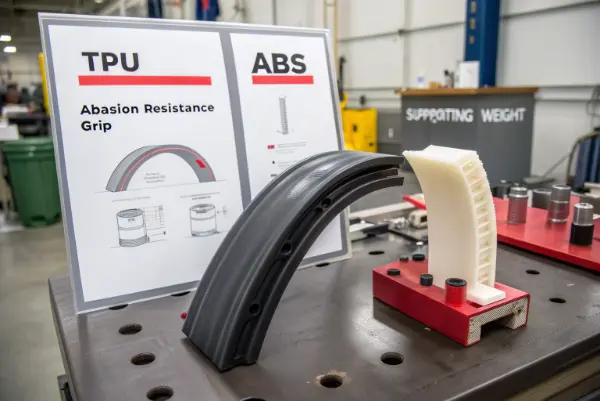
ABS, PC, PLA, nylon and TPU serve different functions in injection-molded products; none is the best material without a defined application. Start with load, temperature, impact, chemicals, moisture, flexibility, appearance, compliance and production volume. Then compare exact commercial grades—not generic polymer names.
This guide is written for product engineers and molded-part buyers. It focuses on injection molding rather than filament printing, although 3D-printed prototypes may still support early fit checks.
Fast Selection Map
| Material family | Often considered when | Primary risks to resolve |
|---|---|---|
| ABS | Rigid housings need balanced cost, impact and cosmetic finish | Weathering, heat, chemical exposure and flame-rating needs |
| PC | Impact, toughness or transparency is important | Drying, residual stress, chemical attack, high processing temperature |
| PLA | Bio-based content or a specific low-demand application is being evaluated | Heat, hydrolysis, impact, aging and end-of-life claims |
| Nylon | Wear, fatigue, strength or reinforced structural performance is needed | Moisture conditioning, creep, fiber orientation, dimensional change |
| TPU | Elasticity, abrasion resistance or soft-touch function is needed | Hardness alone is insufficient; drying, compression, adhesion and ejection matter |
ABS: Balanced Performance for Rigid Housings
ABS is widely considered for consumer and industrial enclosures because it can combine impact performance, moldability and surface finishing. Grade selection still matters. Heat-resistant, plated, flame-retardant and impact-modified grades can behave differently. Outdoor exposure and aggressive chemicals may point toward another material or a qualified coating system.
From a tooling perspective, review wall transitions, knit lines at bosses, gate vestige and the finish needed for painting, plating or texture. If fire performance is required, specify the exact rating, thickness and color rather than assuming all ABS behaves alike.
PC: Impact and Optical Options With Stress Sensitivity
Polycarbonate can provide high impact performance and transparent grades, but it requires moisture control and appropriate processing. Residual stress can interact with cleaners, oils or assembly loads and produce cracking. The design should minimize sharp corners and excessive molded-in stress, and the validation should use the actual chemicals and conditions.
PC/ABS blends may offer a different balance of flow, heat and impact for opaque housings. They are separate formulations and must be evaluated by grade.
PLA: A Conditional Choice, Not a Universal Sustainable Substitute
PLA may be bio-based, but bio-based does not automatically mean biodegradable in the use environment, compostable in every system or lower impact for every product. Ordinary PLA can have heat, impact, moisture and aging limitations. Modified PLA and bio-based composites may perform differently, so claims and end-of-life routes need evidence.
PLA can be useful for prototypes and selected molded products when the service conditions fit. It should not be substituted into a hot, impact-loaded or long-life application without grade-specific qualification.
Nylon: Structural and Wear Performance With Moisture Effects
Nylon families include many grades and reinforcements. Unfilled grades may provide toughness and wear behavior; glass-filled grades can increase stiffness while changing shrinkage, surface and anisotropy. Moisture absorption affects both dimensions and properties, so drawing tolerances and tests need a defined conditioning state.
For structural components, evaluate creep, weld lines, fiber orientation and insert loads. A dry-as-molded sample may not represent the in-service condition.
TPU: Flexible Function Beyond Shore Hardness
TPU is selected for elasticity, abrasion, damping and soft-touch uses, but two grades with similar hardness can differ in chemistry, compression set, tear, hydrolysis and adhesion. Thin flexible parts can be difficult to eject without distortion. Overmolding also requires compatibility and interface validation with the exact substrate.
Compare the Production Consequences
- Moisture: PC, nylon and many TPU grades require controlled drying; the exact instruction comes from the resin supplier.
- Shrinkage: range and direction depend on grade, reinforcement, wall, flow and process. Use data as an initial mold-sizing input, then validate at trial.
- Tool wear: reinforced or additive-filled grades can increase wear and affect steel, gate and maintenance decisions.
- Surface: gloss, texture, fiber read-through, gate location and secondary finishing can change the preferred material.
- Change control: a substitute grade may require dimensional, functional, appearance or compliance revalidation.
Illustrative Buyer Decision
This is a hypothetical example. A handheld enclosure needs a rigid cosmetic shell, drop resistance, resistance to a named cleaning chemical and a soft grip. Instead of choosing one polymer for the entire product, the team compares ABS and PC/ABS for the shell, checks chemical stress cracking on molded samples, and evaluates a compatible TPU for the grip. The decision is made from the assembly and validation evidence, not a generic “strongest plastic” ranking.
Information Needed for Material Review
Provide the part’s function, CAD, loads, temperature range, chemicals, indoor or outdoor use, regulatory needs, appearance, annual volume and assembly method. CKMOLD’s plastic materials overview can frame the discussion, while DFM analysis connects the selected grade to gates, shrinkage, walls and ejection.
Buyer Questions
Can I select a material from tensile strength alone?
No. Creep, impact, temperature, moisture, chemicals, geometry, molding direction and failure mode can be equally important.
Is a printed prototype representative of an injection-molded part?
It can answer some fit and handling questions, but print orientation, porosity and thermal history differ from molding. Use production-representative material and process for final validation.
When do I need a flame-retardant or UV-stabilized grade?
When the product specification or service environment requires it. Name the applicable test, thickness, color, exposure and acceptance criteria in the RFQ.
For a grade-specific recommendation, submit the application requirements through CKMOLD’s project form. CAD files can be emailed separately when needed.