
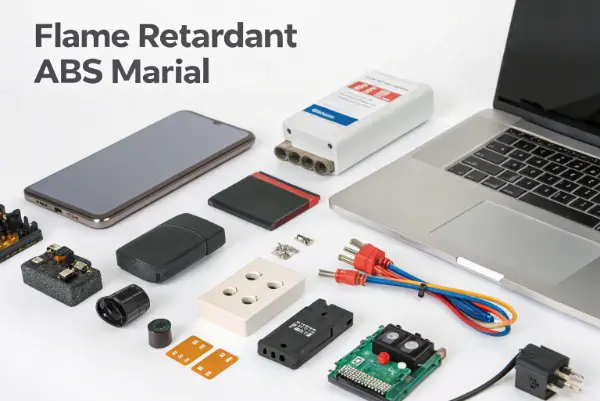
Dealing with safety regulations for plastic parts can feel like navigating a minefield, especially when fire resistance is non-negotiable. You design a perfect enclosure, but then you worry: will this material melt or catch fire under stress? It is a common fear that keeps many designers awake at night.
Flame Retardant ABS (FR-ABS) is a modified version of standard Acrylonitrile Butadiene Styrene that includes chemical additives to resist ignition and slow down combustion1. It combines the toughness and ease of processing found in regular ABS with critical safety properties, making it the go-to choice for electronics, automotive interiors, and consumer appliances where fire safety standards like UL94 V-0 must be met2.
I remember when I first started in the mold factory, we had a client who insisted on using cheap, standard plastic for a power strip casing. I tried to explain the risks, but cost was their only focus. A few months later, they faced a recall because the casings were warping and smoking from internal heat. That experience taught me a valuable lesson: material selection isn’t just about function; it is about responsibility. Let’s look closer at what makes this material so special.
What is fireproof ABS?
Many people use the terms "fireproof" and "flame retardant" interchangeably, but there is a distinct difference in the world of plastics. Are you confused about whether a plastic can truly be proof against fire? It is a tricky concept because almost all organic materials will burn if the fire is hot enough.
Fireproof ABS is a colloquial term for Flame Retardant ABS (FR-ABS) that has been engineered to self-extinguish when the flame source is removed. It does not mean the material is immune to fire damage; rather, it means the material will not contribute to the spread of the fire. It meets specific flammability standards, such as UL94, ensuring it stops burning within a set time frame.
When we talk about "fireproof" in the mold industry, we need to be very precise. I often tell my clients that we are not making magic shields; we are creating safety buffers. "Fireproof" creates a false sense of invincibility. In reality, we are managing risk.
To understand this deeper, we need to look at how we measure "fireproof" capabilities. The industry standard is the UL94 rating system. This is not just a label; it determines where you can legally sell your product.
Understanding UL94 Ratings
| Rating | Description | Typical Application |
|---|---|---|
| HB (Horizontal Burn) | Slow burning on a horizontal specimen; burning rate < 76 mm/min. This is the lowest rating. | Decorative parts, non-electrical housings. |
| V-2 | Burning stops within 30 seconds on a vertical specimen; drips of flaming particles are allowed. | Less critical internal components. |
| V-1 | Burning stops within 30 seconds on a vertical specimen; drips of particles allowed as long as they are not inflamed. | Office equipment, some appliance parts. |
| V-0 | Burning stops within 10 seconds on a vertical specimen; drips of particles allowed as long as they are not inflamed. | Power supplies, adapters, high-voltage enclosures. |
| 5VA / 5VB | Burning stops within 60 seconds on a vertical specimen; strictly no drips allowed; plaque specimens may not have a hole burned through (5VA). | Large enclosures, industrial machinery covers. |
When I design molds for FR-ABS, I always ask for the specific UL rating required. Designing for V-0 is different from designing for HB.
- Gate Sizing: FR-ABS is more sensitive to shear heat. If the gate is too small, the friction can degrade the flame retardant additives, causing splay marks or reducing fire resistance.
- Venting: Because of the additives, FR-ABS produces more gas during molding. We need aggressive venting channels (0.02mm – 0.03mm deep) to prevent gas traps and burning at the end of the fill.
- Cooling: The additives can act as insulators. This means the cycle time might be longer compared to standard ABS. We need to optimize cooling lines to extract heat efficiently without warping the part.
What is the flame retardant in ABS?
Standard ABS burns quite easily, smelling like burnt rubber and releasing thick black smoke. So, how do we turn this flammable material into something that resists fire? You might wonder what chemical wizardry goes into the mixing hopper to change the material’s fundamental nature.
The flame retardant in ABS usually consists of halogenated compounds, often brominated chemicals, combined with antimony trioxide as a synergist. These additives work by interrupting the chemical reaction of combustion in the gas phase or by forming a protective char layer on the surface that blocks oxygen and heat from reaching the material underneath.
I recall working on a project for a server rack component where we had to switch suppliers because the batch color was inconsistent. It turned out the new supplier was using a different type of flame retardant that reacted poorly with our masterbatch. The chemistry here is sensitive.
Let’s break down the different types of retardants, because "halogenated" isn’t the only option anymore, especially with environmental regulations getting stricter.
Types of Flame Retardant Systems
-
Halogenated Systems (Bromine/Chlorine):
- Mechanism: These release heavy gases that displace oxygen and trap free radicals that sustain the fire.
- Pros: Very efficient, low cost, minimal impact on mechanical properties.
- Cons: Produces toxic smoke when burned; restricted by RoHS and REACH in some regions.
-
Halogen-Free Systems (Phosphorus-based):
- Mechanism: These usually promote char formation. When heated, the surface expands into a carbon foam (intumescence) that acts as a thermal barrier.
- Pros: Lower smoke toxicity, environmentally friendlier.
- Cons: Can be more expensive; requires higher loading levels which might reduce impact strength; can be sensitive to moisture (hydrolysis).
-
Inorganic Fillers (Magnesium Hydroxide / Aluminum Trihydrate):
- Mechanism: They release water vapor when heated (endothermic reaction), cooling the material down and diluting combustible gases.
- Pros: Cheap and non-toxic.
- Cons: Requires very high loading (up to 60%), which destroys the impact resistance of ABS and makes it very difficult to mold (high viscosity).
Impact on Molding:
When you add these chemicals, you change the rheology (flow) of the plastic.
- Processing Temperature: You have a narrower processing window. If you heat FR-ABS too much (above 240°C usually), the flame retardant starts to decompose inside the barrel. This releases gases that corrode the screw and mold steel.
- Corrosion Protection: Because of this potential for corrosive gas, I always recommend using stainless steel (like H13 or Stavax) for the mold core and cavity, or at least plating the mold with chrome or nickel. Standard P20 steel will rust very quickly with FR-ABS.
What are the applications of ABS material?
Before we look specifically at where the fire-resistant version is used, it is helpful to remember why we use ABS in the first place. Why is this terpolymer the workhorse of the consumer product industry? It strikes a balance that few other materials can match.
Standard ABS (Acrylonitrile Butadiene Styrene) is widely used for consumer goods, automotive parts, and protective gear due to its high impact resistance, excellent surface finish, and rigidity. It is the material of choice for things like LEGO bricks, computer keyboard keys, luggage shells, and dashboard components because it is tough, holds color well, and is easy to glue or paint.

I built my first few molds for standard ABS toys. It is a forgiving material. It doesn’t flash easily, and it shrinks predictably (around 0.5%). But standard ABS has limits.
When we look deeper into standard ABS applications, we see it dominates wherever "touch and feel" plus durability matters.
Why ABS Dominates General Manufacturing
- Consumer Electronics (Non-Critical): Computer mice, keyboard keys, and headphones. These parts need to feel good in the hand. ABS offers a "warm" touch compared to metals and can be polished to a high gloss or textured for grip.
- Automotive Interiors: Door handles, dashboard trims, and air vents. The "Butadiene" rubber component in ABS gives it good impact strength even at lower temperatures, which is crucial for cars in winter.
- Household Items: Vacuum cleaner bodies, shaver housings, and kitchen appliance shells (the parts that don’t get hot). It resists scratching better than Polypropylene (PP) and looks more premium.
- Prototyping: ABS is the standard filament for FDM 3D printing. This allows designers like Jacky to prototype a part in ABS, test the fit, and then move to injection molding with the exact same material properties.
The Limitation:
The main downside of standard ABS is its poor UV resistance and flammability. If you leave a white ABS monitor casing in the sun, it turns yellow. If you expose it to a spark, it burns. This is why for outdoor use, we switch to ASA (Acrylonitrile Styrene Acrylate), and for safety-critical parts, we must switch to FR-ABS. Understanding the base material helps you appreciate why the Flame Retardant version is necessary for the next step up in engineering requirements.
What are the applications of flame retardant?
Now that we know what ABS does and how we make it fire-safe, where do we actually use this modified material? Is it only for heavy industry, or is it closer to home than you think? The reality is that FR-ABS is likely sitting on your desk right now.
Flame Retardant applications are essential in sectors where electrical currents, high heat, or public safety regulations are involved. This includes consumer electronics enclosures, power distribution units, aerospace interiors, and automotive electrical connectors. Wherever a device plugs into a wall or houses a battery, FR-ABS is typically the required standard to prevent electrical fires.
I once had a project for a Wi-Fi router housing. The design was sleek, with very thin ribs for ventilation. We had to use FR-ABS because the device ran hot and was plugged in 24/7. This project highlighted the specific challenges of these applications.
Let’s dive deeper into the specific sectors and the critical thinking behind choosing FR-ABS for them.
Critical Application Sectors
-
Consumer Electronics (The "Always On" Devices):
- Examples: Wi-Fi routers, modems, set-top boxes, chargers, and power strips.
- Why: These devices generate internal heat. If a capacitor fails and sparks, the casing must not catch fire.
- Design Insight: FR-ABS is denser than standard ABS (Specific Gravity around 1.15 to 1.20 vs. 1.05). This makes the part feel heavier and higher quality, which is a side benefit. However, the flow is stiffer. For thin-walled electronics (like 1.5mm walls), we need high-flow grades of FR-ABS to fill the mold without high pressure that causes internal stress.
-
E-Mobility and Automotive:
- Examples: EV battery module covers, charging gun shells, connector housings.
- Why: With the rise of Electric Vehicles, high voltage is everywhere. A thermal runaway event in a battery pack is catastrophic. FR-ABS acts as a barrier to delay fire spread, giving passengers time to exit.
- Design Insight: These parts often need to be chemically resistant to road salts and oils too. Sometimes FR-ABS is blended with Polycarbonate (PC/ABS) to get the best of both worlds: higher heat resistance and better impact strength at low temperatures.
-
Public Transport and Aerospace:
- Examples: Seat backs, overhead bin latches, armrests.
- Why: Regulations here are the strictest (like FAR 25.853 for aircraft). Smoke density is just as important as flammability.
- Design Insight: Here, we often move away from halogenated FR-ABS because of the toxic smoke. We use specialized halogen-free grades.
The "Living Hinge" Problem:
One specific design note for you, Jacky. Standard PP (Polypropylene) is great for living hinges. ABS is not. FR-ABS is even worse because the additives make it brittle. If your application needs a flame-retardant box with a living hinge, do not use FR-ABS. You will need to design a mechanical hinge or switch to a specialized FR-PP, though the surface finish won’t be as good. Knowing these material limits prevents costly tooling changes later.
Conclusion
Flame Retardant ABS is a vital material that bridges the gap between aesthetics and safety. By understanding the chemistry of UL94 ratings, the specific molding challenges like corrosion and venting, and the correct applications in electronics and automotive, we can design safer, compliant products. It is not just about avoiding fire; it is about building trust in the products we create.
-
"Thermal Degradation and Flame Resistance Mechanism of … – PMC", https://pmc.ncbi.nlm.nih.gov/articles/PMC12251474/. Flame retardant additives in ABS typically work by releasing gases that dilute flammable volatiles, forming protective char layers, or interfering with free radical combustion reactions in the polymer matrix. Evidence role: mechanism; source type: research. Supports: chemical additives in FR-ABS function to inhibit combustion through gas-phase or condensed-phase mechanisms. Scope note: The specific additive systems vary by manufacturer and formulation, so mechanisms may differ across FR-ABS products. ↩
-
"UL 94", https://en.wikipedia.org/wiki/UL_94. UL94 is a plastics flammability standard published by Underwriters Laboratories, with V-0 representing the highest vertical burn rating, requiring that specimens self-extinguish within 10 seconds and produce no flaming drips. Evidence role: definition; source type: institution. Supports: UL94 V-0 is a flammability classification standard established by Underwriters Laboratories for plastic materials. ↩