
Ensuring the safety of materials in food manufacturing can be a headache for business owners. You worry about compliance, consumer safety, and the potential legal nightmares of using the wrong plastic. It feels like navigating a minefield of regulations. We will clear up the confusion surrounding ABS plastic in food contact applications so you can make confident manufacturing decisions.
Generally, standard ABS (Acrylonitrile Butadiene Styrene) is not considered safe for direct food contact. While the base polymer is often stable, the additives, colorants, and stabilizers used during processing can leach toxic chemicals into food, especially under heat or acidic conditions1. However, specific food-grade ABS formulations exist that meet FDA regulations2. Always verify the Material Safety Data Sheet (MSDS) to ensure specific compliance before use.
Let’s be honest, the world of plastics is confusing. I remember when I first started in the mold factory, we had a client who insisted on using cheap ABS for lunchboxes. I had to sit him down and explain that just because a material is tough, doesn’t mean you should eat off of it. It’s not just about the plastic itself; it’s about what happens when that plastic touches hot food or goes through a dishwasher. If you are manufacturing products that will touch food, you need to know exactly what you are dealing with. Let’s dig into the details.
Is ABS safe for direct food contact?
You might think ABS is safe because it is used in everything from LEGO bricks to computer keyboards. But when it comes to food, the stakes are much higher. You don’t want to risk contamination or chemical leaching. The fear of a product recall is enough to keep any manufacturer up at night.
Standard ABS is typically not safe for direct food contact because of the chemicals used in its production. The primary concern is the potential migration of acrylonitrile and butadiene, which are considered toxic. However, "Food Grade" ABS is a specific formulation manufactured without harmful additives and is processed to ensure chemical stability. Always distinguish between general-purpose ABS and certified Food Grade ABS.
We need to look closer at why standard ABS gets a bad reputation in the kitchen. It is not just one thing; it is a combination of chemical properties and processing methods. When I consult with clients at CKMOLD, I always tell them to look at the "Three Critical Factors" when considering ABS for food.
The Chemical Breakdown
ABS is made of three monomers: Acrylonitrile, Butadiene, and Styrene.
- Acrylonitrile: This gives the plastic its chemical resistance and heat stability. The problem is that residual acrylonitrile monomer is toxic.
- Butadiene: This provides toughness and impact strength.
- Styrene: This offers that nice, glossy finish and processability.
The Risk of Leaching
Leaching is when chemicals from the plastic move into the food. This happens more often when:
- Heat is involved: Think about hot soup in a plastic bowl. Heat accelerates chemical migration.
- Acidity is high: Tomato sauce or lemon juice can react with the plastic surface.
- Fat content is high: Oils and fats can sometimes pull chemicals out of plastics.
Safer Alternatives
If you find that food-grade ABS is too expensive or hard to source, I often recommend looking at other materials. Here is a quick comparison table I use with my clients:
| Material | Food Safety Rating | Best Use Case | Cost Relative to ABS |
|---|---|---|---|
| Standard ABS | Low / Unsafe | Electronic housings, toys | Baseline |
| Food Grade ABS | High (Certified) | Coffee machine parts, kitchen tools | Higher |
| Polypropylene (PP) | Very High | Food containers, Tupperware | Generally Lower |
| HDPE | Very High | Cutting boards, milk jugs | Lower |
| Tritan | Very High | High-end water bottles | Higher |
If you absolutely must use ABS for a part—maybe because you need that specific impact resistance—you have to ensure the raw material supplier provides a certification specifically stating it is for food contact. Do not assume.
Is ABS FDA-approved for food applications?
Understanding FDA approval can feel like reading a different language. You see a "FDA compliant" sticker and think you are safe, but it is rarely that simple. Misinterpreting these regulations can lead to massive fines and a damaged reputation.
ABS is not universally FDA-approved as a single category. Instead, the FDA approves specific grades of ABS resin based on their chemical formulation and intended use. Under Title 21 of the Code of Federal Regulations (CFR), specifically section 177.1020, acrylonitrile copolymers are regulated. You must use a resin grade that has a specific "Letter of Guaranty" from the supplier stating compliance with FDA 21 CFR.
Let’s break down what "FDA Approved" actually means in the context of manufacturing. I have seen many business owners get tripped up here. They buy a bag of ABS pellets, see a vague compliance note, and start molding cups. That is dangerous.
The Difference Between Material and Product
The FDA does not approve the material (ABS) in a general sense. They approve the specific formulation.
- Resin Compliance: The raw pellets must be certified.
- Additive Compliance: Any colorant, stabilizer, or mold release agent you add during the injection molding process must also be FDA compliant. If you take FDA-approved ABS pellets and add a non-approved red dye, your final product is not safe.
Key Regulations to Know (21 CFR)
If you are selling in the US market, these are the codes you need to be familiar with. You don’t need to be a lawyer, but you should recognize these numbers on a datasheet.
- 21 CFR 177.1020: This covers Acrylonitrile/Butadiene/Styrene co-polymer. It sets strict limits on the amount of acrylonitrile that can migrate into food.
- 21 CFR 177.1010: This deals with Acrylic and modified acrylic plastics.
- 21 CFR 178.3297: This covers colorants for polymers.
The Migration Test
To truly be FDA compliant, the final part often needs to pass migration testing. This involves simulating use conditions.
- Solvent simulation: The lab exposes the plastic to alcohol, water, or oil to simulate different food types.
- Temperature testing: They heat the plastic to the maximum intended use temperature.
- Duration: They leave it for a set time to see how much chemical leaches out.
When I started my trading company, I learned the hard way that "Food Safe" is a supply chain commitment. You need a paper trail from the resin manufacturer (like BASF, Sabic, or Chi Mei) all the way to your factory floor. If you break the chain, you lose the compliance.
What is the ASTM standard for ABS?
Engineers love standards, but business owners just want to know if the product will work. Confusing ASTM standards with safety standards is a common mistake. You might build a part that is incredibly strong according to ASTM, but totally toxic for food.
The primary standard for ABS is ASTM D4673, which covers the classification system for ABS molding and extrusion materials. This standard defines the physical properties like impact strength, tensile stress, and deflection temperature. While ASTM D4673 ensures the mechanical quality of the plastic, it does not certify food safety. You must combine ASTM physical standards with FDA chemical standards for a complete product specification.
I often see technical drawings that list "Material: ABS per ASTM D4673" but fail to mention food safety requirements. This is a recipe for disaster. The ASTM standard tells you how the material behaves mechanically; it does not tell you if it will poison someone.
Understanding ASTM D4673
This standard uses a line call-out system. It looks like a secret code, for example: ABS0111.
- Group: Identifies the material type (ABS).
- Class: Identifies the processing method (Injection molding, extrusion).
- Grade: Identifies specific property ranges (High impact, medium impact).
Why Physical Standards Matter for Food Safety
You might ask, "Jerry, if ASTM isn’t about food safety, why do I care?"
Because physical failure leads to food safety issues.
- Cracking: If an ABS container cracks because it didn’t meet ASTM impact standards, bacteria can grow in those cracks.
- Heat Deflection: If the ASTM heat deflection temperature is too low, the dishwasher will warp the container, potentially releasing more chemicals or creating traps for food residue.
Creating a Robust Specification
When you order molds or parts from a company like mine, your specification sheet should look like a fortress. It needs to combine both worlds. Here is how I structure specifications for my clients:
Example Specification Structure:
- Material Base: ABS (Acrylonitrile Butadiene Styrene)
- Mechanical Standard: Must meet ASTM D4673 Group 1, Class 1, Grade 2 (for high impact).
- Regulatory Standard: Must be compliant with FDA 21 CFR 177.1020 for food contact.
- Additives: All colorants must meet 21 CFR 178.3297.
- Prohibited Substances: No heavy metals, no BPA (if applicable).
By layering these standards, you ensure the product is tough enough to do the job (ASTM) and safe enough for the customer (FDA).
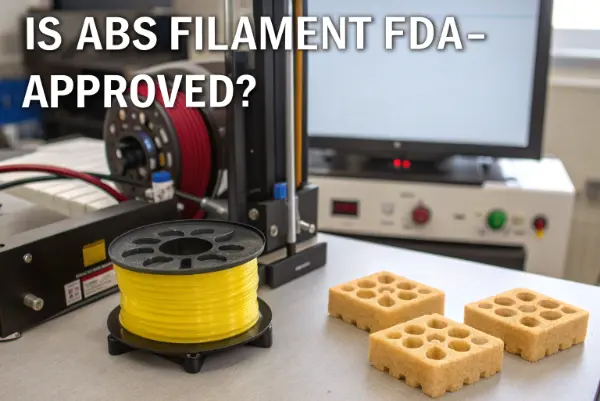
Is ABS Filament FDA-approved?
3D printing has changed manufacturing, allowing for rapid prototyping and small-batch production. But many people assume the filament they buy online is the same as the industrial pellets used in injection molding. This assumption can be dangerous when making custom cookie cutters or kitchen gadgets.
Most standard ABS filaments used in 3D printing are not FDA-approved. The printing process itself introduces gaps between layers where bacteria can thrive and cannot be easily cleaned. Additionally, the brass nozzles on 3D printers often contain lead, which can contaminate the print. Unless you use specific "Food Safe" certified filament and a stainless steel nozzle, printed ABS parts are unsafe for food contact.
This is a topic near to my heart because I love tinkering with 3D printers. I have seen so many "cool" designs for cups and plates on the internet, and I cringe. The reality of FDM (Fused Deposition Modeling) printing makes food safety very difficult to achieve.
The "Layer Line" Problem
Injection molding creates a smooth, solid surface. 3D printing lays down lines of plastic.
- Micro-crevices: Even at high resolution, there are tiny valleys between the layers.
- Bacteria Trap: Food particles get stuck in these valleys. You cannot wash them out with a sponge. Eventually, mold and salmonella can grow there.
- Solution: If you must print a food contact part, you have to coat it with a food-safe epoxy resin to smooth out the surface.
The Contamination Issue
It is not just the plastic; it is the machine.
- The Nozzle: Standard 3D printer nozzles are brass. Brass is an alloy of copper and zinc, but it often contains small amounts of lead to make it easier to machine. That lead can rub off into your plastic.
- The Pathway: The tube that feeds the filament might have residue from previous, non-food-safe materials like carbon fiber or PLA with toxic dyes.
When to Use 3D Printed ABS
I advise my clients to use 3D printed ABS for:
- Form and Fit testing: Check if the handle feels right.
- Visual Models: See how the product looks on a shelf.
- Indirect Parts: Parts of a machine that do not touch the food directly.
If you need a food-safe prototype, it is often better to machine it from a block of food-grade ABS or use a silicone mold casting method. Do not rely on raw 3D prints for functional food testing. It is not worth the risk to your health or your business liability.
Conclusion
Navigating the safety of ABS in food applications requires attention to detail. While standard ABS is generally unsafe for direct food contact due to chemical leaching, certified food-grade formulations exist and are compliant with FDA regulations. You must verify compliance through MSDS sheets, ensure your manufacturing process (including additives and machinery) maintains that safety, and distinguish between mechanical standards like ASTM and safety regulations. For prototyping, avoid raw 3D printed ABS for food contact. Always choose the right material grade to protect your customers and your business.
-
"Food Packaging and Chemical Migration – PMC – NIH", https://pmc.ncbi.nlm.nih.gov/articles/PMC12096275/. Research on polymer-food interactions demonstrates that additives including plasticizers, stabilizers, and colorants can migrate from plastic materials into food matrices, with migration rates increasing under elevated temperatures and acidic pH conditions. Evidence role: mechanism; source type: research. Supports: that plastic additives can migrate from polymers into food under elevated temperature or acidic pH conditions. Scope note: While this supports the general mechanism of additive migration, specific leaching rates and toxicity profiles vary by additive type and ABS formulation. ↩
-
"poly(acrylonitrile-co-butadiene-co-styrene)", https://www.hfpappexternal.fda.gov/scripts/fdcc/index.cfm?set=IndirectAdditives&id=POLYACRYLONITRILECOBUTADIENECOSTYRENE. The FDA regulates food contact substances under 21 CFR Parts 170-189, and manufacturers may obtain authorization for specific polymer formulations including ABS variants through the Food Contact Notification (FCN) program when they meet safety requirements for intended use conditions. Evidence role: general_support; source type: government. Supports: that certain ABS formulations can be authorized for food contact use under FDA regulations. Scope note: This confirms the regulatory pathway exists but does not verify that all food-grade ABS products on the market have obtained proper FDA authorization. ↩