
Global Safety Standards for ABS Toys: How Do EN71, ASTM F963, and ISO 8124 Compare?

You have finally perfected your ABS toy design, but now you face a maze of international regulations. One wrong move with compliance can lead to recalled products, lawsuits, and a damaged brand reputation. It is terrifying to think your hard work could be destroyed by a single failed safety test.

Global safety standards for ABS toys are critical regulations that ensure products are safe for children to use. The three major frameworks are EN71 (European Union), ASTM F963 (United States), and ISO 8124 (International)1. While they share the goal of preventing choking, toxicity, and injury, they differ in specific testing methods, chemical limits, and mechanical stress requirements2. Understanding these differences helps manufacturers choose the right compliance strategy for their target markets.

Navigating these standards feels overwhelming, but I have broken them down simply. Let us look at exactly what each standard requires so you can sell your toys globally with confidence.

What is the EN71 toy safety standard?

If you want to sell toys in Europe, you must deal with strict rules that can feel impossible to satisfy. Failing to meet European safety requirements means your products will be stopped at the border immediately.

EN71 is the set of safety standards that applies to all toys sold within the European Union. It consists of several parts, covering everything from mechanical and physical properties to flammability and chemical migration. The most famous part, EN71-3, strictly limits the migration of 19 toxic elements like lead and cadmium from toy materials. Compliance with EN71 is mandatory for obtaining the CE mark.

The European market is known for being rigorous, especially regarding chemicals. When we talk about EN71, we are usually discussing a multi-part document. It is not just one test; it is a series of hurdles your ABS toy must clear.

Here is a breakdown of the critical sections you will encounter most often:

EN71 Part Focus Area Key Requirement for ABS Toys
EN71-1 Mechanical & Physical Checks for sharp edges, sharp points, and small parts that could cause choking. It includes drop tests and torque tests.
EN71-2 Flammability Ensures the plastic does not burn too quickly if it catches fire, giving a child time to drop it and move away.
EN71-3 Chemical Migration This is the big one. It measures how much of a chemical (like heavy metals) transfers from the toy to the child if they suck or chew on it.

In my experience at CKMOLD, many clients assume that because ABS is a common plastic, it is automatically safe. This is a dangerous assumption. The base resin might be safe, but the additives, colorants, or surface paints you use can fail the EN71-3 chemical migration test. I once worked with a client whose red ABS toy failed because the pigment supplier changed their formula without notice. We had to re-source the material immediately. For European compliance, you must have full traceability of every pellet that goes into your mold. The "CE" mark is not just a sticker; it is a promise that you have passed these specific tests.

What is the safety standard mandating ASTM F963 for toys?

Selling in the United States without understanding ASTM F963 is a guaranteed way to get sued or shut down by the CPSC. Many business owners do not realize that voluntary standards became federal law years ago.

ASTM F963 is the standard consumer safety specification for toy safety in the United States. Since the Consumer Product Safety Improvement Act (CPSIA) of 2008, compliance with ASTM F963 has been mandatory for all toys intended for children under 12. It focuses heavily on preventing mechanical hazards, restricting heavy metals like lead in surface coatings, and ensuring magnets are safe.

While EN71 and ASTM F963 look similar on the surface, the US standard has its own specific triggers. The history here is important. Before 2008, this was technically "voluntary," though most retailers demanded it. After the CPSIA passed, it became the law of the land.

Let us look deeper at what makes ASTM F963 unique compared to other standards:

Key Focus Areas of ASTM F963

  1. Lead and Heavy Metals:
    The US is incredibly strict about lead, especially in surface coatings (paint on your ABS plastic). The limit is 90 ppm (parts per million) for lead in paint. If you paint your ABS parts, you need third-party testing for every batch.

  2. Magnet Safety:
    This is a major difference. After several incidents where children swallowed high-powered magnets, ASTM F963 added very specific tests. If your ABS toy has a magnet, it must be either too large to swallow or have a low magnetic flux index. If a small magnet breaks loose during a drop test, you fail.

  3. Battery Operated Toys:
    ASTM F963 includes specific sections on battery compartments. They must be secured so a child cannot easily open them (usually requiring a tool like a screwdriver) to prevent battery ingestion or burns.

  4. Mechanical Stress:
    The drop tests and compression tests in ASTM are aggressive. They simulate "reasonably foreseeable abuse." This means the test assumes a child will throw, step on, and crush the toy.

Feature ASTM F963 (USA) EN71 (Europe)
Heavy Metals Focuses heavily on total lead content and soluble limits. Focuses on the migration of 19 different elements.
Small Parts Mandatory "Small Parts Cylinder" test for under 3s. Similar cylinder test, but warning label requirements differ.
Enforcement CPSC (Consumer Product Safety Commission). Individual member state authorities.

At CKMOLD, when we design molds for US clients, we often add extra ribs to the internal structure of ABS parts. Why? To pass the ASTM impact tests. It is cheaper to add plastic strength during the design phase than to fail a safety test later.

What is the difference between ASTM and EN 71?

Confusion between these two standards is the number one reason global product launches get delayed. You might think passing one means you pass the other, but subtle differences can cause major compliance failures.

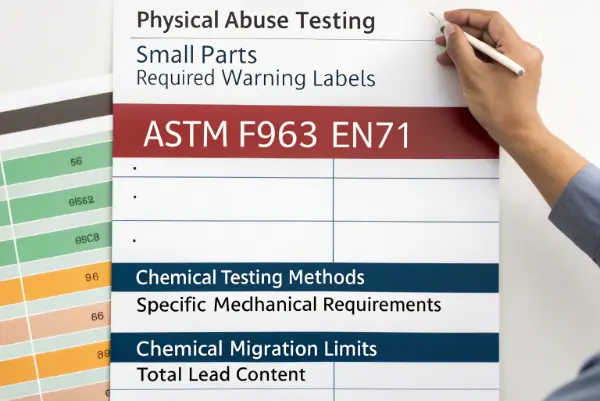
The main difference between ASTM F963 and EN71 lies in their chemical testing methods and specific mechanical requirements. EN71 generally has broader and stricter chemical migration limits (looking for more substances), while ASTM F963 places a heavier emphasis on total lead content and physical abuse testing. Additionally, their definitions of "small parts" and required warning labels vary slightly.

It is helpful to think of these two standards as siblings who have different personalities. They come from the same family (toy safety), but they behave differently. If you are a business owner like Michael, you need to know where the traps are.

Here is a deeper analysis of the technical divergences:

Chemical Testing Methodologies

  • ASTM F963 (Soluble vs. Total): The US standard often screens for total lead content first. If you pass the total content screen, you might not need the more expensive soluble test. However, for soluble elements, it tests for 8 metals (Antimony, Arsenic, Barium, Cadmium, Chromium, Lead, Mercury, Selenium).
  • EN71-3 (The Migration Monster): Europe does not care as much about total content; they care about migration. This simulates stomach acid. They test for 19 elements, including different forms of Chromium (III and VI) and organic tin. An ABS toy could pass ASTM but fail EN71 because of organic tin stabilizers used in the plastic.

Mechanical and Physical Nuances

  • The Sound Test: EN71 has very strict rules about how loud a toy can be (acoustics). ASTM covers this too, but the allowable decibel levels and measurement distances can differ.
  • The Bite Test: ASTM F963 includes a "bite test" simulation to see if a child can bite off a piece of plastic. EN71 focuses more on tension and torque.
  • Flammability: Both test this, but the acceptable rate of flame spread differs. A thin ABS sheet might pass one and fail the other depending on the exact thickness and additives.

Strategy for Dual Compliance:
When I help clients manufacturing at CKMOLD, I recommend a "highest bar" approach.

  1. Design: Design to the strictest mechanical standard (usually ASTM for physical abuse).
  2. Materials: Select materials that meet the strictest chemical standard (usually EN71-3).

If you use ABS resin that is certified for EN71-3, it will almost certainly pass ASTM F963 chemical limits. Conversely, if you build the toy strong enough to survive ASTM abuse tests, it will likely pass EN71 physical tests.

What is the role of ISO 8124 in this mix?

You might see ISO 8124 mentioned in supplier documents and wonder if it replaces the other standards. Relying on ISO alone for US or EU markets is a critical mistake that can block your sales.

ISO 8124 is the international standard for toy safety, designed to harmonize rules across different countries. While it is very similar to EN71 and ASTM F963, it is not automatically accepted in the US or EU. However, it is the primary standard for markets like Australia, New Zealand, and China. It serves as a solid baseline for global safety but is rarely a substitute for local laws.

ISO (International Organization for Standardization) tries to get everyone on the same page. In an ideal world, we would have one standard for the whole planet. We are not there yet.

Here is how ISO 8124 fits into your manufacturing strategy:

Where ISO 8124 Applies

If you are selling to Australia (AS/NZS ISO 8124) or China (GB 6675 is heavily based on ISO), this is your bible. Many emerging markets in Southeast Asia and the Middle East also adopt ISO standards because they do not want to write their own from scratch.

The Similarities and Differences

  • Structure: ISO 8124 is structured very much like EN71.
    • Part 1: Mechanical/Physical
    • Part 2: Flammability
    • Part 3: Migration of certain elements
  • Divergence: While the structure is the same, the limits can be slightly different. For example, ISO 8124-3 (chemicals) is very close to the old EN71-3 limits, but Europe has since updated and tightened their rules. So, an ISO-compliant toy might fail current European laws.

Why You Should Care

As a business owner, you want to simplify your supply chain. You do not want three different SKUs for three different continents if you can avoid it.

The "Golden Sample" Approach:
At CKMOLD, we advise creating a "Golden Sample" or a master specification.

  • We review the overlap of ASTM, EN71, and ISO.
  • We identify the strictest limit for every single test.
    • Example: If ASTM allows 90ppm lead, and a hypothetical new ISO rule allowed 100ppm, but EN71 allowed 80ppm, we aim for <80ppm.
  • We manufacture the ABS parts to meet that strictest requirement.

This allows you to test the same production batch against all three standards. The lab will run the tests and issue three different reports based on the same product. This is much cheaper than running three separate production runs. It requires strict control over your molding process and raw materials, but it is the only way to scale efficiently.

Conclusion

Ensuring your ABS toys meet global safety standards is not just about avoiding fines; it is about protecting children and your business’s future. EN71 is the strictest on chemicals for Europe, ASTM F963 focuses on physical durability for the US, and ISO 8124 covers many other international markets. By understanding the differences and designing for the highest standards, you can create a single, high-quality product that sells safely worldwide.


  1. "Toy Safety Business Guidance | CPSC.gov", https://www.cpsc.gov/Business–Manufacturing/Business-Education/Toy-Safety. EN71, ASTM F963, and ISO 8124 are widely recognized as primary toy safety standards governing the European, United States, and international markets respectively, each establishing requirements for mechanical, physical, flammability, and chemical properties of toys. Evidence role: general_support; source type: institution. Supports: That EN71, ASTM F963, and ISO 8124 represent major international toy safety frameworks. Scope note: Standards evolve over time and additional regional standards may apply in specific markets beyond these three frameworks 

  2. "Toy Safety Business Guidance | CPSC.gov", https://www.cpsc.gov/Business–Manufacturing/Business-Education/Toy-Safety. International toy safety standards exhibit variations in their technical specifications, including differences in permissible chemical concentration limits, mechanical testing protocols for small parts and sharp edges, and flammability test conditions, reflecting regional regulatory priorities and risk assessment approaches. Evidence role: general_support; source type: research. Supports: That major toy safety standards have variations in their technical requirements and testing protocols. Scope note: Specific numerical thresholds and test procedures are subject to periodic revision and should be verified against current standard versions 

Facebook
Twitter
LinkedIn

Request A Quote for Your Projects!

Hi there! I’m Jerry, a proud dad and passionate at CKMOLD. With years of hands-on experience in the injection mold and CNC industry, I’ve grown from managing the smallest details on the shop floor to leading international projects with clients across Europe and the U.S.

At CKMOLD, we specialize in precision molds, plastic parts, and CNC solutions that help bring bold product ideas to life. I love solving complex challenges, building long-term partnerships, and pushing the limits of what great manufacturing can do.

Let’s connect, exchange ideas, and grow together—whether you’re looking for a reliable manufacturing partner or just want to talk shop!

Request a Quick Quote

Send your drawings and detailed requirements via:
Email: jerry@ckmold.com

Or fill out the contact form below:

We will contact you within one working day. Please pay attention to the email with the suffix “@ckmold.com”

Wait, We Have Something Special for You!

Join our mailing list and receive a 10% discount on your next mold or CNC project.