
How Does Impact-Modified ABS Enhance Safety in Automotive Applications?

Have you ever wondered why the plastic parts in your car don’t shatter into a thousand pieces during a minor fender bender? It is frustrating to worry about material failure when designing critical automotive components. We all want materials that are tough, reliable, and cost-effective. The fear of safety recalls due to brittle plastics is a real nightmare for manufacturers. Fortunately, there is a proven solution that balances performance and safety perfectly.

Impact-modified ABS (Acrylonitrile Butadiene Styrene) is a thermoplastic specifically engineered to resist sudden shocks and high-stress impacts without cracking. By blending standard ABS with rubber tougheners or other modifiers, manufacturers create a material that absorbs energy rather than fracturing.1 This makes it ideal for automotive interiors and exteriors, such as bumper covers and dashboard components, where passenger safety is paramount.2 It ensures parts maintain their structural integrity even during collisions.

Impact-modified ABS automotive dashboard

Using the right material can mean the difference between a safe product and a liability. I remember when I was just starting out in the mold factory, seeing how different plastics behaved under stress was eye-opening. We once tested a standard plastic part against an impact-modified one, and the difference was night and day. But knowing what it is isn’t enough; we need to understand how it works and where to use it. Let’s look deeper into the specific technologies and applications that make this material a staple in modern car manufacturing.

What Makes Impact-Modified ABS Different from Standard ABS?

Standard ABS is great, but have you ever seen it fail under extreme cold or sudden shock? It can be brittle. This is a problem when you are designing parts that need to protect people. You need something that can take a hit. The problem is that standard formulations often trade toughness for rigidity. Impact-modified ABS solves this by changing the chemical structure to prioritize energy absorption.

The primary difference lies in the addition of specific impact modifiers, often rubber-based additives like polybutadiene or elastomers, which are blended into the styrene-acrylonitrile matrix. These additives act as shock absorbers at a microscopic level. When the material is struck, these rubber particles disperse the energy throughout the part, preventing crack propagation. This modification significantly increases the Izod impact strength, making the material capable of withstanding forces that would shatter standard ABS.

The Science of Toughening

To really understand this, we have to look at the chemistry. In my early days trading molds, clients would often ask why the "stronger" material felt slightly softer. It is because stiffness and toughness are often opposites.

When we modify ABS, we are essentially creating a two-phase system. You have the rigid plastic phase and the rubbery phase.

  • Standard ABS: Good rigidity, decent impact strength, but fails brittlely at low temperatures.
  • Impact-Modified ABS: Slightly lower tensile strength, but massively higher elongation at break.

Think of it like a shock absorber on a car. If the suspension is too stiff (Standard ABS), you feel every bump. If it has some give (Impact-Modified), it rides smoothly.

Here is a breakdown of the property shifts:

Property Standard ABS Impact-Modified ABS Benefit for Automotive
Notched Izod Impact Medium High to Ultra-High Resists cracking during crashes.
Ductility Low High Bends before breaking, absorbing energy.
Temperature Resistance Moderate Improved Low-Temp Performance Won’t shatter in freezing winters.
Processability Excellent Good Still easy to mold into complex shapes.

This trade-off is crucial. We sacrifice a tiny bit of rigidity to gain a massive amount of safety. For a dashboard or a pillar trim, you don’t need the material to be as hard as rock; you need it not to turn into shrapnel if an airbag deploys.

Why Is Thermal Stability Critical for Automotive Safety Parts?

Have you ever noticed how hot a car interior gets in the summer sun, or how cold it gets in winter? Materials expand and contract. If a plastic part warps or becomes brittle due to temperature swings, it loses its safety function. A dashboard that cracks in the winter cold is a safety hazard. We need materials that perform consistently regardless of the weather outside.

Thermal stability in impact-modified ABS ensures that safety components retain their mechanical properties across a wide range of temperatures, from -40°C to over 80°C. High-heat ABS variants are often used in conjunction with impact modifiers. This combination prevents the material from becoming too soft in heat (losing structural support) or too brittle in cold (shattering upon impact). This stability is essential for maintaining tight tolerances and ensuring that safety systems, like airbag housings, deploy correctly.

Managing the Extremes

I recall a project for a client making interior trim parts for vehicles sold in Canada and Arizona. They needed one material that worked in both climates. This is where thermal stability is key.

If you use a cheap, standard grade of plastic, the "glass transition temperature" (Tg) might be too high or low. In impact-modified ABS, we often add heat stabilizers or blend it with Polycarbonate (PC/ABS blends) to boost this performance.

Key Thermal Challenges in Automotive:

  1. Solar Load: Dashboards sit under direct sunlight. Surface temperatures can reach 100°C or more. If the ABS softens, the airbag door might not open with the correct force.
  2. Cold Snap: In freezing temperatures, rubber tougheners can freeze and lose their elasticity. High-quality impact-modified ABS uses specific elastomers that stay rubbery even in the cold.
  3. Coefficient of Thermal Expansion (CLTE): Plastic expands when hot. If it expands too much, it pushes against other parts, causing squeaks, rattles, or stress fractures.

Critical Thinking: The Cost vs. Safety Balance

It is easy to say "just use the best material." But as business owners, we know cost matters. High-heat, high-impact ABS costs more.

However, consider the cost of failure.

  • Scenario A: Use cheap ABS. It cracks after two winters. Customer warranty claims rise. Brand reputation drops.
  • Scenario B: Use Impact-Modified High-Heat ABS. Part cost is $0.50 higher. Zero failures.

In the mold industry, I always advise my clients to look at the "Total Cost of Ownership." The material is just one line item. A recall is a company-killer. Using thermally stable ABS for parts like pillar covers, knee bolsters, and seat belt mechanisms is a non-negotiable insurance policy. It ensures the safety mechanism works exactly when it is supposed to, whether it is a scorching July day or a freezing January night.

How Does This Material Improve Energy Absorption in Crashes?

What happens to the energy when a car hits something? It has to go somewhere. If the car body is too rigid, the force goes into the passengers. This causes injury. We need the car to crumple and absorb that energy. The plastic parts inside the cabin play a huge role in this "secondary impact" – when the passenger hits the interior of the car.

Impact-modified ABS improves energy absorption by deforming plastically rather than fracturing elastically. This means that when a passenger’s knee hits the lower dashboard or their head hits a pillar during a crash, the plastic yields and dents. This deformation process uses up the kinetic energy of the impact. Instead of transferring that shock directly to the human body, the material acts as a sacrificial buffer, significantly reducing the G-forces experienced by the occupant.

The Mechanics of "Controlled Failure"

This is perhaps the most fascinating part of mold design and material selection. We are designing things to fail, but to fail safely.

When I help clients design molds for these parts, we look at wall thickness and ribbing structures, but the material is the foundation.

Elastic vs. Plastic Deformation:

  • Elastic: Think of a spring. You push it, it pushes back. In a crash, you don’t want the dashboard to push back hard. That causes injury.
  • Plastic: Think of clay. You push it, it changes shape and stays there. This absorbs energy.

Impact-modified ABS is engineered to have a large "plastic deformation zone."

Applications in the Cabin:

  1. Knee Bolsters: Located under the steering wheel. In a head-on collision, knees strike this area. The ABS must crush to protect the legs.
  2. Pillar Trims: These cover the metal pillars of the car. They often house side curtain airbags. Upon deployment, or if a head strikes the pillar, the plastic must split or dent without creating sharp shards.
  3. Door Panels: In a side-impact, the door panel pushes into the occupant. The armrest and map pocket areas need to compress.

The Role of Ductility

Ductility is the ability to stretch. Impact modifiers allow the polymer chains to slide over each other. When a high-speed impact happens, the rubber particles in the ABS undergo "cavitation." They create tiny voids that relieve stress. This prevents a catastrophic crack from shooting through the part.

If you look at a broken piece of standard ABS, the edge is sharp and glassy. If you look at a broken piece of impact-modified ABS, the edge is whitened (stress whitening) and ragged, showing it stretched before it broke. That stretching saved lives. It effectively slows down the impact, turning a sharp blow into a softer stop. This is the heart of passive safety in modern automotive design.

Can Impact-Modified ABS Be Used for Exterior Safety Parts?

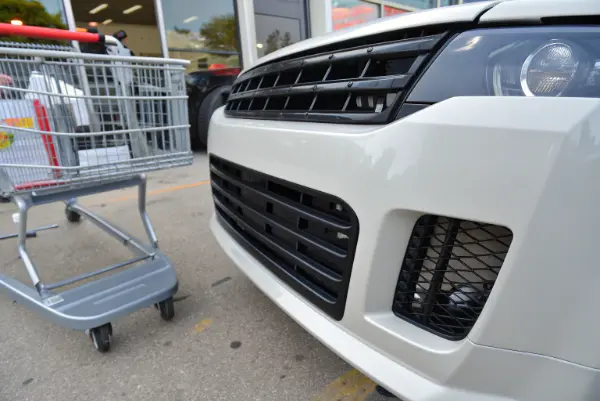
We usually think of ABS as an interior material, but what about the outside? Exterior parts face UV rays, stones, and minor bumps. While many exteriors use Polypropylene (PP), ABS has a specific niche. Does it have the durability for the outside world? It needs to be tough enough to handle a shopping cart hitting it, but also look good.

Yes, impact-modified ABS is widely used for specific exterior safety applications, particularly where painting or plating is required. It is commonly found in radiator grilles, mirror housings, and sensor covers. While it needs UV stabilizers to prevent degradation from sunlight, its superior surface finish makes it ideal for parts that need to look premium while providing impact protection. It creates a rigid shell that protects sensitive electronics like parking sensors and cameras from road debris.

Automotive exterior grill and sensor housing

Aesthetic Durability and Sensor Protection

This is where the "Business Owner" perspective really kicks in. Michael, you know that customers buy with their eyes. An interior part just needs to be safe, but an exterior part needs to shine.

Standard Polypropylene (PP) is tough and cheap, but it is hard to paint and hard to chrome plate. ABS is fantastic for painting and plating.

Why use ABS outside?

  1. Grilles and Logos: The front grille takes a beating from rocks on the highway. Impact-modified ABS can take these hits without cracking. Plus, it holds chrome plating beautifully. A cracked grille looks cheap; a shattered grille is dangerous if pieces fall onto the road.
  2. Mirror Housings: Side mirrors stick out. They get hit by garage doors and other cars. Impact-modified ABS allows the housing to absorb the knock without snapping off completely.
  3. ADAS (Advanced Driver Assistance Systems): This is the new frontier. Cars are covered in sensors now. Radars, LiDARs, and cameras. These sensors are expensive. We need a housing that is rigid enough to keep the sensor aligned (calibration is key) but tough enough to protect it from a stone.

The UV Challenge

I have to be honest here—ABS hates the sun. Standard ABS will turn yellow and brittle if left outside.

Therefore, for exterior applications, the "Impact-Modified" ABS is almost always:

  • Painted: The paint acts as a shield.
  • Plated: Chrome or nickel protects the plastic.
  • UV-Stabilized: Additives are put into the resin to fight UV degradation.
  • Co-extruded: Capped with a layer of Acrylic (ASA) which is weather-resistant.

Design Considerations for Molds:

When we design molds for these exterior parts, we have to account for the impact modifiers. These additives can sometimes affect the surface finish (flow lines). We have to use specific gate locations and molding parameters to ensure the part looks like a mirror but acts like a shield.

It is a balance of beauty and brawn. We are protecting the car’s "eyes" (sensors) and its "face" (grille) with a material that won’t fail when a rock hits it at 70 mph.

Conclusion

Impact-modified ABS is a critical hero in automotive manufacturing, blending toughness with versatility. It transforms brittle plastic into a life-saving material that absorbs energy, withstands extreme temperatures, and protects vital sensors. For manufacturers, choosing this material isn’t just about meeting specs; it is about ensuring the safety and trust of the end-user. It is a smart investment in quality and reliability.


  1. "Rubber toughening", https://en.wikipedia.org/wiki/Rubber_toughening. Rubber particles dispersed in a glassy polymer matrix can arrest crack propagation through mechanisms including shear yielding, crazing, and cavitation, which collectively dissipate impact energy that would otherwise cause brittle fracture. Evidence role: mechanism; source type: research. Supports: the mechanism by which rubber tougheners enable energy absorption in impact-modified polymers. Scope note: This describes general rubber-toughening mechanisms in polymers; specific formulations of impact-modified ABS may employ different modifier types or concentrations. â†©

  2. "4 Types Of Plastic Used In Cars And Car Parts", https://www.acplasticsinc.com/informationcenter/r/plastic-used-in-cars. Impact-modified thermoplastics including ABS variants are widely specified for automotive applications such as instrument panels, interior trim, and exterior body panels due to their balance of impact resistance, processability, and cost-effectiveness. Evidence role: case_reference; source type: research. Supports: the use of impact-modified ABS and similar thermoplastics in automotive interior and exterior components. Scope note: Specific material choices vary by manufacturer, model year, and component requirements; not all bumper covers or dashboards use impact-modified ABS exclusively. â†©

Facebook
Twitter
LinkedIn

Request A Quote for Your Projects!

Hi there! I’m Jerry, a proud dad and passionate at CKMOLD. With years of hands-on experience in the injection mold and CNC industry, I’ve grown from managing the smallest details on the shop floor to leading international projects with clients across Europe and the U.S.

At CKMOLD, we specialize in precision molds, plastic parts, and CNC solutions that help bring bold product ideas to life. I love solving complex challenges, building long-term partnerships, and pushing the limits of what great manufacturing can do.

Let’s connect, exchange ideas, and grow together—whether you’re looking for a reliable manufacturing partner or just want to talk shop!

Request a Quick Quote

Send your drawings and detailed requirements via:
Email: jerry@ckmold.com

Or fill out the contact form below:

We will contact you within one working day. Please pay attention to the email with the suffix “@ckmold.com”

Wait, We Have Something Special for You!

Join our mailing list and receive a 10% discount on your next mold or CNC project.