
Are you struggling to ensure your car interior parts meet the strict safety codes required in today’s market? It’s a common headache for manufacturers. Failing to comply with safety regulations for materials like ABS can lead to costly recalls, legal nightmares, and a damaged reputation. You need to know exactly how ABS fits into the regulatory landscape to protect your business.
ABS (Acrylonitrile Butadiene Styrene) is a crucial thermoplastic used in automotive interiors because of its impact resistance and customizability, but it must adhere to specific safety standards. Key regulations often involve flammability tests like FMVSS 302 in the US, which dictates burn rates for interior materials1. Additionally, ABS components must meet standards for volatile organic compound (VOC) emissions to ensure air quality inside the cabin2, and impact absorption criteria to protect passengers during collisions.

Navigating the maze of automotive regulations can feel overwhelming, especially when you are trying to balance cost and quality. However, understanding these rules is not just about avoiding fines; it’s about building a product that people trust with their lives. Let’s break down exactly what you need to know about ABS in car safety.
What is ABS in car safety and why does it matter?
Many manufacturers assume that "safety" only refers to airbags or seatbelts, ignoring the role of the plastic itself. This oversight is dangerous. If the material used for your dashboard or door panels shatters into sharp shards during an accident, passengers get hurt. Ignoring the specific safety properties of ABS puts your end-users at significant risk.
In the context of car safety, ABS is valued for its ability to absorb energy and deform plastically rather than shattering dangerously upon impact. Its chemical structure provides a balance of rigidity and toughness, making it ideal for components that passengers might strike during a crash, such as pillar trims or glove boxes. Furthermore, safety-grade ABS is often modified with additives to improve fire resistance, ensuring it doesn’t accelerate the spread of flames in the cabin.
Let’s dig deeper into the material science here. Why is ABS so special for safety? It comes down to its three monomers: Acrylonitrile, Butadiene, and Styrene. The "Butadiene" part is the rubbery component. It gives the material resilience. When a car stops suddenly or hits something, you want the interior parts to have a little "give." You do not want them to be as brittle as glass.
From my experience on the factory floor, I have seen crash test results where inferior plastics simply exploded. ABS doesn’t do that if molded correctly. It tends to yield. This is critical for Head Impact Protection (FMVSS 201). This regulation requires that interior components provide a certain level of cushioning when a head strikes them.
To help you understand the specific safety roles ABS plays, look at this breakdown:
| Safety Property | Function in Crash Scenario | Critical Standard |
|---|---|---|
| Energy Absorption | Deforms to absorb kinetic energy, reducing force on the passenger. | FMVSS 201 (Occupant Protection) |
| Ductility | Stretches rather than snapping; prevents sharp flying debris. | General Automotive Safety Specs |
| Thermal Stability | Maintains integrity in extreme heat; doesn’t melt onto passengers easily. | Heat Deflection Temperature Tests |
| Chemical Resistance | Resists degradation from cleaning agents, maintaining structural integrity over time. | OEM Specific Standards (e.g., GM, Ford specs) |
We often modify ABS for specific safety needs. For example, we might blend ABS with Polycarbonate (PC/ABS). This blend is very common in safety-critical areas like the knee bolster (the part under the steering wheel). Pure ABS is good, but PC/ABS is even tougher. As a business owner like Michael, you need to ask your molder: "Is this pure ABS, or is it a blend for higher impact?" The answer changes the safety profile significantly.
Is it a legal requirement to have ABS in interiors?
You might be wondering if the law explicitly says, "You must use ABS plastic here." This confusion creates anxiety for purchasing managers who fear they are buying the wrong material. The reality is that the law dictates performance, not the specific material brand or type, which can make selection even harder.
No, it is not a specific legal requirement to use ABS plastic exclusively; the law requires that whatever material you use must meet specific performance criteria. Regulations focus on the outcome—like flammability resistance and impact absorption—rather than mandating a specific polymer. However, ABS is the industry standard because it is one of the most cost-effective materials that consistently passes these strict legal tests.
Since the law is performance-based, you have choices. But choices come with risks. Why do almost all OEMs (Original Equipment Manufacturers) stick with ABS or ABS blends? Because it is a known quantity. It is the safe bet.
When I started my trading company, I had a client who wanted to use a cheaper Polypropylene (PP) for a dashboard part to save money. He asked, "Is it illegal?" I told him, "No, but it might fail the burn test." In the US, the big rule is FMVSS 302. This standard measures the burn rate of materials in the occupant compartments. The material cannot burn faster than 102 mm per minute.
If you choose a cheap plastic that catches fire like paper, you are violating the law. ABS, especially when treated with flame retardants, passes this test easily.
Here is a look at the "Legal vs. Practical" reality of choosing ABS:
1. The Flammability Hurdle (FMVSS 302 / ISO 3795)
- The Law: The material must self-extinguish or burn very slowly.
- The ABS Solution: Standard ABS burns, but we add flame retardants. We can tweak the formula until it meets the standard perfectly. Other cheap plastics might need expensive additives to pass, negating the cost savings.
2. The Smell and Fogging Hurdle (VDA 278 / VDA 270)
- The Requirement: While not always a federal law, every major car company (VW, GM, Toyota) mandates low VOCs (Volatile Organic Compounds). They don’t want the "new car smell" to be toxic.
- The ABS Solution: High-quality ABS has low outgassing. Poorly processed ABS can release styrene gas, which smells bad and is a health concern. This is why "Master Molding Right" matters. If we process it too hot, it degrades and fails the smell test.
3. The Recycling Mandate (ELV Directive in Europe)
- The Law: Cars must be recyclable at the end of their life.
- The ABS Solution: ABS is a thermoplastic. It can be melted down and reused. This helps you meet sustainability goals which are becoming legal requirements in many regions.
So, while the government won’t arrest you for not using ABS, the market and the testing standards effectively force your hand toward reliable materials like ABS.
What is ABS interior in the context of design?
Designers often focus on aesthetics—texture, color, and shine—while engineers worry about structure. If these two groups don’t communicate, you end up with a part that looks good but fails in production or safety. Understanding "ABS interior" means understanding how this material bridges the gap between looking good and being safe.
An "ABS interior" refers to the suite of cabin components manufactured from Acrylonitrile Butadiene Styrene, chosen for their ability to be molded into complex, aesthetically pleasing shapes that are also durable. This includes the dashboard, center console, door panels, and pillar trims. In this context, ABS allows for high-quality surface finishes, such as texturing or painting, while maintaining the structural rigidity necessary to house electronics and airbags.
When we talk about ABS interiors, we are talking about the "A-Surface." This is the side the customer sees and touches. But as a business owner, you care about the "B-Surface" too—the back side with the clips and bosses.
ABS is fantastic here because it has low shrinkage. When you mold a plastic part, it shrinks as it cools. If it shrinks unevenly, it warps. A warped dashboard doesn’t fit. Gaps in the interior are not just ugly; they can be safety hazards if they interfere with airbag deployment.
Let’s break down the critical aspects of designing an ABS interior:
1. Surface Finish and Safety:
You might not think texture is a safety issue, but it is.
- Glare Reduction: A shiny dashboard reflects the sun into the driver’s eyes. This is dangerous. ABS can be easily textured in the mold to be matte (dull). This prevents blinding glare.
- Touch: ABS provides a solid feel. It doesn’t feel "cheap." While this is quality, not safety, it inspires confidence in the vehicle.
2. Integration of Electronics:
Modern interiors are full of screens and sensors.
- ABS is electrically insulating. It protects wires behind the dash.
- It has good dimensional stability. This means it holds the heavy infotainment screen significantly tighter than softer plastics. If you crash, you don’t want that screen becoming a projectile. ABS holds the screws tight.
3. Airbag Deployment Channels:
This is the most critical design element.
- In the dashboard, there is often an invisible seam where the airbag bursts through.
- We use laser scoring on the back of the ABS panel.
- Because ABS behaves consistently (it breaks reliably at a specific force), engineers can calculate exactly how much pressure the airbag needs to break through the dashboard skin. If the material was inconsistent, the airbag might deploy too late.
| Component | Why ABS is used? | Safety Implication |
|---|---|---|
| Door Handle Cups | High scratch resistance. | Prevents sharp edges from wear over time. |
| Pillar Trim | Impact resistance. | Protects head during side impact (often holds curtain airbags). |
| Seat Belt Buckle Housing | Toughness. | Must withstand thousands of cycles and impact without cracking. |
What is ABS in safety regarding chemical hazards?
Safety isn’t just about crashes; it’s also about the air your customers breathe while driving. There is a growing concern about chemicals leaching from plastics, especially when a car sits in the hot sun. Manufacturers need to be aware of the chemical safety profile of the ABS they select.
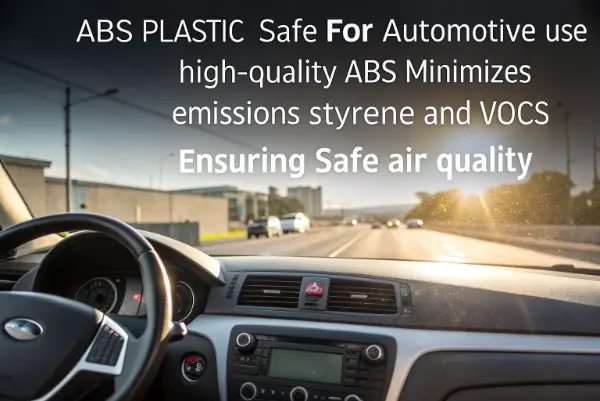
In terms of chemical safety, ABS is generally considered stable, but strict standards control the residual monomers left over from manufacturing. The primary concern is the release of Styrene or other Volatile Organic Compounds (VOCs) when the interior heats up. High-quality, automotive-grade ABS is manufactured to minimize these emissions, ensuring that the air quality inside the cabin remains within safe limits for passengers.
This is a topic close to my heart. When I worked in the factory, we could smell the difference between good material and bad material. Bad ABS smells sweet and acrid—that is the styrene.
For a business owner like Michael, this is a "silent killer" of business deals. You might pass the crash test, but if your parts fail the Odor Test (VDA 270) or the Fogging Test (DIN 75201), the car manufacturer will reject the entire shipment.
What is Fogging?
Have you ever seen a greasy film on the inside of a car windshield? That is "fogging." It is caused by chemicals evaporating from the plastic dashboard and condensing on the glass.
- Safety Risk: It reduces visibility. At night, with oncoming headlights, a fogged windshield creates a blinding glare.
- The ABS Factor: Cheap ABS has low-molecular-weight additives that evaporate easily. High-grade ABS is cleaner.
Understanding the Chemical Breakdown:
-
Monomer Residue:
When we make ABS, we polymerize chemicals. Sometimes, the reaction isn’t 100% complete. "Residual monomers" are left behind.- Risk: These are what smell and cause fogging.
- Solution: We use "stripping" processes in manufacturing to remove these leftovers. You must specify "Low VOC ABS" when ordering.
-
Additives and Stabilizers:
To make ABS safe for cars, we add things.- UV Stabilizers: ABS hates the sun. It turns yellow and brittle. Brittle ABS shatters in a crash. We add UV blockers to keep the safety properties intact for 10+ years.
- Flame Retardants: As mentioned, these stop fire. But some old flame retardants (like certain brominated compounds) are toxic. Modern safety standards (like REACH in Europe) ban these toxins. You must ensure your ABS is compliant with REACH regulations.
-
The "Recycled" Trap:
Using recycled ABS is great for the planet, but tricky for safety.- If you mix different batches of recycled ABS, you can’t guarantee the impact strength or the chemical purity.
- For safety-critical parts (like where the airbag is), I always advise my clients to use Virgin ABS (new material) or a very strictly controlled recycled grade. Do not gamble with safety parts.
A Checklist for Chemical Safety in ABS:
- Does the material pass VDA 278 (VOC emissions)?
- Is it UV stabilized to prevent brittleness?
- Are the flame retardants halogen-free (if required by the client)?
- Does it pass the windshield fogging test?
Conclusion
ABS is the backbone of automotive interiors for a reason: it balances cost, moldability, and critical safety performance. From absorbing impact energy during a crash to resisting fire and minimizing toxic emissions, this material is essential for meeting modern safety regulations. By understanding the specific requirements—like flammability ratings and VOC limits—you can ensure your products protect both your customers and your business reputation. Do not cut corners on material quality; master the molding process right, and safety will follow.
-
"49 CFR 571.302 – Flammability of interior materials.", https://www.ecfr.gov/current/title-49/subtitle-B/chapter-V/part-571/subpart-B/section-571.302. FMVSS 302 is a Federal Motor Vehicle Safety Standard administered by the National Highway Traffic Safety Administration (NHTSA) that establishes flammability requirements for materials used in vehicle passenger compartments, specifying maximum horizontal burn rates to reduce fire hazards. Evidence role: definition; source type: government. Supports: the existence and purpose of FMVSS 302 as a US federal standard governing flammability of automotive interior materials. ↩
-
"40 CFR Part 59 — National Volatile Organic Compound …", https://www.ecfr.gov/current/title-40/chapter-I/subchapter-C/part-59. International standards such as ISO 12219 and industry protocols like VDA 278 establish testing methods for measuring volatile organic compound emissions from automotive interior materials to assess potential impacts on cabin air quality, though specific regulatory thresholds vary by jurisdiction. Evidence role: general_support; source type: institution. Supports: the existence of VOC emission standards for automotive interior materials to protect cabin air quality. Scope note: These standards provide testing methodologies rather than universal mandatory limits, and actual regulatory requirements differ across markets ↩