
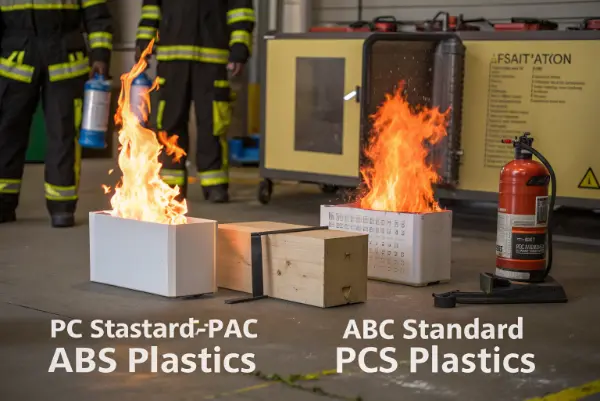
ABS and PC/ABS are both widely used for molded electronics enclosures, but the polymer family name does not decide whether an enclosure is safe or suitable. The decision depends on the exact commercial grade, color, minimum wall thickness, molded condition and end-product requirements. PC/ABS frequently offers a stronger heat-and-impact balance; ABS can provide good cosmetics, processability and cost in moderate environments. Neither should be selected from a generic comparison chart alone.
For a useful material review, define the enclosure temperature, abnormal operating conditions, impact exposure, chemicals, assembly loads, wall thickness, appearance targets and applicable product standard. Then compare supplier data for candidate grades and validate molded assemblies. CKMOLD can review the molding and tooling implications through DFM analysis, but product compliance and final material approval remain tied to the customer’s application and validation plan.
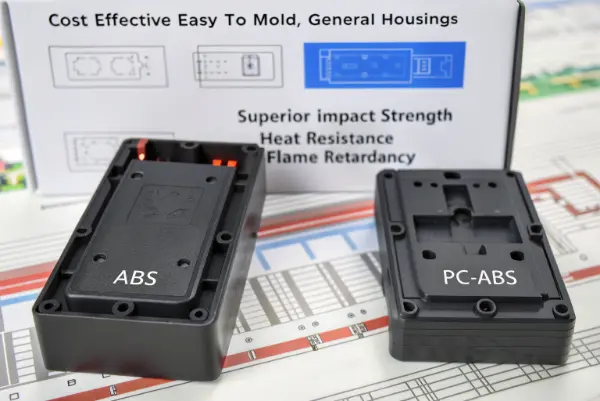
ABS vs PC/ABS: The Short Engineering Answer
| Decision factor | ABS may fit when | PC/ABS may fit when | What must be verified |
|---|---|---|---|
| Impact | Drop and assembly loads are moderate and the chosen grade passes product testing | Higher toughness or low-temperature ductility is needed | Notched impact data, temperature, aging, weld lines and the finished-part drop test |
| Heat | Normal and abnormal enclosure temperatures remain within the grade’s validated margin | More heat capability is required without moving to a different polymer family | HDT/Vicat test method, load, conditioning and actual loaded-part deformation |
| Flammability | An appropriate recognized ABS grade exists at the required thickness and color | An appropriate recognized PC/ABS grade provides the required property balance | Exact grade, color, minimum thickness, UL recognition and end-product standard |
| Appearance | Molded color, texture, painting or printing favor the selected ABS grade | Required toughness and heat can be achieved with acceptable cosmetics | Texture replication, gloss, flow lines, weld lines, color and decoration adhesion |
| Chemical exposure | The molded ABS assembly passes the actual cleaner, oil and skin-contact cycle | The selected blend passes the same test with assembly stress included | Finished-part testing; family-level resistance tables are only screening tools |
| Cost and supply | ABS meets all requirements and has stable approved-grade supply | The additional performance prevents a credible failure mode | Current resin quote, yield, drying, cycle, scrap and approved alternatives |
This is a screening matrix, not a universal recommendation. A flame-retardant ABS grade can be more appropriate than a non-flame-retardant PC/ABS grade when the project requires a verified flame classification. A specially modified PC/ABS grade can also behave very differently from a general-purpose blend. Supplier portfolios illustrate this variation: SABIC lists multiple CYCOLOY PC/ABS grades with different performance and regulatory documents rather than one set of universal PC/ABS properties.
Start With the Electronics Hazard and Use Environment
“Electronics enclosure” covers products with very different risks: a low-energy battery sensor, a desktop controller, a power conversion product and an outdoor device do not share the same material requirements. Before comparing resin data, record:
- normal internal temperature and ambient range;
- credible abnormal conditions, including component faults and blocked ventilation;
- drop height, impact direction and whether the product is tested assembled;
- screw-boss, snap-fit, insert and connector loads;
- cleaners, oils, sunscreen, skin contact, threadlockers or adhesives;
- UV, humidity and outdoor exposure where applicable;
- required electrical, flammability and end-product standards;
- cosmetic surfaces, texture, color and decoration;
- wall thickness, local ribs and weld-line locations; and
- target volume, approved material sources and change-control needs.
An enclosure that plugs into mains power does not automatically require PC/ABS. The product’s safety standard, insulation system, heat sources, spacing, energy level, construction and material recognition determine the requirement. The correct conclusion may be a specific flame-retardant ABS, a specific flame-retardant PC/ABS, another polymer, a design change, or additional protective construction.
Heat Resistance Must Be Compared Under the Same Test Conditions
Many PC/ABS grades provide higher heat capability than many general-purpose ABS grades, but labels such as “high heat” are not directly comparable without the test details. Heat-deflection temperature changes with the test stress and specimen condition. Vicat softening temperature measures something different. Neither value alone predicts whether a loaded screw boss, vented wall or snap feature will remain acceptable after hours of internal heating.
For enclosure decisions, compare candidate grades using the same test method and then test the molded assembly at normal and abnormal temperatures. Include loads from fasteners, PCB mounting, connectors and clips. Also inspect dimensional change, gloss, gap-and-flush and residual stress after thermal aging. A higher data-sheet temperature does not eliminate the need for part-level validation.
Impact Performance Depends on Temperature, Geometry and Molding
PC/ABS is often shortlisted when the enclosure must survive drops or remain ductile at lower temperatures. However, a data-sheet impact result is measured on a standardized specimen. The molded product adds knit lines, gates, sharp corners, openings, ribs, bosses and assembly stress. Poor drying, excessive residence time or an unsuitable process can reduce the expected performance.
Define the real drop orientation and energy, then test assembled units after any relevant thermal, humidity, UV or chemical conditioning. Inspect not only visible fracture but also hidden boss cracking, PCB displacement, connector damage and latch retention. ABS may pass the required test when geometry and conditions are moderate; PC/ABS may fail when the selected grade or molded design is inappropriate.
UL 94 Is Grade-, Thickness- and Color-Specific
UL 94 classifications describe small-scale burning behavior under specified test conditions. UL Solutions explains that the classification accounts for the specimen orientation, burning behavior and material thickness. UL recognition records also identify minimum thickness and color coverage. A V-0 result for one grade at one thickness or color must not be generalized to all ABS, all PC/ABS, or a thinner wall.
For a flame-related material decision:
- Identify the end-product standard and the enclosure function.
- Obtain the exact supplier grade designation and intended color.
- Verify the current UL recognition or other required evidence at the project’s minimum wall.
- Confirm traceability for resin, colorant and any permitted regrind.
- Review molding, decoration and secondary operations that could affect the construction.
- Complete the required end-product evaluation; a material classification is not a complete product certification.
The phrase “V-0 PC/ABS” is therefore incomplete purchasing information. The controlled specification should identify the grade, supplier, color, minimum wall and acceptance evidence. The same discipline applies to flame-retardant ABS.
Surface Appearance and Decoration Can Favor ABS
ABS remains common for consumer housings because suitable grades can provide good molded appearance, texture definition, colorability and decoration. PC/ABS can also produce high-quality cosmetic parts, but the preferred grade may use different processing temperatures, flow behavior and pigment packages. Dark colors can hide some flow variation while showing gloss differences or scratches; light colors can make contamination and discoloration more visible.
Cosmetic approval should use molded samples from representative tooling and the intended grade and color. Define the viewing surface, lighting, inspection distance, texture reference, weld-line limits and allowed gate witness. If the part will be painted, printed, plated or laser marked, validate adhesion and appearance after the same cleaning and aging cycle used by the finished product.
Chemical Resistance Can Reverse the Initial Choice
Polymer blends are sensitive to formulation, molded stress and chemical exposure. Skin oils, alcohol cleaners, disinfectants, sunscreen, threadlockers, lubricants and adhesive carriers can produce stress cracking in some grades. A generic compatibility table is useful for screening but does not represent a stressed molded enclosure.
Test candidate parts with the actual chemical concentration, contact method, time and temperature. Apply realistic screw torque, snap deflection or insert load during exposure. Look for crazing, whitening, cracking, swelling, loss of impact strength and surface change. If the product has a service-cleaning instruction, the validation method should match it.
Molding and Tooling Implications
An existing ABS mold may be capable of running a PC/ABS grade, but substitution is not automatic. PC/ABS commonly requires disciplined drying and may use different melt temperature, mold temperature, viscosity and shrinkage. Those changes can affect:
- gate size and pressure requirement;
- venting and burn-mark risk;
- weld-line location and strength;
- cooling balance and cycle time;
- ejection force and cosmetic marks;
- dimensions, warpage and assembly fit;
- residence time and machine capacity; and
- purging, startup scrap and production cost.
Review the selected grade’s processing guide before committing to a substitution. A controlled mold trial and validation plan should compare process stability and finished-part performance, not only whether the cavity fills.
A Practical Material Approval Workflow
- Define requirements. Record temperature, impact, flammability, chemistry, appearance, dimensions, regulatory evidence and cost.
- Shortlist exact grades. Compare current supplier technical and regulatory documents using consistent test methods.
- Review DFM and processing. Check minimum walls, ribs, bosses, gates, weld lines, venting, cooling and machine range.
- Mold representative samples. Use the intended grade, color, drying procedure and realistic process window.
- Test the assembled enclosure. Include drop, temperature, abnormal operation, chemicals, appearance and product-standard tests that apply.
- Control approval. Freeze the supplier, grade, color, approved sample and change-notification requirements.
For production purchasing, the resin approval should connect to incoming material identification, batch traceability where required, process records and part inspection. Review CKMOLD quality assurance for records that can be agreed by project.
ABS vs PC/ABS Questions
Is PC/ABS always safer than ABS for an electrical enclosure?
No. Safety depends on the exact grade, thickness, color, enclosure function, applicable product standard and finished construction. Both polymer families include grades with different flame, heat, electrical and mechanical properties.
Can a V-0 rating be applied to every wall thickness?
No. Verify the recognition for the exact grade, color coverage and minimum thickness. A material rating also does not replace end-product evaluation.
Can PC/ABS run in an existing ABS tool?
Possibly, but the material change requires review of drying, melt and mold temperatures, viscosity, gate, venting, cooling, shrinkage, ejection, dimensions and machine capacity, followed by a representative trial.
Which material is better for a battery enclosure?
There is no family-level answer. Battery chemistry and energy, normal and fault temperature, charging conditions, venting, impact, wall thickness and the governing product standard determine the material and construction requirements.
Decision Summary
Choose ABS when an exact grade satisfies the product’s thermal, mechanical, chemical, cosmetic and compliance requirements and offers the preferred processing and commercial balance. Shortlist PC/ABS when higher heat or impact capability is needed, then verify that a specific grade meets the required flame, thickness, color, chemical and molding conditions. Do not approve either material from the polymer name alone.
To compare tooling and production implications for an enclosure, submit the project requirements and email the controlled CAD package to jerry@ckmold.com.